Malindi,Kenya
BY Nyongesa wa Mwasame
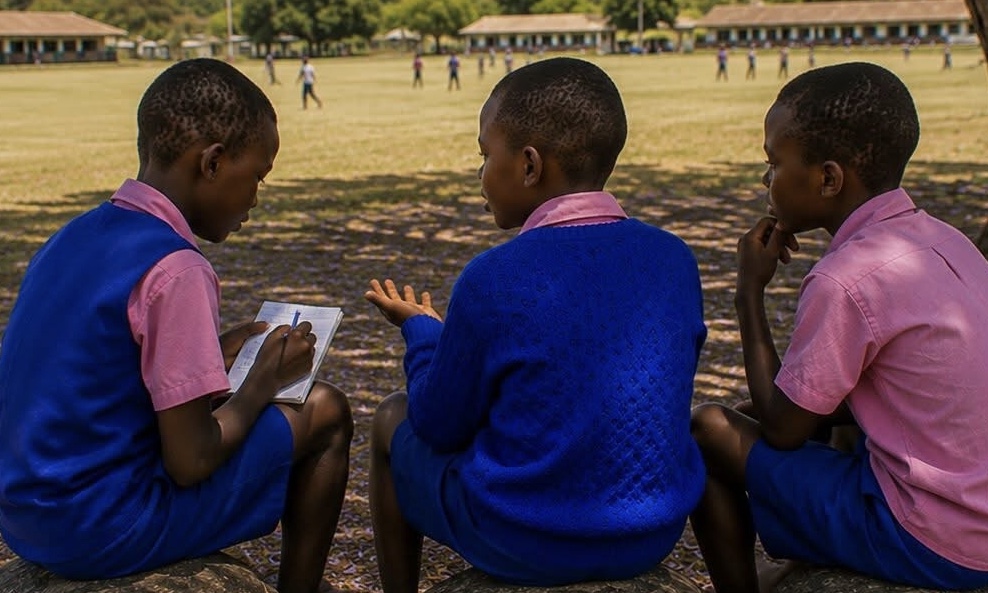
On a Thursday afternoon, we gathered at our usual meeting place beneath a great jacaranda tree, excitedly planning something special.
For the first time, we wanted to celebrate our birthdays together.
To us, it was not just a birthday; it was going to be a grand event.Armed with an exercise book and a pen, we drafted a budget, listing every item we thought we would need.
The plan was simple: prepare a convincing proposal, present it to our parents and persuade them to support our idea.Our discussion became so intense that we barely noticed anyone approaching.From a distance,
Wamalabe—the intellectual in rags—stood watching us.
Seeing our seating arrangement, he naturally assumed we were studying or holding a serious group discussion.
Perhaps, in his mind, this was the perfect opportunity for a teacher to guide his pupils.
Without invitation, he walked into our makeshift classroom.”Good morning, class!” he announced.
We looked at one another, trying hard not to laugh.
“Good morning, Teacher Wamalabe,” we replied in unison.
“I can see you’re having a group discussion,” he observed.
“Yes, Teacher,” we answered, happily playing along.
Without asking what we were discussing, he settled in as though he had been our instructor all along.
Within moments, he had our full attention, and our birthday budget was instantly forgotten.
“Give me just one minute of your time,” he began. “Let me tell you a short story about a very special man who lived for only seven days.”
His words immediately captured our curiosity.
“This man’s name was Simon Makonde. He was born on Monday, named on Tuesday, married on Wednesday, fell ill on Thursday, was treated on Friday, died on Saturday and was buried on Sunday.”
He paused and looked at us. “Was that a normal human being?”
“No way!”I responded innocently.
“And why was he buried on a Sunday?” Charles wondered. “I’ve never heard of such a scenario. The dead are not buried on Sundays.
Sunday is for church.”Robert leaned forward and asked, “On which planet did this man live? That sounds more like a robot than a human being.”
We were just three curious boys, answering with complete innocence and honesty.
Wamalabe smiled. “Very good questions. I like your curiosity.”
Then he gave us our first assignment.
“Your homework is to go and find out the meaning of that story. We shall discuss it in our next class.”
The lesson lasted only a few minutes, yet it left us carrying questions far heavier than its length.
As he prepared to leave, Wamalabe paused.
He looked at each of us before asking a question that caught us completely off guard.
“Since you are such good pupils… who do you want to become in the future?”
Charles answered first, his voice full of confidence. “I want to be a teacher.””A teacher?”
Wamalabe asked, tilting his head.
“Why a teacher?”
“Because I love the way you just taught us,”Charles replied softly.
A gentle smile spread across Wamalabe’s weathered face.
Before he could respond, Robert spoke next, his eyes drifting to the visible struggles our teacher carried.
“I want to be a doctor,” Robert said.”
A doctor?” Wamalabe asked. “Why, my son?”
“So that one day I can come back and treat your wound,” Robert replied.
Robert was referring to the chronic wound on Wamalabe’s leg—the injury everyone noticed but few dared mention.
Wamalabe’s voice trembled.”Oh… thank you, my son. That is very loving and caring of you.”
Then he turned to me. “And you? What do you want to become?”
Without hesitation, I replied, “I want to be a philanthropist.”
He looked puzzled. “A philanthropist? Why?”
I glanced toward the market where he spent most of his days and nights.”Because I want to buy you enough food, nice clothes and build you a good house, so that you will never have to sleep on the cold floors of this market again,” I said.
Our answers came straight from the heart, but we did not realize how deeply our words would touch him.
Our responses reached his soul so profoundly that the full weight of his harsh reality came crashing down upon him.
Right there, beneath the falling purple blossoms of the jacaranda tree, a heavy silence settled over us.
Teacher Wamalabe lowered his head and began to weep openly.
Tears carved clean tracks through the dust on his cheeks, as though no one in his entire life had ever spoken words of kindness or hope to him before.
After a long, emotional silence, he whispered, “Thank you, my children.”
Unable to speak any further, he quietly ended the lesson, slowly turned and walked away, wiping tears from his face as he disappeared toward the market.
The surrounding children watched in complete surprise. They rushed over, desperate to know what had transpired.
How could a simple question about the future reduce our teacher to tears?
Little did they know that, for a brief moment, three young boys had given hope to a man whom society had almost entirely forgotten.
As the years passed, we finally came to understand the lesson behind Simon Makonde.
He was never a man who literally lived for only seven days. The story was commonly taught in the lower primary classes during the early years of Kenya’s 8-4-4 education system.
Many interpreted it differently. To me, it always seemed rather advanced for young pupils but in our little classroom beneath the jacaranda, we came to understand it as a riddle about life itself.
It was a reminder that our journey from birth to death passes far more quickly than we imagine, just like the seven days of the week.
Wamalabe was not merely telling us a story; he was teaching us to think critically, to ask questions and to search for meaning beyond what our eyes could see.
Yet the greatest lesson beneath that jacaranda tree was not the one Wamalabe taught us. It was the one we unknowingly taught him.
Three young boys looked beyond his torn clothes, his wounded leg and the labels society had placed upon him.
We saw not a wandering man, but a teacher. We saw not a beggar, but a fellow human being worthy of dignity, kindness and hope.
Our childhood dreams—to teach, to heal and to give—became words that reached the deepest corners of a broken heart.
The tears that rolled down Wamalabe’s face were not tears of weakness. They were the tears of a man who, perhaps for the first time in many years, felt seen, valued and loved.
Beneath that great jacaranda tree, both the teacher and the pupils left the classroom carrying lessons that no textbook could ever contain.
Wamalabe taught us that knowledge begins with curiosity and thoughtful questions.We taught Wamalabe that compassion has the power to restore hope where the world has only offered rejection.
Above all, that afternoon taught us to have a heart for everyone. You never truly know the hidden battles that have shaped someone’s life.
Life is short, and we must choose kindness toward all humankind. No one wishes to be broken, poor or unhoused.
Sometimes it is simply the cruel turn of life’s circumstances—a reminder that unforeseen hardships can touch any one of us.
That day, beneath the shade of the jacaranda, the classroom had no walls, the teacher wore rags and the pupils had no desks. Yet it remains one of the greatest classrooms I have ever known.
As we watched Wamalabe disappear into the market, we quietly picked up our exercise book and pen.
Only then did we remember why we had gathered beneath the jacaranda tree in the first place: our birthday budget.
The lesson had completely distracted us, and our grand celebration plans remained unfinished.
Somehow, after everything we had just experienced, the budget no longer felt as important.
We had gathered to plan a birthday celebration but instead we had received one of life’s greatest lessons.
Our birthday could wait.So we closed our exercise book, rose from our three stones and agreed that the celebration would have to be planned another day.Little did we know that a baptism at the butchery awaited us on our greatest day.
habakkuknyongesa@gmail.com
Ends.