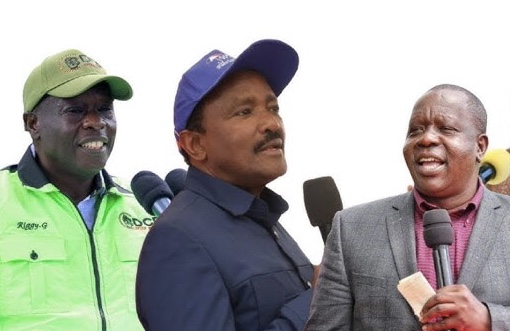
Opposition leaders
By Peter Mwibanda
Legal and Political Analyst | Intellectuals Post
NAIROBI, Kenya (IP)
Kenya’s political landscape is undergoing one of its most significant transformations since the fiercely contested 2022 General Election.
What once appeared to be a dominant governing coalition under President William Ruto’s United Democratic Alliance (UDA) is now facing growing political headwinds as opposition figures, regional movements and disgruntled former allies reposition themselves ahead of the 2027 presidential race.
Although the next election remains more than a year away, the battle has already begun—not in campaign rallies alone, but in by-elections, public discourse, regional realignments and shifting political loyalties.
The question dominating Kenya’s political conversation is no longer whether the opposition can challenge President Ruto. It is whether the opposition can convert growing public dissatisfaction into a united electoral movement.
A Government Under Pressure
President Ruto assumed office promising economic transformation, job creation, lower living costs and empowerment of ordinary Kenyans.
His administration has introduced significant reforms and infrastructure initiatives, but it has also faced persistent criticism over the high cost of living, taxation, unemployment and public concerns about governance.
These issues have created political openings for opponents who argue that many Kenyans have yet to experience the economic improvements they expected.
Whether these concerns translate into votes in 2027 will depend not only on public sentiment but also on how effectively both government and opposition organize over the coming months.
The Opposition’s New Opportunity
Kenya’s opposition has historically struggled with internal divisions. Today, however, changing political dynamics are encouraging greater cooperation among leaders with different political backgrounds but shared electoral interests.
Recent political contests have demonstrated that voters are willing to back opposition candidates even in environments where the ruling coalition campaigns aggressively.
While no single by-election determines a general election, such contests often serve as indicators of changing political moods.
The emerging narrative is that dissatisfaction alone is insufficient; organization, messaging and coalition-building will determine whether the opposition can mount a credible national challenge.
The Edwin Sifuna Factor
Among the most closely watched political figures is Nairobi Senator Edwin Sifuna.
His outspoken criticism of government policy, visibility in national debates and ability to communicate with younger urban audiences have increased his national profile.
Changes to his positions within ODM have prompted debate about his political future, but they have also amplified discussion about his role in the broader opposition landscape.
Whether Sifuna becomes a principal architect of opposition strategy or remains primarily a prominent national voice will depend on decisions made by opposition leaders as coalition negotiations evolve.
Mount Kenya: The Battle for Kenya’s Largest Voting Bloc
Few regions will shape the 2027 election more than Mt. Kenya.
Political developments following the impeachment of former Deputy President Rigathi Gachagua have intensified competition for influence in the region.
Some leaders continue to support President Ruto, while others have aligned themselves with alternative political formations.
The ruling coalition’s ability to retain substantial support in Mt. Kenya could prove decisive. Likewise, the opposition’s ability to capitalize on any erosion in support could significantly reshape the electoral map.
Western Kenya Emerges as the New Political Frontier
Western Kenya is increasingly becoming one of the country’s most competitive political regions.
President Ruto has invested considerable political attention in the region through appointments, development commitments and outreach efforts.
At the same time, regional leaders are seeking to consolidate their own political influence.
Governor George Natembeya’s Tawe movement has attracted attention in parts of Western Kenya, while leaders such as Edwin Sifuna continue to enjoy visibility beyond their home constituencies.
Whether these developments produce lasting electoral shifts remains uncertain, but they underscore the region’s growing strategic importance.
Coalition Politics Will Decide the Election
Kenya’s presidential elections are rarely won by a single party acting alone. They are won through broad coalitions capable of uniting diverse regional, ethnic and ideological constituencies.
The coming months are therefore likely to focus less on policy announcements and more on alliance-building, negotiations and political bargaining.
The coalition that best combines national appeal, regional balance and organizational strength will enter 2027 with a significant advantage.
The Road Ahead
Despite the growing momentum around opposition politics, declaring the outcome of the next election would be premature.
President Ruto remains the incumbent, with the institutional advantages, national visibility and political machinery that accompany the presidency. Incumbency has historically been a powerful asset in Kenyan politics.
Equally, opposition momentum does not automatically translate into electoral victory. Kenya’s political history is filled with shifting alliances and rapidly changing campaign dynamics.
What is already clear, however, is that Kenya is entering a period of intense political competition unlike any seen since the last general election.
The country’s democratic institutions, political parties and electorate will ultimately determine whether this emerging political realignment becomes a temporary moment or a lasting transformation.
As the countdown to 2027 accelerates, one reality stands above all others: Kenya’s political earthquake has begun, and its aftershocks will continue to reshape the nation’s future.
— Ends —