


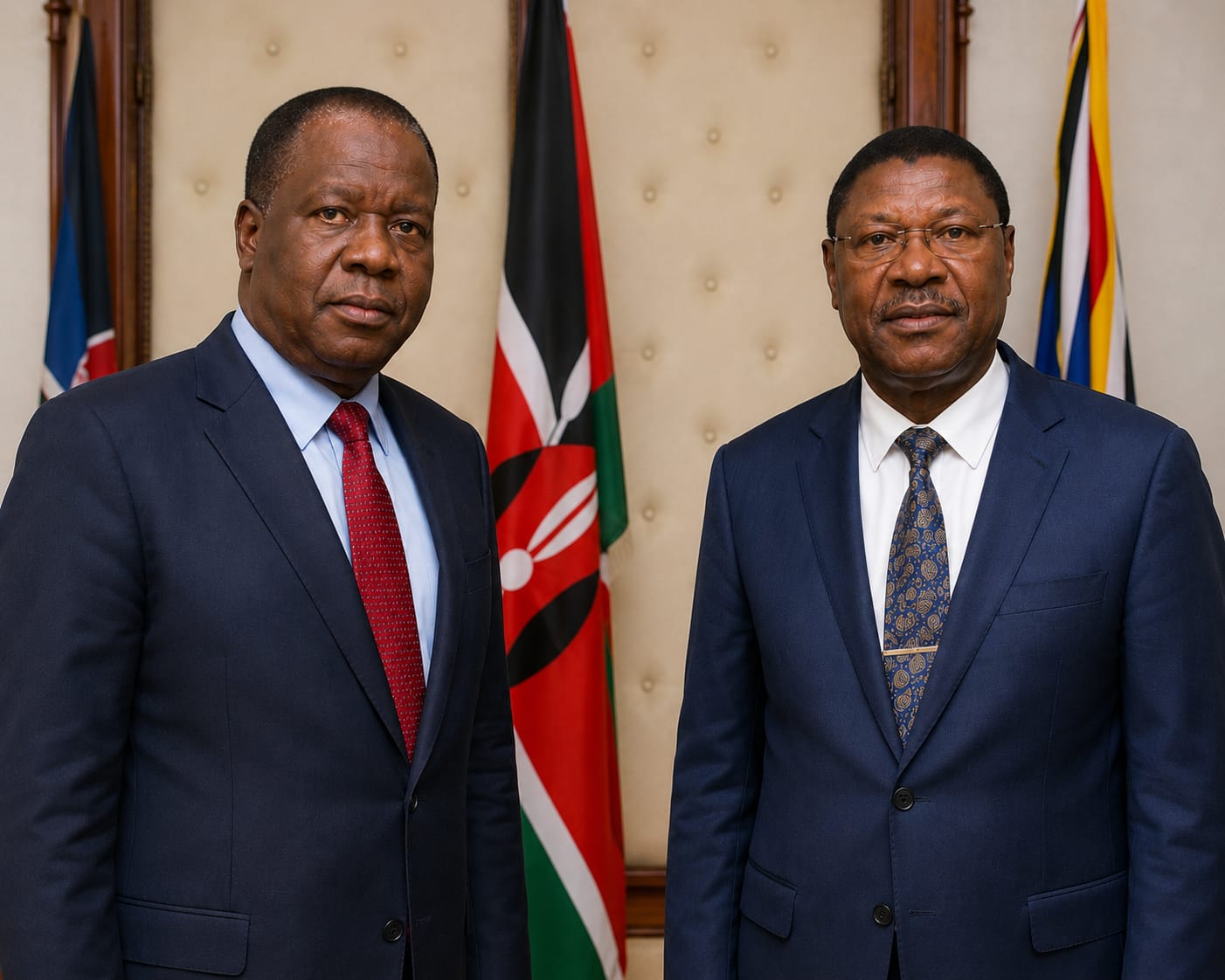
Jubilee leader Prof Fred Matiang’i and Speaker of the National Assembly Dr. Moses Wetang’ula……Photo/IP
NAIROBI, Kenya
As Kenya approaches the 2027 General Election, political attention is increasingly shifting beyond President William Ruto’s re-election prospects to the question of who could inherit power after him.
Recent remarks by President Ruto’s personal assistant Farouk Kibet, an individual within Ruto’s political circle endorsing National Assembly Speaker Moses Wetang’ula for a possible 2032 presidential bid have sparked debate.
The comments are significant because Kenya already has a Deputy President, Kithure Kindiki, who would traditionally be viewed as the natural successor within the ruling coalition.
The development raises questions about whether Kenya Kwanza leaders are united behind a single succession plan or quietly positioning themselves for future contests.
Meanwhile, opposition forces are regrouping. Former Interior Cabinet Secretary Fred Matiang’i has emerged as a potential contender with backing from circles associated with former President Uhuru Kenyatta.
His reputation as a firm administrator appeals to voters seeking competent leadership amid economic challenges.
Former Vice President Kalonzo Musyoka also remains a serious presidential aspirant.
Having spent decades in national politics, Kalonzo is positioning himself as a consensus candidate capable of uniting opposition forces against the ruling coalition.
Perhaps the most intriguing figure is Nairobi Senator Edwin Sifuna.
Increasingly popular among Gen Z and urban voters, Sifuna has built a national profile through issue-based politics, strong communication skills and criticism of government policies.
His rise reflects a growing generational shift in Kenyan politics.
For decades, presidential contests were largely shaped by ethnic alliances and political dynasties.
However, younger voters appear increasingly focused on economic opportunities, accountability, governance and corruption rather than traditional political loyalties.
The 2027 election is therefore becoming more than a contest for State House. It is shaping the succession battle that could define Kenya’s political future well beyond Ruto’s presidency.
Whether the future belongs to establishment figures such as Wetang’ula, Kindiki, Matiang’i and Kalonzo or to a new generation represented by leaders like Sifuna, remains uncertain.
What is clear is that Kenya’s political realignment is already underway, and the choices made in 2027 could determine the country’s leadership trajectory for the next decade.



