


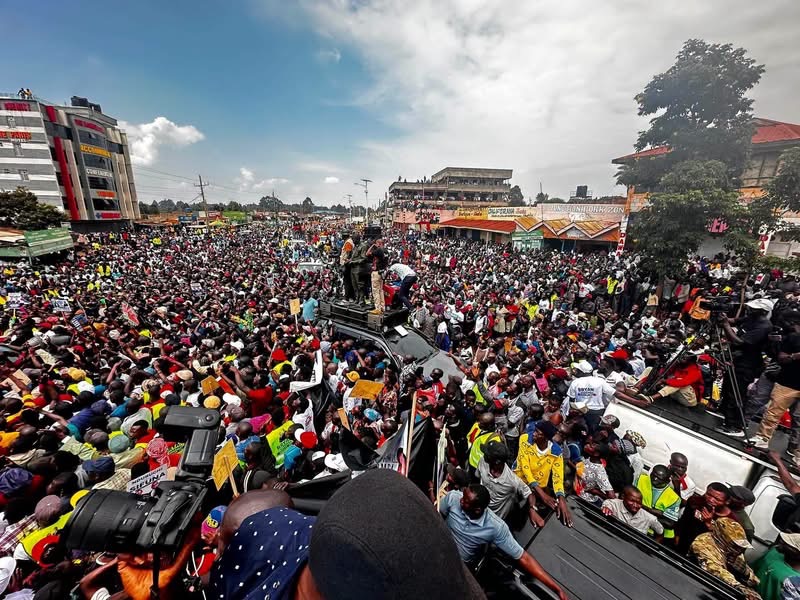
Edwin Sifuna Linda Brigade at Kimilili on Sunday morning……Photo/IP
By Peter Mwibanda
BUNGOMA, Kenya (AP)
The political temperature in Western Kenya is rising rapidly as Nairobi Senator Edwin Sifuna’s “Linda Mwananchi” movement draws large crowds across Trans Nzoia and Bungoma, signalling what could become one of the most closely watched political developments ahead of Kenya’s 2027 General Election.
Whether the gatherings ultimately translate into votes remains to be seen.
However, the optics alone present a challenge for President William Ruto’s Kenya Kwanza administration. Large turnouts at opposition rallies often shape public perception, influence political momentum and encourage previously undecided supporters to become more engaged.
For years, Western Kenya has been regarded as a region whose political direction was largely shaped by established leaders. Sifuna appears to be testing a different model—one centred on issue-based mobilisation, particularly around governance, the cost of living, unemployment, accountability and constitutional rights.
That message appears to resonate with many young people, who make up a significant share of Kenya’s electorate.
The decision to hold major rallies in Trans Nzoia and Bungoma carries political symbolism. These counties have long played an influential role in national coalition-building, and any shift in voter sentiment there could alter political calculations far beyond the region.
Trans Nzoia itself is one of Kenya’s major agricultural counties and has become an increasingly competitive political arena.
The emergence of the Linda Mwananchi movement also reflects a broader trend in Kenyan politics.
Increasingly, voters are demanding leaders who address everyday economic challenges rather than relying solely on ethnic alliances or traditional political patronage.
If that trend continues, parties that fail to respond to these concerns may find themselves facing a more demanding electorate.
For Kenya Kwanza, the growing visibility of Sifuna’s campaign raises strategic questions.
The government cannot dismiss every large opposition gathering as political theatre. Successful campaigns often begin with momentum, public enthusiasm and grassroots organisation before evolving into electoral strength.
That said, political rallies are not elections. History shows that impressive crowds do not always translate into ballots on polling day.
Voter registration, coalition-building, campaign financing and effective grassroots structures remain decisive factors in determining electoral outcomes.
Still, politics is driven as much by perception as by numbers. Every packed rally creates headlines, energises supporters and places pressure on political competitors to respond.
In that respect, Sifuna’s Western Kenya tour has already achieved an important objective: it has become part of the national political conversation.
As the country moves closer to 2027, the contest may no longer be defined solely by established political heavyweights.
New movements, younger voters and issue-based campaigns could reshape Kenya’s electoral landscape in ways that traditional political calculations struggle to predict.
If the momentum behind Linda Mwananchi continues to expand across Western Kenya and beyond, Kenya Kwanza will likely have to do more than defend its record.
It will have to persuade voters that it remains the best vehicle for addressing their aspirations in an increasingly competitive political environment.
— Peter Mwibanda



