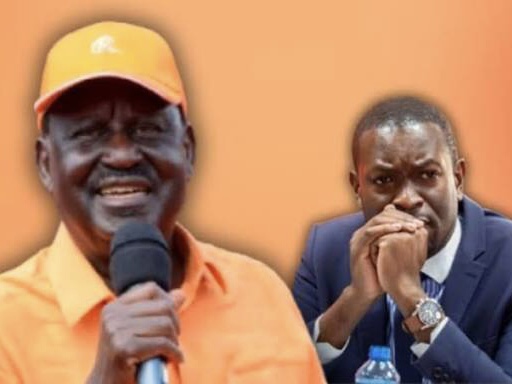
The late Raila Odinga with the ODM Secretary General Edwin Sifuna…..Photo/IP
By Peter Mwibanda
Political and Legal Analyst | Intellectuals Post IP
NAIROBI -KENYA
The death of Raila Odinga in October 2025 marked more than the passing of Kenya’s longest-serving opposition leader.
It marked the beginning of a defining test for one of Africa’s most influential political dynasties.
For over four decades, the Odinga name was synonymous with resistance, democratic reform and opposition politics. Today, that legacy faces its greatest challenge—not from political rivals alone, but from the difficulty of succeeding a leader whose influence overshadowed everyone around him.
The Odinga family now confronts a political reality familiar to many dynasties across Africa: history commands respect, but it cannot substitute for contemporary political legitimacy.
Following Raila’s death, Oburu Odinga assumed the leadership of the Orange Democratic Movement (ODM).
Yet leadership by appointment is fundamentally different from leadership earned through decades of political struggle.
Raila built his influence through detention without trial, constitutional reform campaigns, mass mobilization and five presidential bids. His authority was personal, hard-earned and deeply emotional.
It cannot simply be inherited.
ODM itself is entering unfamiliar territory. For nearly two decades, the party revolved around one central figure.
While it developed a formidable electoral machine, it invested less in cultivating a clear succession plan.
The consequence is increasingly visible: internal competition over ideology, regional influence and the party’s future direction.
Reports of strategic disagreements among senior leaders illustrate the pressures facing the party as it attempts to redefine itself without its founding figure.
The challenge extends beyond ODM.
The Odinga political dynasty must now convince Kenyans that it represents more than a famous surname.
Dynastic politics succeeds only when successors establish independent credibility, articulate fresh ideas and earn public trust on their own merits.
Kenya’s political landscape has also changed dramatically.
The Generation Z movement has transformed political discourse. Young voters are increasingly less persuaded by liberation credentials or historical symbolism.
Their priorities are unemployment, corruption, the cost of living, digital freedoms, accountable governance and economic opportunity.
Political loyalty inherited from parents is steadily giving way to issue-based politics.
This generational shift weakens the traditional advantages enjoyed by political dynasties.
The Odinga name remains respected, particularly in Nyanza, but national elections are no longer won through historical prestige alone.
The 2027 election therefore presents ODM with its most competitive environment since its formation.
President William Ruto’s allies continue consolidating support in several regions, while opposition leaders seek to fill the vacuum left by Raila.
At the same time, regional political formations are becoming increasingly assertive, reducing the certainty of traditional voting blocs.
The Odinga family also faces another strategic dilemma: whether to preserve Raila’s broad coalition politics or retreat into a narrower regional identity.
Raila repeatedly transcended ethnic politics by forging national alliances—from the National Rainbow Coalition to CORD, NASA and Azimio.
Replicating that coalition-building ability may prove far more difficult than preserving the family name.
Ultimately, the survival of the Odinga political dynasty will depend on whether it evolves from a personality-driven movement into a genuinely institutional political force.
Political parties that depend excessively on one individual often struggle after that individual exits the stage.
Sustainable democracies are built on institutions, ideology and internal democracy—not on surnames.
Raila Odinga’s greatest political legacy may not be whether his family continues to dominate Kenyan politics.
It may instead be whether the democratic ideals he championed inspire a new generation of leaders capable of competing on ideas rather than inheritance.
As Kenya approaches the 2027 General Election, one question will define the future of ODM and the Odinga family alike: can a dynasty built by an extraordinary leader remain relevant in an era demanding extraordinary institutions?
Ends.