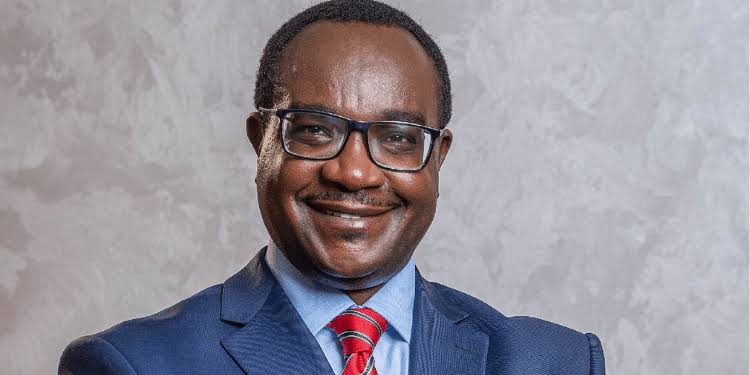
Education CS Julius Migosi .
By Micah Sali.
NAIROBI, Kenya (IP).
More than KSh 3.7 billion intended for Kenyan schools was fraudulently paid to 33 non-existent institutions over a three-year period, raising fresh concerns about financial oversight in the education sector.
The Auditor-General’s latest report reveals that the money was disbursed through the government’s school capitation program and cannot be accounted for.
Officials say the funds were funneled to schools that do not exist on the ground, underlining systemic weaknesses in the National Education Management Information System.
While the funds vanished, the country’s junior secondary school rollout remains hamstrung by infrastructure gaps.
An analysis of education construction budgets shows just how transformative the stolen billions could have been.
At an average cost of KSh 788,000 to construct a classroom and KSh 152,000 to furnish it with 40 desks and chairs, the total cost per fully equipped junior secondary classroom stands at approximately KSh 940,000.
This means that with KSh 3.7 billion, the government could have built and furnished about 3,936 classrooms.
Each classroom accommodates 40 students — offering learning space for over 157,000 junior secondary learners.
Even using a more conservative estimate of KSh 1.152 million per classroom, which includes inflation and improved finishing, the same amount could still deliver 3,189 fully equipped classrooms for at least 127,560 students.
Counties like Bungoma and Trans-Nzoia, where classrooms remain overcrowded and schools under-resourced, would have greatly benefited from such a vast allocation.
WHAT COULD HAVE BEEN ACHIEVED WITH KSh 3.7 BILLION IN JUNIOR SECONDARY SCHOOL INFRASTRUCTURE?
1. Construction of classrooms.
The government’s Competency-Based Curriculum (CBC) rollout includes building new JSS classrooms.
Costs vary:
KSh 788,000 per classroom (as reported in April 2022)
Older estimates note KSh 1 million per classroom.
With KSh 3.7 billion, one could build:
≈ 4,700 classrooms at KSh 788,000 each
≈ 3,700 classrooms at KSh 1 million each
2. Equipping classrooms.
Each classroom needs roughly 40 desks with chairs for students.
A secondary-school desk-chair set was budgeted by the Ministry at KSh 3,800 each in 2020
Furnishing 40 seats costs 40 × KSh 3,800 = KSh 152,000 per classroom
3. Total cost per classroom (built + furnished)
At KSh 788,000 + 152,000 = ~KSh 940,000
At KSh 1 million + 152,000 = ~KSh 1.152 million.
IMPACT IN NUMBERS.
With KSh 3.7 billion, you could fund:
≈3,936 fully built & furnished classrooms (at KSh 940,000 each)
≈3,189 classrooms (at KSh 1.152 million each)
Each of those classrooms would support a JSS class of 40 students, so this amounts to capacity for:
157,440 students (3,936 rooms × 40 students)
or 127,560 students (3,189 rooms × 40 students).
FOR A COUNTY LIKE BUNGOMA OR TRANS-NZOIA;
Imagine rolling out 4,000 new JSS classrooms across these counties:
That’s ≈160,000 additional student places, significantly easing overcrowding.
School infrastructure would meet CBC standards: decent desks, proper seating, a conducive learning environment.
SUMMARY.
KSh 3.7 billion could have:
Built and furnished approximately 3,900 to 4,000 JSS classrooms.
Created space for 127,000–160,000 junior secondary students.
Transformed education infrastructure across rural counties like Bungoma and Trans-Nzoia.
Instead, these resources were siphoned away — undermining the very educational goals they were meant to support.
Thousands of learners currently studying in makeshift or shared spaces could have had access to modern, fully furnished junior secondary classrooms.
Instead, the money was siphoned off to ghost schools — a stark reminder of how corruption continues to rob Kenyan children of their future.
WHAT THAT MONEY COULD HAVE DONE IN DAIRY FARMING:
Farmers in Bungoma and Trans-Nzoia counties — major dairy regions — could have channeled this money into expanding dairy operations. Local data show:
Trans-Nzoia averages about 21 L milk per cow per day (vs. Bungoma’s 11 L)
At an average farm-gate price of KSh 27.53 per liter in Bungoma
, one cow yields roughly KSh 379/day (≈ KSh 11,370/month).
A conservative model:
Investment Cost per Cow Monthly Revenue per Cow
High-yield Friesian/Ayrshire heifer KSh 150,000 KSh 11,370
Yield (15 L/day) — —
Infrastructure + equipment (sheds, water, milking) ~KSh 500,000 total —
Operational costs (feed, vet, labor) ~KSh 1,500/cow/month —
KSh 150 million could purchase 1,000 heifers (at KSh 150k each).
With 1,000 cows at 11 L/day, monthly milk production would be 330,000 liters, generating nearly KSh 9 million/month (~KSh 108 million/year).
Or, for smaller setup:
KSh 3.7 billion could fund ~24 such 10-cow smallholder farms, each capitalized with cow purchases and basic infrastructure (based on KSh 2–3 million startup per 10-cow farm reported locally)
Each 10-cow farm could net KSh 2.1–3.35 million/year, translating into KSh 50–80 million in aggregate annual rural income.
Even more conservatively:
A single zero-grazing cow yields a gross margin of KSh 41,000/year
With KSh 3.7 billion, one could support 90,000 zero-grazing cows, yielding KSh 3.7 billion/year in gross margins — potentially revolutionizing rural livelihoods in these counties.
IN SUMMARY.
KSh 3.7 billion misappropriated could have:
Funded 1,000 high-yield dairy cows, producing over KSh 108 million/year.
Launched 24 smallholder dairy farms (10 cows each), boosting rural income by KSh 50–80 million annually.
Supported 90,000 zero-grazing cows, at KSh 3.7 billion/year in rural gross margins.
While schools were cheated of vital funds, rural dairy farmers in counties like Bungoma and Trans-Nzoia could have seen transformative impact — from increased household income to improved local food security.
IP.
— End —