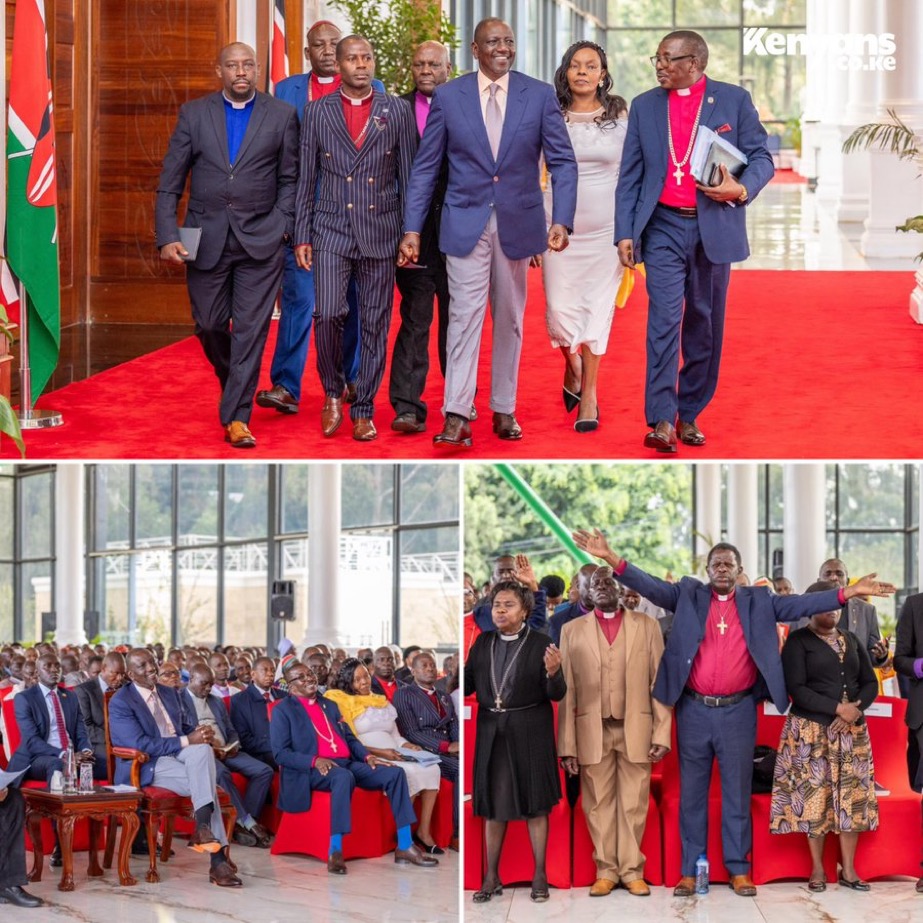
President Ruto hosts clergy at state house on Wednesday.
NAIROBI, Kenya (IP) — “Incitement is not leadership. We must be accountable enough to lead our youth toward opportunity, not violence.”
That was President William Ruto’s message to hundreds of bishops, pastors, and evangelists on Wednesday as he hosted leaders from the Federation of Evangelical and Indigenous Christian Churches of Kenya (FEICCK) at State House, Nairobi.
Addressing the church leaders amid weeks of public unrest and youth-led protests, Ruto urged the clergy to actively discourage incitement and provide moral direction at a time he described as “critical for the nation’s future.”
The president said religious leaders must “stand firm as shepherds, not spectators,” and challenged them to confront what he called “destructive rhetoric” targeting young Kenyans grappling with economic frustrations.
Ruto highlighted several government programs aimed at tackling unemployment, including:
400,000 Kenyans placed in jobs abroad under labour mobility programs,
320,000 employed through the Affordable Housing initiative,
180,000 engaged in the digital economy through Jitume Labs and Tatu City’s Special Economic Zone,
And a plan to establish digital hubs in all 1,450 wards across the country.
On education, Ruto said his administration has hired 76,000 teachers since 2022, with 24,000 more expected to be recruited by January 2026—figures he described as historic.
The president’s meeting with the church comes amid rising controversy over his proposal to construct an 8,000-seat church within State House grounds.
While Ruto insists the project is personally funded, religious leaders from some mainstream denominations have criticized it as blurring the line between faith and state.
Earlier this month, Anglican Archbishop Jackson Ole Sapit warned that the State House church “complicates the separation between church and state,” while other critics questioned whether the move serves spiritual or political goals.
Ruto, however, remained unapologetic about the initiative and reiterated his personal commitment to faith as a cornerstone of his leadership.
“The church is a partner in nation-building,” he told the gathering. “We must build together—spiritually and socially.”
The meeting follows a turbulent political month marked by widespread protests over the now-withdrawn Finance Bill 2024, in which young people took to the streets in what some religious and political leaders struggled to interpret or contain.
Analysts say Ruto’s continued engagement with evangelical groups reflects a broader strategy to ground his presidency in moral authority, amid criticism over economic hardship and governance choices.
While many clerics welcomed the president’s message and prayers were offered for national unity, others have cautioned that religious leaders must not become agents of political comfort at the expense of prophetic truth.
By IP Reporter.