


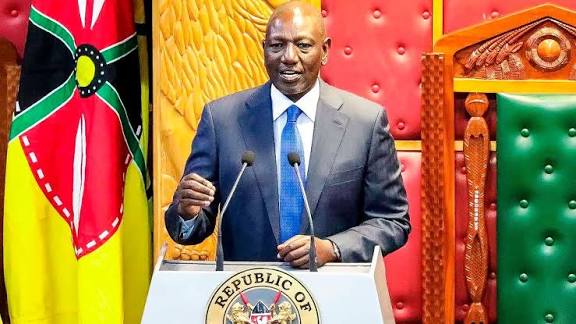
President William Ruto….Photo /courtesy
By Peter Mwibanda
Political and Legal Analyst, The Intellectuals Post
NAIROBI, Kenya — As schools reopen across Kenya, the country’s economic strain is most visible not in budget statements or political rallies, but in crowded secondhand markets where parents haggle over worn textbooks and faded uniforms—after quietly cancelling Christmas to keep their children in school.
From Nairobi to Bungoma, Kisumu to Garissa, the back-to-school season has become an exercise in survival. Festive travel, gifts and family gatherings were shelved, replaced by anxious searches for affordable learning materials.
Formal bookstores report weak sales, while traders dealing in secondhand books and uniforms say demand has surged as families shy away from the high cost of new Competency-Based Curriculum textbooks.
“This year, Christmas was a luxury we couldn’t afford,” said a parent shopping at Nairobi’s Gikomba market. “School comes first, even if it means no celebration.”
The scenes highlight a growing disconnect between Kenya’s economic rhetoric and lived reality. President William Ruto’s administration frequently speaks of transforming Kenya into a Singapore-like economy—efficient, prosperous and globally competitive. For parents scraping together school fees and supplies, that vision feels distant and abstract.
Education stakeholders blame delayed and inadequate capitation for public schools, forcing institutions to operate on debt or quietly pass costs to parents.
Teachers warn that funding gaps deepen inequality, as children from poorer households return to class without essential materials or fall behind early in the term.
The pressure extends beyond education. Rising healthcare costs, rent and food prices are stretching households to the limit, leaving families to choose which necessity to postpone.
Economists caution that these conditions erode human capital—the very foundation of long-term growth. A nation cannot claim first-world ambitions while parents crowd informal markets for basic education needs.
As the term begins, many Kenyans look ahead with less confidence than before, recalling a time when public education was predictable and Christmas did not have to be sacrificed for school survival.



