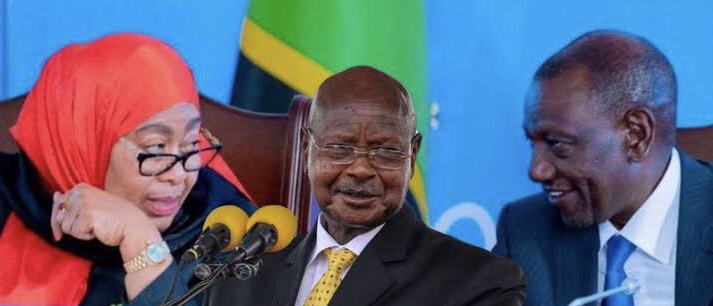
Samia Suluhu of Tanzania,Yoweri Museveni of Uganda and William Ruto of Kenya in a past official function
By Peter Marango Mwibanda
NAIROBI.
Once hailed as a region of peace, progress, and democratic promise, East Africa now stands at a perilous crossroads.
Kenya’s Nairobi once called the City in the Sun, Tanzania — the Island of Peace, and Uganda — the Pearl of Africa — are today confronting deep democratic erosion, widening human rights violations and shrinking spaces for free expression.
The region that once inspired the continent with liberation dreams and post-independence unity now grapples with political decay.
What was once one man’s democracy has quietly turned into another man’s tyranny.
Uganda: Four Decades of Controlled Power
Since 1976, Uganda has remained under the weight of entrenched autocracy.
President Yoweri Museveni, in power since 1986, built the National Resistance Movement (NRM) on a promise of stability and reform.
Yet, over time, that stability has hardened into stagnation.
Today, political succession seems more dynastic than democratic.
Museveni’s son, Gen. Muhoozi Kainerugaba — raised in State House — has become a central figure in Uganda’s political future, symbolizing a generational transfer of power within a single family rather than a nation.
For Uganda’s young population, nearly 80 percent of whom are under 35, political participation remains a dream deferred. Opposition movements, including those led by musician-turned-politician Robert Kyagulanyi, known as Bobi Wine, have faced arrests, torture and censorship.
The regime’s intolerance for dissent has turned Uganda into one of Africa’s longest-standing personalist states.
Tanzania: The Island of Peace Under Pressure
Tanzania, once a symbol of unity and moderation under Julius Nyerere, has seen its democratic foundations weaken.
For decades, the ruling Chama Cha Mapinduzi (CCM) party has maintained political dominance, navigating leadership transitions while preserving control.
President Samia Suluhu Hassan inherited a deeply polarized nation after the death of John Magufuli.
While she has reopened some civic space and reached out to the opposition, underlying structural limits persist.
Youth unemployment, corruption and a culture of fear continue to frustrate Tanzania’s younger generation.
The rise of outspoken opposition figures such as Tundu Lissu signals the growing impatience of a generation no longer content with stability without liberty.
For many young Tanzanians, peace without justice has become a form of quiet oppression.
Kenya: Democracy Tested by Power and Inequality
Kenya, often viewed as East Africa’s democratic anchor, has made significant strides since the reintroduction of multiparty politics in the 1990s.
Yet, decades later, many of the same challenges persist — corruption, elite dominance and a widening gap between citizens and state.
Despite the 2010 Constitution’s robust safeguards for rights and devolution, the political class has continued to manipulate institutions for self-preservation.
Civil society activists and journalists increasingly face harassment and legal intimidation.
The ideal of open democracy is being overshadowed by executive overreach and state control of dissent.
A Generation Rising Against the Old Order
Across the region, a restless generation — the Gen Zs and millennials — is demanding change.
In Kenya, youth-led movements have begun to challenge governance failures and economic inequality.
In Tanzania, young people are turning to digital platforms to voice dissent. In Uganda, despite repression, the youth remain the backbone of the country’s resistance.
Their struggle is not only political but generational — a battle between the liberation legacy that justified one-party dominance and the modern demand for genuine democracy.
Which Way for East Africa?
East Africa’s crisis is not inevitable; it is the result of choices — the choice to prioritize control over dialogue, loyalty over competence and stability over freedom.
As the region’s young people awaken to their collective power, the international community must reassess its partnerships with regimes that silence their citizens in the name of peace.
If democracy is to mean anything in East Africa, it must reflect the hopes of its people — not the entrenchment of those who fear them.
The struggle of the youth is a call to reimagine governance, renew accountability and reclaim a future long denied.
For a region once defined by hope, the message is clear: East Africa must find its light again — or risk losing an entire generation to disillusionment.