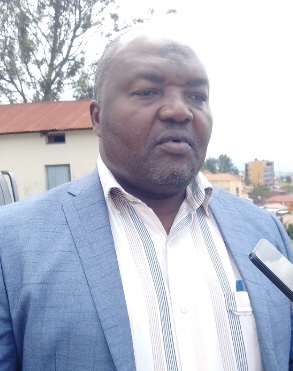
Kaberamaido CAO and Chairman Bamakoki 1986,Hajji Swalihk Wasswa Masokoyi ………Photo/Courtesy
BUSIU,MBALE, Uganda
Leaders in the Bugisu region are rallying farmers to embrace coffee revival alongside intensive banana and cocoa farming as a pathway to rebuild household incomes and reverse rising poverty levels.
Chairman of Bamakoki SACCO (1986) and Kaberamaido CAO Hajji Swalihk Wasswa Masokoyi , led the call during a stakeholders’ meeting in Busiu Town Council, urging a fundamental shift in mindset and leadership.
“Development is a function of leadership. Poor leadership results in poor development,” Masokoli said. “We have not come to give coffee seedlings only, but to change mindset. Leave the blame game and dependency syndrome and focus on production.”
He emphasized that wealth is created through producing goods and services for the market, noting that households must generate surplus income to achieve real development.
“Production brings riches—not prayer and fasting or being anointed alone. Your income must exceed your needs so that you remain with surplus. That is development,” he added.
Masokoli challenged residents to move away from subsistence farming and ensure they have consistent income streams.
“To come out of poverty, you must have something to sell daily, weekly and monthly—milk, eggs, vegetables or cash crops,” he said.
He cited declining productivity in the region, noting that despite a population of about 2 million people, Bugisu produces about 30,000 tonnes of coffee annually—down from stronger per capita output in the 1960s.
He also criticized unproductive habits, saying excessive drinking and poor time management continue to undermine economic progress.
“You spend more time on drinking than on production. What you spend your time on is what you become,” he said.
Busiu Town Council Mayor Nakhaisha Peter Pande endorsed the initiative, describing it as timely and necessary to address poverty.
“This is a noble initiative. Our people must take it seriously and work together to transform our livelihoods,” Pande said, while also calling for action against rising drug abuse in the township.
Mbale District Coordinator Sam Waburoko urged farmers to apply the knowledge shared and emulate earlier generations that thrived through agriculture.
“The information shared here is critical. Our forefathers succeeded because they focused on production. We must replicate that,” Waburoko said.
Joseph Mauso, Vice Chairperson for the Bugisu region, said the area still has the potential to regain its economic strength due to its fertile soils.
“Our vision is achievable. Busiu soils are still productive. We must organize ourselves, form SACCOs and use our land effectively,” Mauso said.
Mzee Francis Wanyina, a former Resident District Commissioner, reinforced the urgency of the initiative, citing data from the Uganda Bureau of Statistics showing Bugisu’s poverty rate at 43%, second only to Karamoja.
“It is unacceptable. Karamoja has its challenges, but Bugisu has fertile land and favorable weather. We must return to the basics that once made us wealthy,” Wanyina said.
He added that the region must plant at least 15 million coffee trees within five years and address post-harvest losses, currently estimated at 40%, to restore productivity and create employment along the value chain.
Masokoli stressed the importance of financial discipline, urging households to save at least 30% of their income through SACCOs or banks and invest in productive ventures.
“Money is for making more money, not just consumption. Wealth is built slowly through saving and investment,” Masokoli said.
The meeting concluded with a unified call for mindset change, hard work and collective action, with leaders warning that Bugisu risks further economic decline without urgent reforms.
“We must come out of the poverty mentality. Nobody will develop us—it starts with us,” Masokoli said.
Mubakye Joel,the youth cordinator Bamakoki 1986 Bugisu sub region also encouraged diversification into cocoa and banana farming for both income and food security, alongside value addition and market-oriented agriculture.