


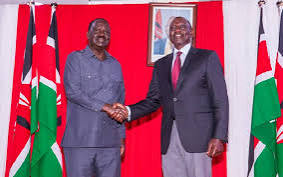
President Ruto with Raila Odinga.
OPINION:
By Peter Mwibanda
NAIROBI — In recent weeks, President William Ruto’s administration has announced the formation of a multi-agency team under the Office of the President to tackle runaway corruption.
While the intent may appear noble on the surface, the move raises serious constitutional and legal concerns.
Kenya’s 2010 Constitution clearly outlines the framework for combating corruption — and the president’s new team does not fit within that framework.
Unconstitutional Overreach
The Constitution establishes several independent commissions and offices mandated to fight corruption and promote transparency.
Chief among these is the Ethics and Anti-Corruption Commission (EACC) established under Article 79 and the Office of the Director of Public Prosecutions (ODPP) under Article 157.
Additionally, oversight institutions such as the Office of the Auditor-General the Judiciary and Parliamentary Committees serve as key players in ensuring public accountability.
A multi-agency team operating directly under the Office of the President undermines the independence of these constitutionally mandated bodies.
It centralizes power in the executive, blurring the lines between the investigator, the accused and the arbiter — a dangerous conflation in any democracy.
Conflict of Interest Within the Executive
The core question is simple: Can an entity housed in the presidency objectively investigate members of the same executive arm? The answer is a resounding no.
Investigations into corruption involving Cabinet Secretaries, Principal Secretaries, or heads of state corporations — all of whom fall under the president’s appointive power — demand institutional independence and prosecutorial discretion. A multi-agency team answerable to the president lacks the impartiality and legal authority to act credibly in such cases.
In fact, Article 249(2)(b) of the Constitution mandates that constitutional commissions and independent offices “shall be subject only to this Constitution and the law, and not subject to direction or control by any person or authority.” This is not a suggestion; it is a legal safeguard meant to preserve the integrity of oversight functions.
Rule of Law, Not Rule by Decree
President Ruto’s administration must recognize that Kenya is not governed by presidential fiat but by the rule of law. The move to create an executive-controlled anti-corruption task force sidelines the institutions established by law and entrenches executive overreach.
The president’s proper role is to support existing institutions, provide them with sufficient funding, ensure operational independence, and respect their findings — even when they implicate individuals within his administration.
Conclusion
Kenya’s war on corruption must be fought, but it must be fought within the bounds of the Constitution. Any attempt to circumvent legally established institutions not only weakens the anti-corruption agenda but sets a troubling precedent of executive interference.
Fighting corruption is not just about results — it’s about process, integrity and legality. A multi-agency team reporting to State House may look effective in the short term, but in the long run, it corrodes the very constitutional order it claims to defend.
Ends.



