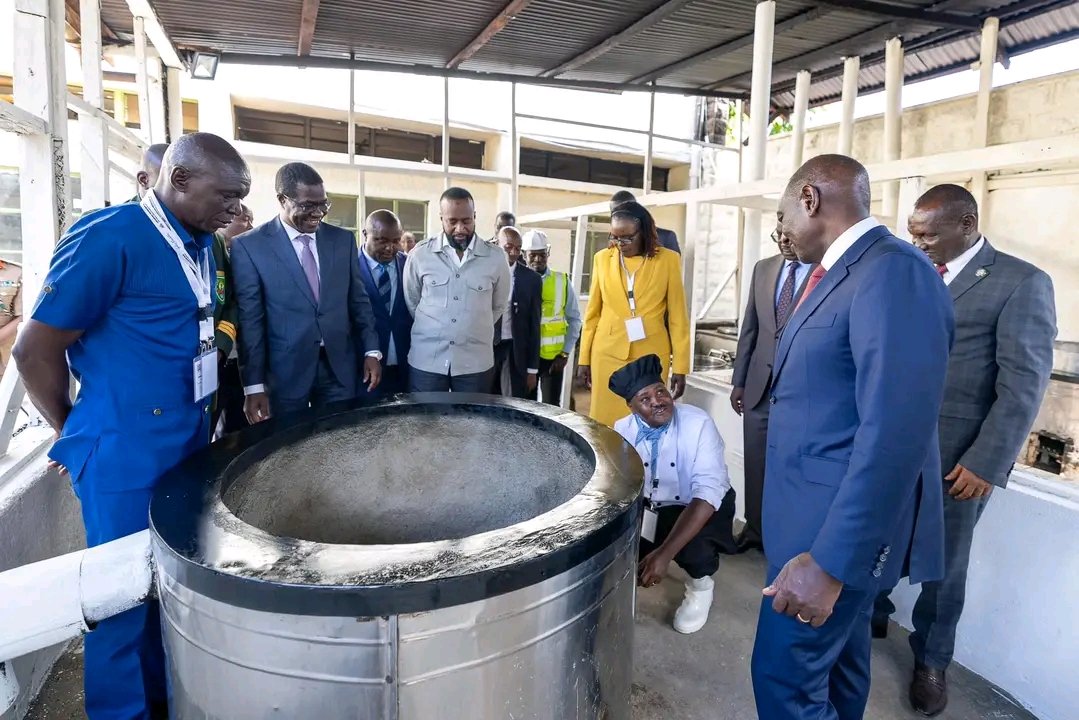
President Ruto commissioning the LPG program at Jamhuri High School,Nairobi.
By I.P. reporter.
NAIROBI.
President William Ruto announced major changes to Kenya’s Liquefied Petroleum Gas (LPG) procurement process, aiming to lower prices for consumers and improve market efficiency.
Speaking on during the launch of the Liquefied Petroleum Gas Programme for public institutions at Jamhuri High School in Nairobi, Ruto said the government would adopt the Open Tender System (OTS) for procuring LPG.
The system, already in use for petroleum products like diesel, petrol, and kerosene, is intended to increase competition and drive down prices.
“Going into the future, we will transition the purchase of gas in Kenya to an open tender mechanism (OTS),” Ruto said. “This OTS will support the competitive purchase of gas, ensuring lower prices and leveraging our country’s scale.”
The president also announced plans to partner with the private sector to create a common user import facility at Kenya Petroleum Refinery Limited.
The facility will enable private companies to import gas without the need for individual storage infrastructure, reducing costs and simplifying the process.
The directive aligns LPG procurement with existing systems for other petroleum products, which have seen price fluctuations in recent years.
In 2022, petrol prices peaked at approximately 208.58 Kenyan shillings per liter, while diesel rose to Ksh197 shillings per liter.
By late 2023, prices fell to 197 shillings for petrol and 183 shillings for diesel, providing some relief to consumers.
LPG prices have remained high over the past two years, with a 13-kg cylinder costing between 2,800 and 3,500 shillings.
The new measures are expected to lower these prices, easing the financial burden on households and encouraging the adoption of cleaner energy sources.
The reforms come as part of broader efforts to reduce carbon emissions and align Kenya with international energy standards.
Comparatively, countries like India have successfully used competitive LPG procurement models to reduce costs and increase household adoption.
Neighboring Tanzania, which rely on private-sector imports, has faced challenges due to limited storage facilities — a problem Kenya aims to solve with its shared import facility.
Ruto’s reforms are expected to positively impact the economy by 2025, reducing household energy costs, supporting small businesses, and promoting environmental sustainability.
Ends.