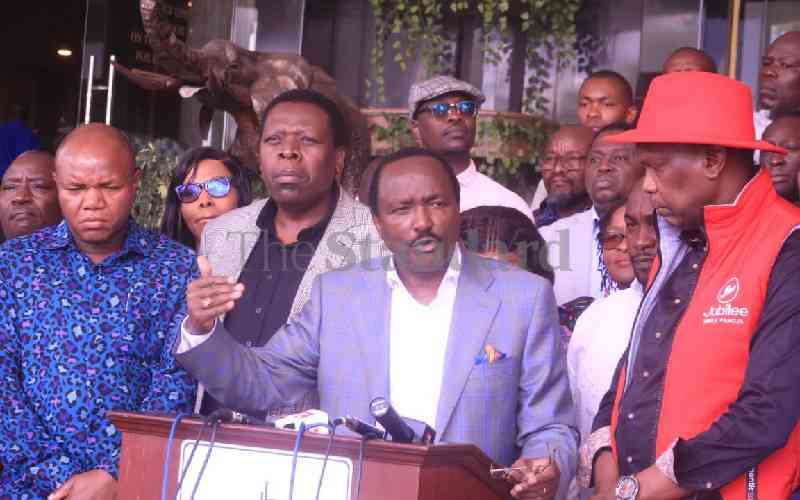
Wiper leader Kalonzo Musyoka addressing the press flanked by Azimio la Umoja leaders…Photo/Courtesy.
By Mwibanda.
Kenya’s political landscape is once again abuzz as the countdown to the 2027 General Election begins.
Barely three years remain, but the political arena is already charged with activity.
With heightened tribal alliances and strategic realignments, the race for supremacy promises to test the ingenuity of President William Ruto as he navigates a path that eluded his predecessors.
Ethnic Alignments: Kalonzo’s Calculations.
The entry of Wiper leader Kalonzo Musyoka into the GEMs tribal grouping — an alliance representing the Gikuyu, Embu, and Meru communities — has added a new layer of complexity to Kenya’s political dynamics.
Kalonzo’s move to lead the Kamba community into this traditionally dominant bloc signals his ambition to influence national politics from a stronger negotiating position.
However, this alignment raises questions about how other communities will perceive and respond to this evolving equation.
Historically, Kenyan politics has revolved around tribal coalitions, with political kingpins leveraging their ethnic constituencies for bargaining power.
Kalonzo’s strategic pivot may be aimed at countering Ruto’s charm offensive in other regions, particularly Nyanza and Western Kenya, which have been strongholds of opposition leader Raila Odinga.
Ruto’s Outreach to Raila’s Base.
President Ruto’s recent overtures to Nyanza and Western Kenya have sparked speculation about a possible shift in the political matrix.
These regions have, for decades, been loyal to Raila Odinga, a political titan and enduring opposition figure.
By focusing on development projects and political inclusivity in these areas, Ruto seeks to erode Raila’s traditional support base.
However, the challenges are immense. Nyanza, particularly Luo Nyanza, has remained steadfastly loyal to Raila, while Western Kenya has often found itself split between competing leaders.
Ruto’s ability to deliver tangible benefits to these regions could be a game-changer, but convincing deeply entrenched political loyalties to shift is easier said than done.
The Historical Hurdle: Why Others Failed.
Ruto is attempting to achieve what Kenya’s three former presidents—Jomo Kenyatta, Daniel arap Moi, and Mwai Kibaki—struggled to accomplish: building a truly national political movement that transcends tribal boundaries.
All three relied on ethnic alliances to secure power, often sidelining regions perceived as opposition strongholds.
Their strategies created a cycle of mistrust and marginalization that persists today.
President Uhuru Kenyatta’s handshake with Raila Odinga in 2018 was a bold attempt to heal these rifts, but it also polarized the political scene further, as seen in the fallout with his then-deputy, Ruto.
The Building Bridges Initiative (BBI), meant to address the underlying issues of ethnic divisions, failed to gain traction after being declared unconstitutional.
Ruto’s Political Gamble.
Ruto’s strategy to woo traditionally opposition-friendly regions involves a delicate balancing act.
By appointing leaders from Nyanza and Western to key government positions and initiating development projects, he hopes to create a sense of belonging.
However, these gestures must translate into genuine empowerment and equity, not just symbolic moves.
Moreover, Ruto must maintain his existing stronghold in the Rift Valley and Mount Kenya regions, where his UDA party has enjoyed overwhelming support.
Any perceived shift of focus could alienate his base, jeopardizing his reelection bid.
Will Ruto Succeed?
The big question remains: Can Ruto succeed where others have failed? His approach will depend on his ability to:
1. Deliver Tangible Benefits: Development projects in opposition regions must go beyond ribbon-cutting ceremonies to address long-standing grievances.
2. Create a Unifying Narrative: Ruto needs to craft a national vision that resonates across tribal lines, challenging the perception that he is merely solidifying ethnic alliances.
3. Neutralize Opposition: By co-opting key figures from opposition regions, Ruto could weaken Raila’s dominance. However, this strategy risks alienating his core supporters.
The Road Ahead.
As Kenya inches closer to the 2027 elections, the political arena is set for dramatic realignments.
The interplay between ethnic loyalty and national interest will define the coming years.
While Ruto’s moves signal a break from tradition, the deeply entrenched nature of Kenya’s tribal politics presents a formidable challenge.
Whether he can emerge as a unifying leader or succumb to the same pitfalls as his predecessors will ultimately shape the future of Kenya’s democracy.
In this high-stakes game, one thing is certain: the road to 2027 will be anything but predictable.
Ends.