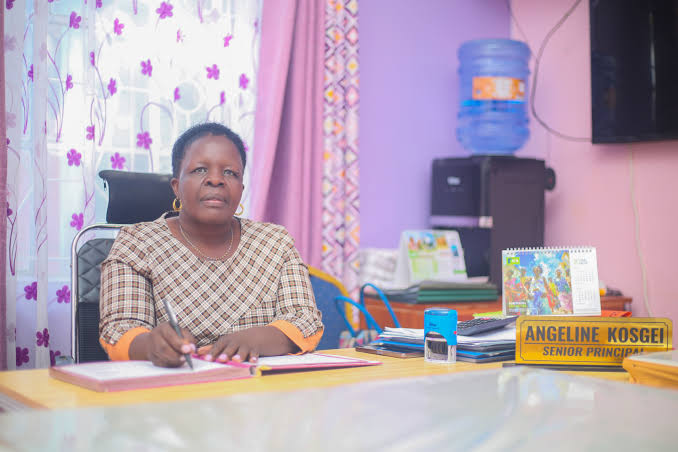
The chief Principal Angelina Kosgei
By Godfrey Wamalwa
In a country where the conversation around education is increasingly shifting from access to quality, Mitua Girls Senior School emerges not just as a participant—but as a pacesetter.
Its story is no longer one of potential; it is one of proven excellence, consistency and impact.
The question is no longer if the school deserves national status, but why the recognition has taken so long.
Mitua Girls has steadily built an academic legacy that commands attention. Year after year, the institution has posted results that stand shoulder to shoulder with some of Kenya’s most established national schools.
This is not a stroke of luck—it is the outcome of a deliberate culture of discipline, high expectations and relentless pursuit of excellence.
The school has become a center where academic ambition is not just encouraged but expected.
However, reducing Mitua Girls to academic performance alone would be an injustice to its broader contribution.
The institution has mastered what many schools struggle to achieve: balance.
In co-curricular activities, Mitua Girls continues to shine—whether in sports arenas, drama festivals, or music competitions.
It is here that students are molded into confident, expressive, and competitive individuals ready to take on the world beyond examinations.
This holistic development is precisely what defines a national school in both spirit and practice.
Central to this transformation is the visionary leadership of Chief Principal Angelina Kosgei.
Her stewardship has not only raised academic standards but has instilled a culture of purpose within the institution. Under her guidance, teaching is not a routine—it is a mission.
Supported by a team of deeply committed educators, the school has cultivated an environment where excellence is nurtured, character is built and dreams are validated.
Elevating Mitua Girls to national status would not merely be an administrative decision—it would be an affirmation of meritocracy.
It would signal that recognition in Kenya’s education system is earned through performance, innovation and consistency—not history alone.
More importantly, it would unlock greater opportunities for the students—enhanced resources, wider exposure and a stronger platform to compete on a national stage.
But perhaps the most compelling reason lies in what Mitua Girls represents. It is a symbol of what is possible when dedication meets vision.
It is proof that greatness is not confined to legacy institutions—it can be built, nurtured, and sustained.
To deny Mitua Girls Senior School national status is to overlook a living example of educational excellence.
To grant it is to align recognition with reality.
The time is not coming—it is now.