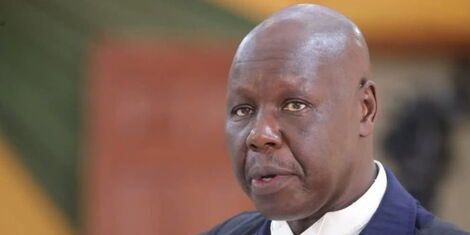
Appeal Court Judge Justice Katwa Kigen….Photo/File
NAIROBI, Kenya
Kenya’s next presidential election could be decided as much in courtrooms as at polling stations, with growing scrutiny on changes within the Supreme Court and what they could mean for a potential post-election dispute.
In a scenario where President William Ruto loses at the ballot, analysts say the decisive phase may shift to judicial interpretation, where presidential election petitions are conclusively determined.
The Supreme Court, composed of seven judges, requires only a simple majority to decide such cases — making its composition critical.
Two impending exits have already drawn attention.
Justice Njoki Ndung’u is expected to leave office, while Deputy Chief Justice Philomena Mwilu is set to retire next year, creating two vacancies on the bench.
Justice Mohamed Ibraham who is to be replaced died last year.
Those openings will be filled through constitutional processes, but within a politically sensitive environment where nominations and approvals often attract scrutiny.
A further layer to the debate is emerging around potential appointees.
Legal circles have increasingly speculated on figures such as Appeal court Judge Katwa Kigen — a senior advocate with deep experience in constitutional and electoral law and a close confidant of President Ruto— as possible candidates for elevation to the Supreme Court.
Justice Kigen was appointed to the Appeal court two months ago but has already been shortlisted as one of the six candidates to be interviewed as a possible replacement of the late Justice Ibrahim Mohamed.
If individuals with strong backgrounds in election litigation join the bench, analysts say, it could shape not just legal interpretation but also the strategic calculations of political actors heading into 2027.
“It’s not just about numbers on the bench, but the judicial philosophy and past experience each judge brings,” a Nairobi-based legal analyst said.
Kenya’s Supreme Court has previously asserted independence, most notably during the 2017 Kenyan presidential election annulment, when it nullified a presidential result.
That precedent underscored the court’s central role in electoral legitimacy.
However, critics argue that if the court’s composition is perceived to tilt in any direction — whether through appointments or broader political influence — public confidence could be strained.
In such a scenario, the electoral contest risks shifting from a question of vote counts to one of judicial confirmation.
“That’s the real pivot,” one governance observer noted. “From ‘Who won?’ to ‘What will the court decide?’”
Supporters of Kenya’s judicial system maintain that constitutional safeguards, including vetting and multi-institutional oversight, are designed to protect the integrity of appointments and rulings.
Still, as vacancies open and names circulate, the stakes are rising.
If the Supreme Court becomes the focal point of electoral outcomes, its credibility will not only determine legal disputes but also shape public trust in the democratic process.
With the 2027 election approaching, the intersection of judicial transitions, potential appointments like Appeal court Judge Katwa Kigen, and political strategy is expected to define not just the campaign — but the arena in which the final outcome is settled.