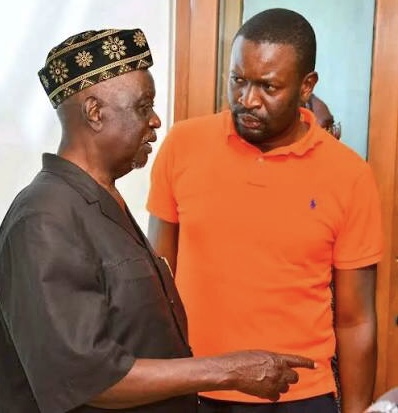
ODM party leader Dr Oburu Odinga and secretary general Edwin Sifuna…Photo/File
By Peter Marango Mwibanda | Political and Legal Analysis | The Intellectuals Post
NAIROBI
One of Africa’s most influential opposition movements is confronting its most serious internal rupture in nearly two decades.
The Orange Democratic Movement (ODM), long regarded as one of the largest and most formidable political parties in sub-Saharan Africa, now finds itself navigating a deep ideological and generational divide following its uneasy political alignment with President William Ruto’s administration.
What was presented as a pragmatic political détente — the so-called “broad-based government” — has instead triggered a struggle over the soul of the party founded and led by veteran opposition figure Raila Odinga.
At the center of the storm is Edwin Sifuna, the party’s outspoken secretary-general and a rising political force who has emerged as the most visible voice challenging ODM’s new political direction.
The confrontation unfolding inside ODM is more than a party disagreement. It is a defining moment in Kenya’s evolving political architecture ahead of the 2027 general election.
From Opposition Giant to Government Ally
For years, ODM positioned itself as the ideological counterweight to the ruling establishment, advocating social justice, electoral reforms and constitutionalism.
The party’s influence extended far beyond Kenya’s borders, often cited as one of the most structured political organizations in sub-Saharan Africa.
But the political equation shifted dramatically after the contested 2022 election that brought United Democratic Alliance (UDA) and President Ruto to power.
Following months of intense political tensions and street protests, ODM’s leadership gradually embraced a cooperative political arrangement with the government under the banner of a “broad-based administration.”
For supporters of Raila Odinga, the move was framed as a strategic effort to stabilize the country and influence governance from within.
For critics inside the party, it was something else entirely — a betrayal of ODM’s founding ideals.
The Sifuna Factor
Into this ideological vacuum stepped Edwin Sifuna.
Young, articulate and unapologetically confrontational, Sifuna has become the most prominent figure pushing back against ODM’s rapprochement with the ruling establishment.
His argument is blunt: the ideological distance between ODM and UDA is too wide to bridge.
ODM historically championed redistributive economic policies, institutional reforms and social democracy. UDA, by contrast, has promoted a populist “bottom-up” economic model tied closely to President Ruto’s political brand.
For Sifuna and a growing segment of younger ODM leaders, cooperation with the government risks diluting the party’s identity and alienating its core supporters.
In political terms, Sifuna is attempting something rare in Kenyan politics — redefining an opposition party from within while challenging the authority of its founding leadership.
A Party of Old Guards and New Insurgents
ODM now appears to be balancing between two competing centers of gravity.
On one side stands the old guard, loyal to Raila Odinga and supportive of the pragmatic engagement with the government.
On the other is a younger faction, led publicly by Sifuna, that believes ODM must reclaim its opposition credentials to remain politically relevant.
The split is not yet a formal schism, but the ideological tension is unmistakable.
If unresolved, it could transform ODM from a dominant national movement into competing political factions.
Such fragmentation would carry significant implications for Kenya’s broader political landscape.
The 2027 Calculation
Every move in Kenya’s political chessboard is already being interpreted through the lens of the 2027 presidential election.
For President Ruto, the cooperation with ODM weakens the opposition and consolidates his political space.
For Raila Odinga, the arrangement may preserve his influence within the national power structure while maintaining relevance in Kenya’s shifting alliances.
But for Edwin Sifuna and his allies, the calculation is different.
Their strategy appears aimed at preserving ODM as a credible opposition platform capable of mobilizing voters dissatisfied with the current administration.
If Sifuna successfully positions himself as the ideological guardian of ODM’s original principles, he could emerge as one of the most influential political figures of Kenya’s next generation.
A Generational Political Moment
Kenyan politics has historically revolved around dominant personalities rather than institutional party structures.
ODM itself has long been synonymous with Raila Odinga’s political brand.
The challenge now emerging within the party represents a generational test: whether ODM can transition from a personality-driven movement to an institution capable of internal ideological debate.
Sifuna’s defiance is therefore more than political theater.
It signals a broader shift where younger leaders are increasingly willing to challenge entrenched political hierarchies.
Popularity vs. Party Discipline
Whether Sifuna’s rising profile translates into sustained political momentum remains uncertain.
Kenyan political parties often prioritize loyalty to senior leadership, and open dissent can carry significant consequences.
Yet Sifuna’s outspoken stance has already resonated with sections of the electorate, particularly younger voters frustrated by what they perceive as elite political deals that blur the lines between government and opposition.
In an era where public trust in political institutions remains fragile, authenticity and ideological clarity can become powerful political assets.
The Future of ODM
ODM now stands at a critical crossroads.
It must decide whether to fully embrace the pragmatic politics of coalition building with the government or reaffirm its identity as a robust opposition movement.
The outcome will shape not only the party’s future but also the balance of power in Kenyan politics.
If the internal tensions escalate into a formal split, Kenya could witness the fragmentation of one of its most influential political formations.
If managed carefully, however, the current debate could rejuvenate ODM by forcing a necessary ideological recalibration.
The Road to 2027
As the countdown to 2027 begins, Kenya’s political landscape is already shifting beneath the surface.
Alliances are forming, rivalries are hardening and a new generation of political actors is testing the boundaries of influence.
Within ODM, Edwin Sifuna has positioned himself at the center of this transformation.
Whether he becomes the face of a renewed opposition movement or another casualty of Kenya’s complex political dynamics will depend on how the battle for the party’s soul unfolds.
What is certain is that the struggle inside ODM is no longer just an internal party matter.
It is the opening chapter of Kenya’s next political contest.