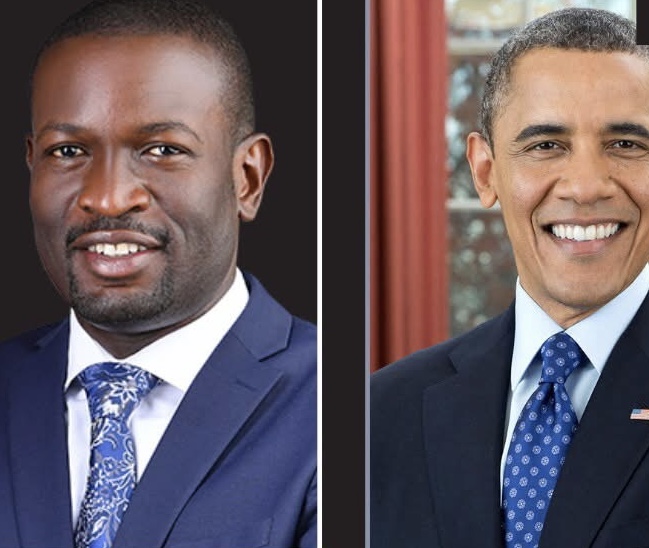
ODM SG Senator Edwin Sifuna and former US President Barrack Obama…Photo/IP
By Peter Mwibanda
Political and Legal Analyst, The Intellectuals Post
NAIROBI, Kenya (IP)
In politics, there are moments when rhetoric must transform into movement. For Edwin Sifuna, that moment may have arrived.
Sifuna stands at a rare political intersection — a sitting senator navigating the high chamber of Parliament while retaining resonance in the dust-lined market sheds and university corridors where public anger is loudest.
His recent posture inside the Orange Democratic Movement (ODM) has ignited an internal reckoning that goes beyond party hierarchy. It is about identity, ideology and ownership of a legacy.
Following the death of Raila Odinga last October, ODM entered an era of succession anxiety.
Raila was not merely a party leader; he was the ideological spine of a movement built on resistance, reform and protection of ordinary citizens. His absence has exposed generational fault lines.
Sifuna’s critics within the party — often described by younger supporters as the “old guard” — question his confrontational tone and independent streak.
They view his dissenting positions as destabilizing at a time when unity is paramount. His supporters counter that dissent is the oxygen of democracy and argue that ODM risks irrelevance if it drifts from its historical mandate.
The Obama Analogy
Comparisons between Sifuna and former U.S. President Barack Obama are not about biography but timing.
Obama emerged nationally by channeling disillusionment into disciplined messaging — blending institutional credibility with grassroots energy.
Sifuna’s challenge is similar in structure, though uniquely Kenyan in context: can he convert parliamentary gravitas into a national awakening?
Can he articulate a reform message that resonates beyond party loyalists and speaks to citizens disenchanted with rising taxes, economic strain and governance fatigue under President William Ruto?
The present administration’s economic policies have faced criticism from sections of the electorate who argue that the promised “bottom-up” transformation has yet to materialize in tangible relief.
This vacuum of trust presents opportunity — but only for leaders able to offer clarity rather than noise.
A Movement or a Moment?
Sifuna’s recent mobilization of youth networks and civil forums signals more than factional positioning. It suggests an attempt to re-anchor ODM in its traditional posture as a defender of constitutionalism and social equity.
Under Raila, ODM built its brand on standing with the marginalized — from constitutional reform battles to electoral justice campaigns.
The question now confronting the party is whether it remains a vehicle of civic resistance or transitions into accommodation politics.
Sifuna’s rhetoric indicates preference for the former.
Yet ODM’s internal resistance is formidable. Established power brokers, wary of generational displacement, appear reluctant to yield strategic control.
The tension has crystallized into a blunt political question: who will blink first — the young reformists seeking renewal or the veterans guarding institutional memory?
The Risk Equation
Political renewal carries risk. A youth-driven recalibration could energize a dormant base but fracture elite cohesion.
Conversely, suppressing reformist energy may preserve short-term stability while eroding long-term relevance.
Kenyan political history shows that parties which fail to adapt often fragment.
The post-2022 environment is especially volatile, with Gen Z activism reshaping public discourse and demanding transparency beyond ethnic arithmetic.
Sifuna’s advantage lies in narrative fluency. He speaks the language of institutional procedure in the Senate and the language of frustration in informal settlements.
That dual fluency is rare. But bridging constituencies requires more than eloquence; it demands strategic patience and coalition-building.
Beyond ODM
The stakes extend beyond party corridors. If Sifuna successfully reframes ODM as a reformist counterweight, he could influence national discourse heading toward 2027.
If he falters, the party risks drifting into internal stagnation while alternative opposition formations consolidate.
The “Obama moment” is not about celebrity or charisma. It is about seizing a transitional vacuum and articulating a unifying thesis at a time of public uncertainty.
For Sifuna, that thesis would need to answer three core questions:
What does ODM stand for in a post-Raila era?
How does it protect citizens amid economic strain?
Can generational transition occur without institutional collapse?
A Party at Crossroads
ODM now confronts a defining choice — continuity without reinvention, or recalibration with risk.
Sifuna appears ready to test that boundary.
Whether he becomes a bridge between the Senate chamber and the market stall, or a casualty of intra-party containment, will depend on how far he is willing to push — and how far the establishment is willing to resist.
In moments like these, political movements either renew themselves or fade.
Kenya is watching which path ODM will take — and whether its rising figure will transform dissent into disciplined reform.