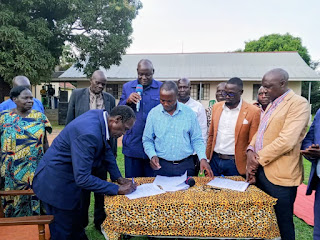
Paul Sande Emolot, the Emorimor of Teso, standing at the union’s headquarters in Soroti as his chief rival, William Alloch Akol, signs a memorandum of understanding withdrawing a High Court petition that had challenged Emolot’s election….Photo/IP
By IP Reporter,
SOROTI, Uganda (IP)
For months, the contest over the throne of the Iteso Cultural Union played out like a courtroom epic.
On Tuesday, it ended more like a family meeting.
Paul Sande Emolot, the Emorimor of Teso, stood at the union’s headquarters in Soroti as his chief rival, William Alloch Akol, signed a memorandum of understanding withdrawing a High Court petition that had challenged Emolot’s election.
In a region where land disputes and clan rivalries often spill into litigation, the decision to shelve the case was hailed as both pragmatic and symbolic — a rare moment when tradition and modern law opted for a handshake over a ruling.
The petition, filed at the Soroti High Court, had cited alleged irregularities in the electoral process of the Iteso Cultural Union, the legally recognized body that oversees Iteso cultural affairs in eastern Uganda.
The Union, established under Uganda’s cultural institutions framework following the 1995 Constitution, plays a ceremonial but influential role in mobilizing the Teso sub-region on social and development matters.
Alloch, chairperson of the Iteso House of Elders, had sought nullification of Emolot’s election, arguing that procedures were not strictly followed.
But after months of mediation chaired by the Deputy Registrar of the Soroti High Court, the two sides agreed to resolve their grievances internally.
“I could not allow the court ruling to take place in order to avoid the huge expenses that both my team and Emolot’s team were going to face,” Alloch said at the ceremony. “My decision to go to court was meant to quench the annoyance and open the door for dialogue.”
The subtext was clear: unity costs less than litigation.
Emolot, who ascended to the throne amid high expectations in a region still rebuilding from past insurgencies and cattle rustling conflicts, described the withdrawal as courageous and selfless.
“We must put aside our differences and work together for the prosperity of our people,” he said, urging the Iteso community to prioritize dialogue, especially in resolving land disputes that have clogged local courts.
Andrew Ochole, Prime Minister of the Cultural Union, called the mediation “hard but fruitful,” announcing that a meeting of newly elected Teso leaders would be convened before their swearing-in.
Soroti Resident City Commissioner John Michael Okurut said the reconciliation marked “a new journey for Teso,” encouraging leaders to move forward without revisiting past grievances.
The ceremony drew cultural and religious leaders, security officials and representatives from Uganda and neighboring Kenya, underscoring the cross-border ties of the Iteso community, whose population spans eastern Uganda and western Kenya.
Analysts note that while Uganda’s cultural leaders hold no executive political power, they wield significant soft influence in community mobilization, conflict resolution and advocacy for development projects.
In Teso — a sub-region of more than two million people, according to national census data — unity within the cultural institution is often viewed as a prerequisite for coordinated lobbying for infrastructure, education and health investments.
For now, the High Court file will gather dust, and the palace politics have yielded to public pledges of cooperation.
In Teso, at least this week, reconciliation has replaced rivalry — and the gavel has given way to applause.