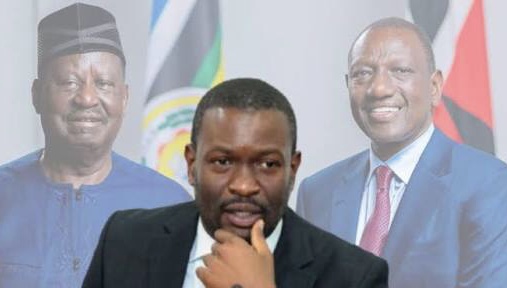
The late ODM leader Raila Odinga,Senator Edwin Sifuna (center)and President William Ruto…..Photo/courtesy
By Peter Mwibanda/
Political and Legal Analyst, Intellectuals Post
NAIROBI, Kenya
The political trajectory of the Luhya nation, Kenya’s second-largest ethnic bloc, is once again under national scrutiny following the turbulent tenure of Edwin Sifuna as secretary-general of the Orange Democratic Movement.
Sifuna’s ouster from the party’s secretariat — and his subsequent reinstatement by court order — has done more than expose internal fissures within ODM.
It has ignited a broader national debate about party identity, generational transition and the realignment of ethnic voting blocs ahead of the 2027 general election.
At the center of this turbulence lies a fundamental question: Is a new political axis emerging between sections of the Luhya and Kikuyu voting blocs, anchored by youth disillusionment and dissatisfaction with the current administration?
The Luhya Political Dilemma
Historically, the Luhya vote has oscillated between coalition pragmatism and regional loyalty.
From the days of KANU to the multiparty era, the community has often negotiated its political capital within broader alliances rather than consolidating around a single kingpin.
ODM, under Raila Odinga, became the principal vehicle for Luhya political expression in the last two decades.
The party’s social democratic posture, emphasis on constitutionalism and rhetoric of protecting “wananchi” resonated strongly in Western Kenya.
However, ODM’s cooperation with the ruling United Democratic Alliance under what has been framed as a “broad-based government” has unsettled a segment of its youthful base.
Many perceive the rapprochement as ideological dilution — a departure from the combative opposition politics that defined ODM’s brand.
Sifuna’s dissenting tone, particularly his open criticism of certain policy directions, positioned him as a lightning rod for that discontent.
Youth Disillusionment and the Search for Authenticity
Kenya’s demographic reality is decisive: more than 70 percent of the population is under 35.
This generation is less tethered to historical loyalties and more responsive to governance outcomes — unemployment, taxation, cost of living and digital freedoms.
For many young ODM supporters, the party symbolized resistance and institutional accountability. Its perceived proximity to power has, in their view, blurred that identity.
Sifuna’s legal reinstatement has therefore been interpreted symbolically by some as judicial affirmation of internal democracy.
Whether that symbolism translates into durable political capital remains uncertain. Yet the optics matter: a youthful leader challenging entrenched accommodation politics resonates in an era where authenticity is currency.
The Kikuyu Variable and the Gachagua Factor
Parallel to developments in Western Kenya is the evolving political mood in the Mt. Kenya region.
The impeachment of former Deputy President Rigathi Gachagua altered the regional equation.
President William Ruto ascended to power in 2022 with significant backing from Mt. Kenya voters. Any erosion of that support could recalibrate the national arithmetic.
Estimates often place the combined voting strength of the Luhya and Kikuyu communities at close to 10 million voters.
While ethnic arithmetic alone does not guarantee electoral outcomes, Kenyan political history demonstrates that strategic coalitions among large blocs can decisively influence presidential contests.
The hypothetical alignment of disaffected youth within ODM’s Luhya base and segments of Mt. Kenya voters alienated by recent political developments would present a formidable challenge to the incumbent in 2027.
Is ODM Becoming a Shell?
A more provocative question now circulates within political circles: If a significant portion of ODM’s youthful base drifts toward alternative formations under leaders perceived as uncompromised, what remains of the party’s grassroots vitality?
ODM retains institutional structures, seasoned legislators and historical legitimacy.
Political parties derive strength from enthusiasm as much as from infrastructure. If enthusiasm migrates, the institutional shell risks becoming administratively intact but emotionally hollow.
For President Ruto, a weakened yet cooperative ODM could provide parliamentary stability and broadened legitimacy under the broad-based framework. However, such stability may prove fragile if grassroots sentiment continues to shift.
The Raila Legacy and Generational Transition
The looming subtext in all these developments is the legacy of Raila Odinga.
ODM has long been synonymous with his political persona.
The question is whether the party can transition from personality-driven mobilization to generational leadership without fracturing.
Some observers interpret Sifuna’s posture as an attempt to embody a reformist continuation of ODM’s foundational ideals.
Others view it as tactical positioning in anticipation of a post-Raila political vacuum.
If the “spirit” of ODM’s reformist past finds renewed expression in younger leadership, the party could reinvent itself. If not, it risks gradual erosion as voters seek alternative platforms.
2027: Arithmetic Versus Momentum
Kenyan elections are shaped by two forces: ethnic arithmetic and narrative momentum. Arithmetic aggregates numbers; momentum mobilizes emotion.
A Luhya–Kikuyu convergence driven by youth dissatisfaction would combine both elements.
Yet such an alliance would require disciplined organization, credible leadership and a unifying national agenda beyond grievance politics.
For President Ruto, the strategic burden is complex. He must rebuild confidence among constituencies showing signs of drift while simultaneously preserving unity within his governing coalition.
Should that balancing act falter, scattered frustrations over taxation, cost of living and political accommodation could crystallize into a coherent, nationwide opposition front.
Time Will Tell
Whether Edwin Sifuna’s dissent marks the beginning of a generational shift or merely a passing internal dispute remains to be seen. What is clear is that Kenya’s political landscape is fluid, and traditional loyalties are under strain.
The Luhya nation stands at a crossroads: remain tethered to institutional ODM pragmatism or channel youthful energy into a recalibrated political project. Mt. Kenya voters face a parallel reckoning.
If these currents converge, 2027 may not simply be another election cycle — it may represent a reconfiguration of Kenya’s post-2010 political order.
For now, the tremors are visible. The aftershocks will define the next chapter.