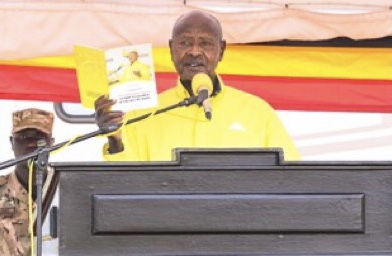
President Yoweri Museveni of Uganda….Photo/IP
By Peter Mwibanda,
KAMPALA, Uganda
Elections across East Africa continue to be held with ritualistic regularity. Ballot papers are printed, voters queue, results are declared, observers issue carefully worded statements, and incumbents are sworn in—again.
Yet behind this choreography lies a more unsettling question confronting the region after Uganda’s just-concluded polls: do elections still function as instruments of popular sovereignty, or have they become mechanisms for legitimizing permanent incumbency?
Uganda today stands as a democratic stress test for East Africa. Its elections, once infused with post-liberation hope, increasingly resemble political ceremonies devoid of meaningful choice.
President Yoweri Museveni’s four-decade grip on power has survived constitutional amendments, demographic shifts, and repeated electoral cycles.
The ballot, critics argue, has not removed power but has instead insulated it.
The Ritualization of the Vote
Uganda’s elections illustrate a broader regional pattern where the act of voting persists even as its transformative power evaporates.
Opposition parties participate, campaigns are conducted and turnout is mobilized—but outcomes appear preordained.
State machinery, security agencies, electoral commissions, and public broadcasters operate in a synchronized orbit around the incumbent.
This is not unique to Uganda.
In Rwanda, elections deliver overwhelming margins that affirm stability but foreclose competition.
In Tanzania, the space for opposition has narrowed sharply since 2020, with legal and administrative barriers thinning pluralism.
Burundi’s post-conflict elections have restored formal order but not genuine alternation of power.
Even Kenya—often cited as the region’s most competitive democracy—remains trapped in ethnic arithmetic, where elections redistribute access to the state among elites rather than dismantle incumbency as a governing culture.
Across the region, elections exist—but power rarely moves.
Votes Under Surveillance
One defining feature of this democratic stagnation is the normalization of militarized elections.
In Uganda, soldiers patrol polling stations, opposition rallies are ringed by armed personnel, and protest is treated as a security threat rather than a constitutional right.
This security-first approach has become a regional export.
When voters cast ballots under surveillance, participation becomes an act of compliance rather than choice.
The chilling effect is profound: self-censorship replaces debate, fear supplants enthusiasm, and the ballot loses its emancipatory character.
Governments justify this posture in the language of stability and order. Yet stability without accountability breeds fragility. It delays, rather than resolves, political rupture.
Youth: From Hope to Fatigue
East Africa is one of the youngest regions in the world. In Uganda, youth make up the overwhelming majority of the population—yet remain structurally excluded from power.
Their political awakening, once channeled through the ballot, is now colliding with digital repression, arrests, internet shutdowns, and protest crackdowns.
The result is democratic fatigue.
For many young Ugandans, elections no longer represent change but repetition. Voting feels symbolic, not consequential.
As faith in electoral remedies wanes, politics migrates to the streets, social media, and informal networks—spaces the state increasingly seeks to control.
This generational disillusionment is a warning signal for the region. When young citizens disengage from formal politics, democratic decay accelerates.
Winning at All Costs
Permanent incumbency is sustained not merely by popularity but by institutional capture. Electoral commissions lack independence.
Courts adjudicate election disputes cautiously, if at all. Parliamentarians owe loyalty upward rather than outward. State resources are deployed as campaign tools.
The fear of losing power—often tied to personal security, wealth, and historical grievances—has turned elections into zero-sum contests.
Losing is not an option; therefore, competition must be managed, diluted, or neutralized.
This is the death of competitive politics.
Do Elections Still Matter?
Elections still matter—but increasingly less for citizens and more for regimes. They provide international legitimacy, donor reassurance, and constitutional cover. They signal order, not openness.
For democracy to regain meaning in East Africa, elections must once again enable power transfer, not just power confirmation.
That requires independent institutions, demilitarized civic space, credible opposition, and an international community willing to prioritize democratic substance over superficial stability.
Uganda’s election is not an isolated failure; it is a regional mirror. What East Africa confronts today is not the absence of elections, but the absence of democratic consequence.
Until ballots can remove power—and not merely renew it—the region’s democracies will remain stuck in permanent incumbency, democratic in form but hollow in effect.