


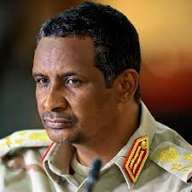
Mohamed Hamdan Dagalo — better known as Hemedti
By Peter Mwibanda
KHARTOUM
From a camel trader in the deserts of Darfur to a warlord who now commands half of Sudan, Mohamed Hamdan Dagalo — better known as Hemedti — embodies both the rise and ruin of a country spiraling into an abyss.
Once a humble herder, Hemedti built a fortune out of gold and fear and today stands accused of orchestrating a genocide that has left tens of thousands dead and millions displaced.
The United Nations estimates that up to 15,000 civilians were killed in the city of El Geneina in western Darfur in just a few months between April and November 2023.
The United States has since declared these killings an act of genocide, citing deliberate ethnic targeting by Hemedti’s paramilitary group, the Rapid Support Forces (RSF).
From Camel Trader to Warlord
Born around 1974 in Sudan’s Darfur region, Hemedti came from the Mahariya branch of the Rizeigat Arab tribe, traditionally camel herders who roamed between Sudan, Chad and Niger.
He left school at 15, trading camels across the Sahara before joining the Janjaweed militias during the Darfur conflict in the early 2000s — a campaign that left an estimated 300,000 dead and millions displaced.
In 2013, then-President Omar al-Bashir formalized Hemedti’s forces into the Rapid Support Forces, effectively legitimizing the Janjaweed under a new banner.
The RSF became his private army, operating outside the control of Sudan’s formal military command.
The Gold Empire
While the world saw Hemedti as a warlord, he saw business opportunities in blood and dust.
In the early 2010s, his family firm, Al-Gunaid, seized control of lucrative gold mines in Jebel Amir in North Darfur.
Gold became his weapon — funding his fighters, buying allegiance and granting him independence from the state.
By 2018, Sudan’s gold exports — nearly half of which were linked to Hemedti’s operations — were valued at over $2 billion.
The RSF’s commercial empire extended into transportation, logistics and real estate.
His influence reached foreign capitals — from Moscow to Abu Dhabi — where his gold and soldiers became currency in regional power games.
Hemedti’s alliance with Russia’s Wagner Group and the United Arab Emirates helped him smuggle gold and acquire arms, giving him a geopolitical advantage over Sudan’s regular army.
The Genocide and the Fall
When Sudan’s fragile transition to democracy crumbled in 2023, war erupted between the RSF and the Sudanese Armed Forces (SAF). The result was catastrophic.
Satellite imagery and eyewitness reports confirm that RSF fighters massacred civilians in El Geneina, burning entire neighborhoods, raping women and executing community leaders.
Refugees fleeing into Chad described the killings as “indiscriminate slaughter.”
The UN High Commissioner for Human Rights called the conflict “one of the fastest deteriorating humanitarian crises in modern history.”
Over 10 million people have been displaced, famine looms and infrastructure has collapsed.
Despite this, Hemedti maintains his image as a “protector of civilians” — a master of propaganda who posts social media videos in a white jalabiya, promising peace while his troops wage terror.
A Billionaire with Blood on His Hands
Hemedti’s personal wealth is estimated in the billions of dollars, most of it derived from gold mining, foreign contracts and smuggling routes.
He owns fleets of luxury cars, multiple residences in Khartoum and abroad and maintains strong ties with Gulf financiers.
Yet, beneath his soft-spoken tone lies a man driven by raw power and fear. Analysts describe him as a hybrid of Africa’s most notorious warlords — part businessman, part rebel commander, part populist politician.
His survival depends on a delicate balance: rewarding loyalty through wealth while eliminating dissent through violence.
Sudan’s Future: Between Anarchy and Fragmentation
With the RSF controlling most of western Sudan, including key trade and mining routes, Sudan risks fracturing into rival fiefdoms.
The official government in Port Sudan has lost control over vast territories.
Diplomatic efforts led by the African Union, IGAD, and the United Nations have so far failed.
Western governments, preoccupied with other global crises, offer little more than statements of condemnation.
Sudan’s humanitarian disaster is now the world’s worst, according to the United Nations Office for the Coordination of Humanitarian Affairs (OCHA).
Schools, hospitals, and markets have been bombed or looted. Aid workers face attacks and food supplies are blocked.
For ordinary Sudanese citizens, there is no end in sight.
The World Watches in Silence
The tragedy of Sudan is not just a story of war. It is a reflection of global apathy.
While the international community debates sanctions and resolutions, an entire nation is disintegrating in real time.
If the world continues to look away, Sudan may soon become another Somalia — a failed state run by warlords and mercenaries.
The rise of Hemedti — from a camel herder to a gold tycoon to an alleged war criminal — reveals the dark mechanics of modern African conflict: where resources replace democracy and power grows from the barrel of a gun, not the will of the people.
A Nation on the Edge
As the dust settles over Darfur’s burned villages, Sudan’s future hangs by a thread. Whether Hemedti wins or falls, the real losers are Sudan’s civilians — the mothers, children and families who now live under the shadow of a man whose fortune is built on their suffering.
The world cannot claim ignorance. The genocide is documented. The perpetrators are known.
What remains unknown is whether global conscience still has the power to act before Sudan disappears into darkness.



