By Peter Marango Mwibanda | The Intellectuals Post.
BUSIA, Kenya
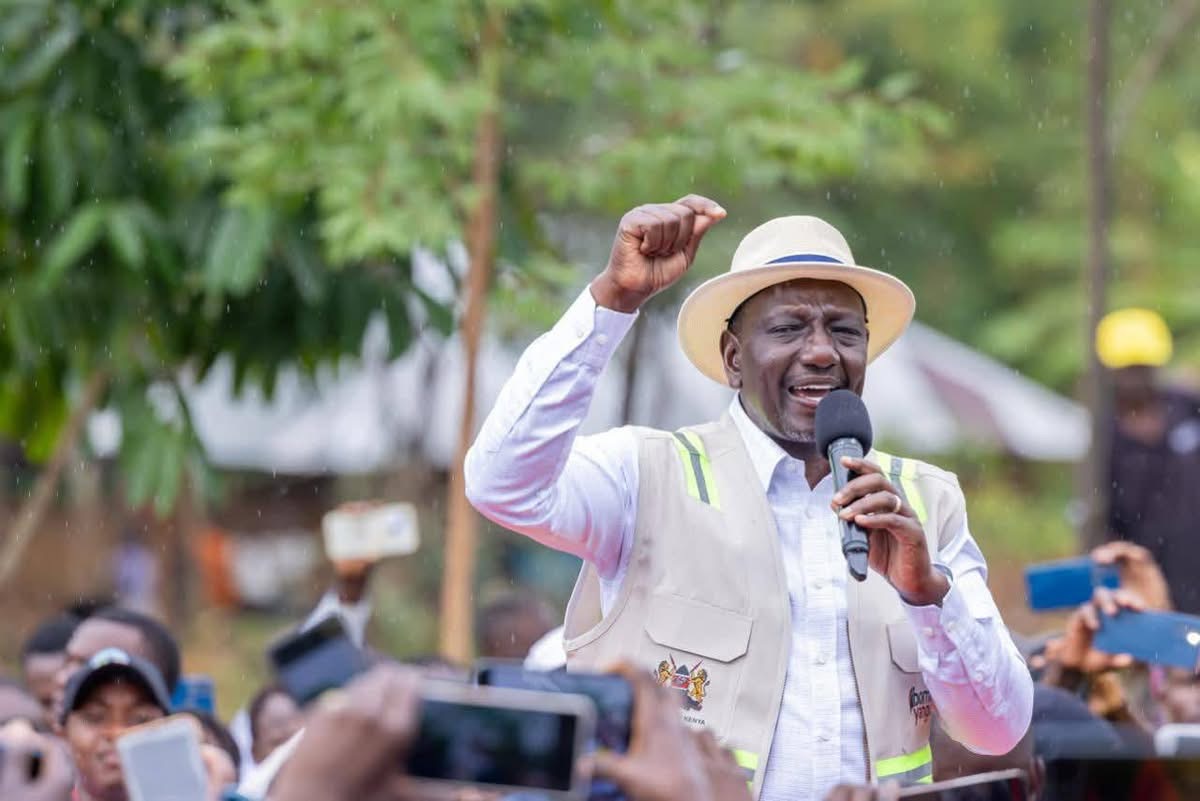
President William Ruto’s recent tour of Western Kenya has reignited debate over the thin line between development and politics, as he unveiled Sh1.1 billion worth of projects and delivered sharp criticism of opposition leaders.
The president’s multi-day visit to Busia, Kakamega and Bungoma counties — regions historically aligned with the opposition — was billed as a development drive focused on infrastructure, education, sports and youth empowerment but the tone and staging of the events suggest a deeper political undercurrent.
Speaking at Busia Stadium, Ruto urged locals to embrace government-led initiatives and distance themselves from what he described as “leaders of rhetoric.”
“We must move from politics of talk to politics of work,” Ruto declared. “Those who reject development are enemies of progress.”
As part of the tour, Ruto launched major road upgrades, construction of technical training institutes, new sporting facilities and expanded educational opportunities including scholarships and campus infrastructure.
In his remarks he stressed that the Republic’s development agenda would now fully include Western Kenya, signalling a possible shift in long-standing regional political alignments.
The announcement was received with enthusiasm by local leaders allied with the ruling United Democratic Alliance (UDA), who hailed the president’s visit as proof of his government’s commitment to regional equity.
Political Undertones and Opposition Outcry
However, the optics of Ruto’s Western Kenya tour — replete with UDA flags, song-and-dance, supporters and charged rhetoric — have drawn sharp reactions from opposition quarters.
Okiya Omtatah, the Busia Senator representing the opposition, accused the president of turning development projects into political tools:
“This was not a development tour; it was an early campaign disguised as governance. Public funds must not be used to buy loyalty.”
The opposition has also questioned the timing and feasibility of the announced initiatives, citing previous promises that failed to materialize.
Ruto’s Western Strategy: A Shift in Power Dynamics
Political observers say the Busia tour is part of Ruto’s broader plan to penetrate Western Kenya — a region that has long been a dependable base for Raila Odinga and his coalition.
With Odinga now absent from the 2027 playing field, Ruto is rapidly moving to fill the vacuum.
“Ruto understands that power in Kenya is built through visibility and presence,” said analyst Martin Oloo. “By physically visiting and unveiling projects, he is rewriting the political narrative of Western Kenya — from a region of opposition loyalty to one of economic partnership with government.”
By bringing development promises directly to communities, Ruto is positioning himself as a “president for all,” while quietly eroding the opposition’s emotional and political grip in regions previously out of his direct reach.
The Waning Grip of Raila Odinga and the Emerging Political Matrix
The death of Raila Odinga has left a significant leadership vacuum in the opposition. Odinga, a towering figure in Kenyan politics and a key mobiliser in Western Kenya, passed away after a heart-attack while in India.
His absence leaves his party, the Orange Democratic Movement (ODM), and the broader opposition alignment without a clear successor capable of matching his influence and grassroots ties. Analysts warn that this opens space for realignment.
Within this emerging matrix:
The ruling UDA under Ruto is now making deeper inroads into regions once considered opposition strongholds, like Western Kenya.
Local elites in those regions, sensing potential new alignment opportunities, may reposition themselves closer to government.
The absence of a dominant opposition figure gives the government an upper hand in shaping the terms of regional political inclusion.
Conversely, the opposition must now rapidly reorganise, redefine leadership and clarify its message, if it is to remain relevant in 2027.
In short, Kenya’s political chessboard is being reset: The veteran opposition voice is gone; a government-led development narrative is gaining ground; regional blocks are becoming less monolithic; and the 2027 election may look very different.
Hope, Skepticism and the Road Ahead
For ordinary residents of Western Kenya, the president’s visit has stirred both hope and skepticism. Some view the investment package as long-overdue recognition of their region’s potential; others regard it as political bait ahead of 2027.
> “If the projects are completed, we’ll remember this visit,” said one trader in Busia town. “But if it’s politics, we’ve seen this movie before.”
As the dust settles on Ruto’s tour, the country is left to weigh two conflicting narratives: one of genuine national development, and another of calculated political strategy. With the legacy of Raila Odinga now part of history, the question emerging loud and clear is: Who will fill the void? And on whose terms will Kenya head into 2027?
Peter Marango Mwibanda is a political and legal affairs writer focusing on governance, democracy, and development in East Africa. He blogs at The Intellectuals Post.