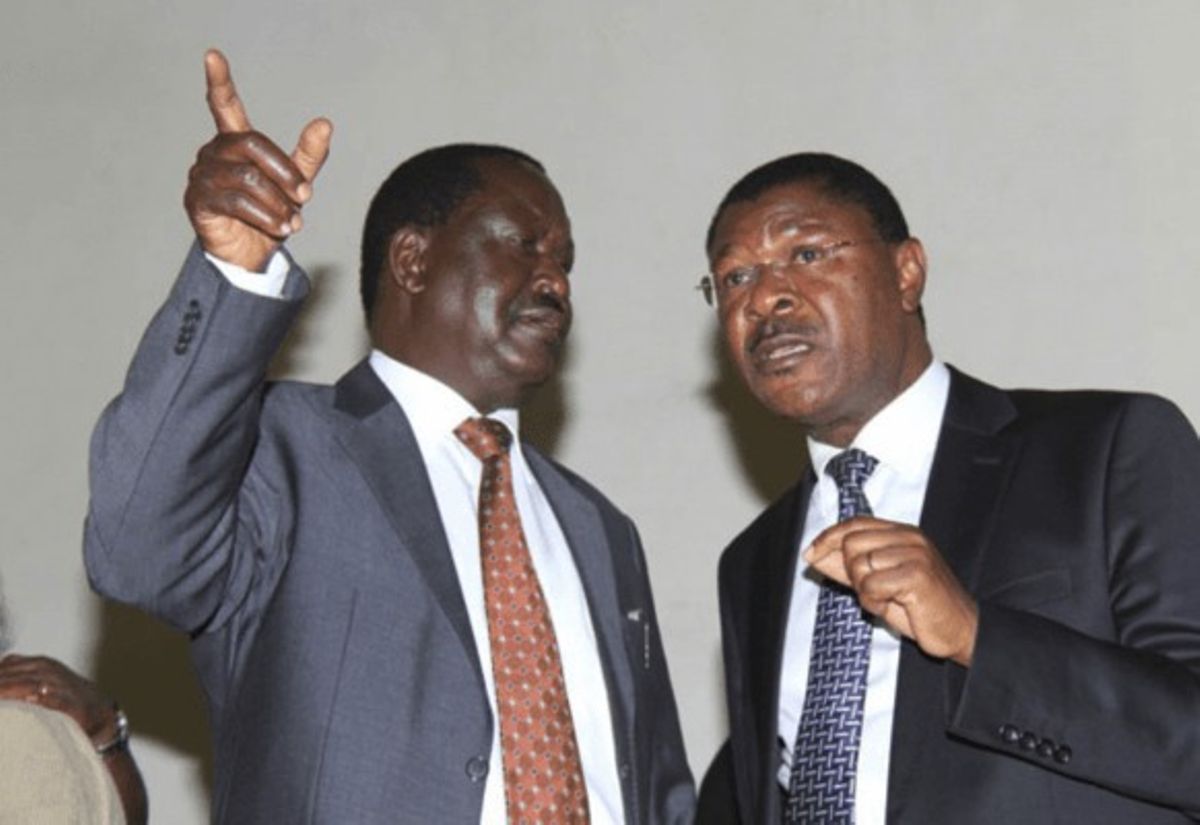
The late ODM leader Raila Odinga and Ford Kenya party leader Moses Wetang’ula in a past function…Photo/courtesy
By Peter Mwibanda
Kakamega, Kenya (IP)
For decades, Western Kenya stood as a loyal pillar of Raila Odinga’s opposition politics .
The region was bound not only by shared grievances, but by a carefully cultivated alliance between the doyen of Kenya’s resistance movement and the region’s powerful political class.
From his early collaborations with veteran politicians like former VP Moody Awour,Wycliffe Oparanya,Musalia Mudavadi,Moses Wetang’ula and the late Michael Kijana Wamalwa, to the power-sharing deals that followed disputed elections, Raila helped shape Western Kenya into a political fortress — one that defied presidential tides and stood firm behind the man they called “Baba.”
But with Odinga’s passing, and with President William Ruto already making aggressive inroads into the region ahead of the 2027 general election, a new political battle is unfolding — one that may redefine Western Kenya’s political identity for years to come.
Raila’s Deep Roots in the West
Odinga’s relationship with the Luhya nation — Kenya’s second-largest ethnic voting bloc — was never accidental.
He understood the power of coalition politics early, and Western Kenya became a key component of every alliance he built.
In 2007, during the bitterly contested election against President Mwai Kibaki, Western Kenya overwhelmingly backed Raila’s ODM, securing him a large share of the vote.
When post-election violence forced a power-sharing deal, Odinga, as Prime Minister, ensured Western leaders were rewarded with cabinet positions and influence.
The appointments of Musalia Mudavadi as Deputy Prime Minister and Wycliffe Oparanya as Minister for Planning reflected not just political calculus but trust.
Raila was viewed as a political ally who delivered — even in defeat.
“We stood with Raila not just out of loyalty,” said local political commentator David Shikuku. “He understood our issues, brought our leaders to the table, and gave the region a national voice.”
The 2022 Fracture
By 2022, however, cracks had begun to show. Key Western leaders — including Moses Wetang’ula and Musalia Mudavadi — abandoned Odinga to back Ruto’s Kenya Kwanza alliance.
The region was left divided, with some counties backing Azimio la Umoja while others pivoted to Ruto’s camp.
Raila’s grip had loosened — but his symbolic power still held.
Now, with his passing, Western Kenya finds itself politically unmoored.
The unifying figure who once brokered peace between local rivals, distributed power and offered a path to national relevance is no longer in the equation.
With 2027 fast approaching, the region is a prime target in President Ruto’s reelection strategy.
Ruto’s New Chessboard
Ruto has wasted little time in advancing his Western Kenya agenda.
Through key appointments — including giving Ford Kenya party leader Wetang’ula the powerful role of National Assembly Speaker and rewarding Musalia Mudavadi with the Prime Cabinet Secretary post — Ruto has signaled his intent to lock in the region for 2027.
The government has also accelerated infrastructure projects in Bungoma, Busia,Kakamega and Vihiga counties, while funneling national programs to local grassroots networks.
Whether these overtures translate into votes remains to be seen — but the strategy is clear: fill the vacuum left by Raila with visible development and strategic alliances.
Still, analysts warn that Western Kenya’s politics are rarely linear.
“The region respects leadership, but also punishes betrayal,” said Dr. Maureen Nabwire, a political science lecturer at Masinde Muliro University. “Just because Ruto has Mudavadi and Wetang’ula doesn’t mean he owns the Luhya vote. Voters here are watching closely — especially post-Raila.”
A New Political Identity?
The deeper question remains: without Raila, can Western Kenya develop its own cohesive political identity?
For years, the region’s leaders played second to Odinga — forming alliances rather than mounting their own sustained presidential challenge.
With Odinga gone, 2027 could see the emergence of new Western voices — possibly younger, issue-driven, and less tied to traditional political patronage.
There are murmurs of a generational shift, especially among urban youth and civil society groups calling for new leadership untainted by past alignments.
Yet, the path ahead is uncertain.
If Ruto succeeds in consolidating the region through state patronage and political appointments, the opposition may struggle to maintain relevance in a region that once formed its backbone.
Conversely, if Western Kenya turns inward and reorganizes under fresh leadership, it could become a decisive swing vote — capable of tipping the scales in any national election.
Raila’s Absence, Raila’s Shadow
Even in death, Odinga’s influence lingers. His decades of solidarity with the region — through protest, prison and power — are etched into the political memory of many Western Kenyans.
While loyalty may not automatically transfer to his party or allies, his absence will continue to shape the region’s choices.
As 2027 approaches, Western Kenya stands at a political crossroads: cling to old loyalties, embrace new alignments, or chart an entirely different course.