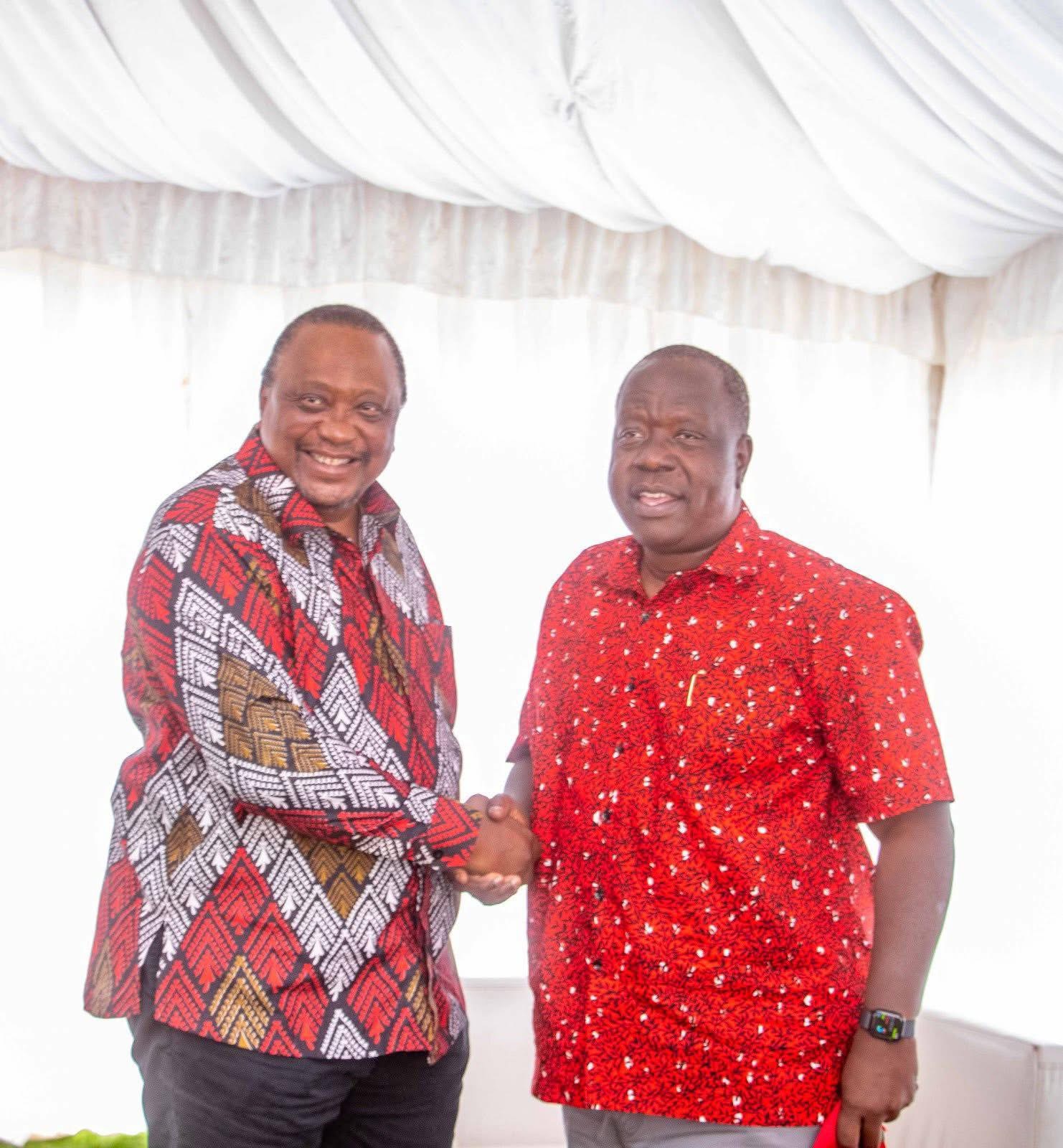
Jubilee leader Uhuru Kenyatta with probable Jubilee party’s flagbearer Prof Matiang’i last week
By Peter Mwibanda
Date: Sept. 27, 2025
NAIROBI
Kenya’s political battleground is shifting — and the tremors are strongest in Mount Kenya, where former Deputy President Rigathi Gachagua faces growing isolation amid an escalating war of influence.
Former President Uhuru Kenyatta’s dramatic revival of the once-dead Jubilee Party has not only reignited political rivalries but also reopened old wounds in a region critical to Kenya’s electoral destiny.
At stake is the future of the Mount Kenya bloc, home to over 5.2 million registered voters and historically the country’s most powerful electoral force.
Gachagua, who emerged in 2022 as the region’s political face now finds himself caught in a power squeeze — from above by a calculating President William Ruto and from behind by a resurgent Uhuru.
Political insiders are calling it what it is: a high-stakes chess match for 2027, where Ruto’s potential second term hangs in the balance.
Uhuru’s Counteroffensive: Jubilee Is Not Dead
The former president’s recent moves to reclaim and restructure the Jubilee Party are sending shockwaves through Kenya Kwanza’s base.
While Uhuru himself has shown no interest in elective politics, his moves signal an intent to frustrate Gachagua’s rising dominance and reposition himself as a behind-the-scenes powerbroker.
“Uhuru’s Jubilee isn’t about Raila or Azimio anymore — it’s about reclaiming Mount Kenya from Gachagua and reminding Ruto that the kingmaker hasn’t left the throne,” said political analyst Njeri Kamau.
By tapping into discontented leaders — from Martha Karua and Mwangi wa Iria to youthful politicians sidelined by the Kenya Kwanza regime — Jubilee may evolve into a broader anti-Gachagua, anti-Ruto coalition, right from the former President’s backyard.
Divide and Rule: Is Ruto Behind the Rift?
While Uhuru and Gachagua have publicly denied any fallout, their recent body language and separate political tours suggest otherwise.
Critics now accuse the President of engineering quiet divisions in Mount Kenya to prevent Gachagua from building a united ethnic base — and potentially challenging him in 2027 or 2032.
“Ruto doesn’t want a powerful running mate who can bargain. He wants a fragmented mountain so he can walk back into office while others are still fighting over the ashes,” one senior Kenya Kwanza MP told this blog on condition of anonymity.
This Machiavellian strategy may well explain the increased political latitude given to Mount Kenya East leaders, the elevation of new Cabinet figures allied to Uhuru from the region and the cold shoulder Gachagua has received on major government projects.
Will Gachagua Break Away?
Faced with growing resistance, Gachagua has hinted at leading a “united opposition” after he’s been pushed out of Kenya Kwanza’s 2027 matrix.
While many doubt he would risk going solo, political watchers believe he’s testing the waters and rallying grassroots loyalty before making his next move.
If he breaks off and runs separately or backs a rival coalition, it could split Mount Kenya’s vote and throw Ruto’s reelection bid into uncertainty.
The Ethnic Chessboard: Who Holds the Votes in 2027?
Kenya’s voting patterns have long been shaped by ethnic alliances and 2027 will be no different.
Alongside Mount Kenya’s Kikuyu, Embu, and Meru communities, several other blocs are expected to wield decisive influence:
Luhya Nation (Western Kenya): With nearly 2.5 million votes, this bloc could swing either toward Kenya Kwanza or a new opposition, depending on the positioning of Prime Cabinet Secretary Musalia Mudavadi and Speaker Moses Wetang’ula.
Kalenjin Bloc (Rift Valley): Ruto’s home turf, contributing over 2.2 million votes, is expected to hold firm — unless economic disillusionment or internal divisions weaken his grip.
Luo Community (Nyanza): Traditionally backing Raila Odinga, the over 2 million strong Luo vote could shift if Raila exits the stage and backs a new coalition.
Coastal Communities (Mijikenda, Swahili, Arab): Fragmented but strategic, the Coast region holds 1.7 million votes, and has been a battleground between Azimio and Kenya Kwanza.
Somali and Northeastern Communities: While smaller in number, they are kingmakers in tight races, especially in coalition-building and parliamentary negotiations.
Pastoralist and Maa Communities (Samburu, Maasai, Turkana): Traditionally swing voters, their grievances around land and climate will shape their choices.
In such a volatile ethnic mosaic, Mount Kenya remains the crown jewel — but now it’s a jewel at war with itself.
2027: A Political Powder Keg
The writing is on the wall: Ruto’s path to 2027 will not be smooth. If Mount Kenya splits, he risks facing a united opposition — possibly led or backed by his former Deputy President.
Meanwhile, the return of Uhuru, the rising youth rebellion and economic hardship could ignite new coalitions and realignments.
The mountain is rumbling and when it erupts, it could rewrite Kenya’s political map.