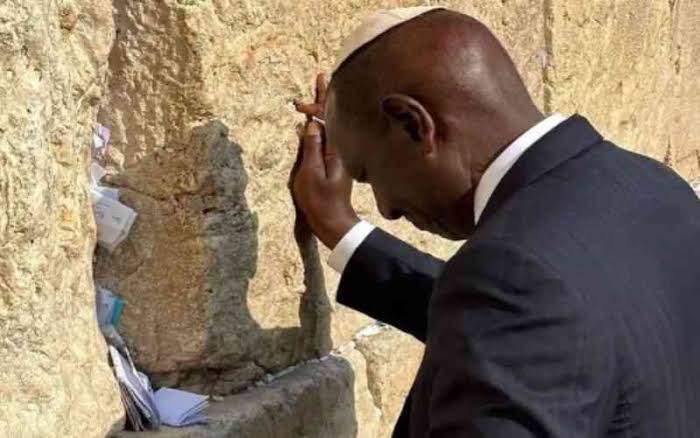
President Ruto praying at Israel’s wailing wall.
By Peter Mwibanda
NAIROBI, Kenya (IP).
Kenyan President William Ruto’s reported plan to construct a taxpayer-funded megachurch within State House, at an estimated cost of Sh1.2 billion to Sh2 billion, is drawing sharp criticism from legal experts, opposition figures and civil society leaders.
Details of the 8,000-seat church emerged through leaked documents and insider accounts, sparking national outrage at a time when public hospitals are short of essential drugs, schools have not received government capitation funds, and even the military is reportedly going without lunch.
At the heart of the uproar is Article 8 of the Kenyan Constitution, which states simply: “There shall be no State religion.”
Constitutional Concerns
The constitutional provision, though brief, has far-reaching implications. It bars the state from establishing, funding or endorsing any religion, compelling citizens to follow a particular faith, or granting privileges to one religion over others.
Critics say Ruto’s plan to erect a Christian church within the seat of executive power using public funds not only suggests state endorsement of Christianity but violates the spirit and letter of Article 8.
“This is not just about religion. It’s about the Constitution, the rule of law, and equality,” said constitutional lawyer Wachira Maina. “You cannot use national revenue to build a sanctuary for one faith at the heart of government.”
State House Is Not Public Ground
The proposed sanctuary would sit inside State House Nairobi, a high-security zone protected under the Protected Areas Act. That raises further ethical and legal concerns.
“If ordinary Kenyans can’t access State House, who is this church for?” asked political analyst Daisy Amdany. “It’s essentially a private facility for the President and select clergy, paid for by struggling taxpayers.”
Religious Favoritism Alleged
Although State House has not confirmed which denomination will use the facility, the President has regularly hosted evangelical pastors and held prayer meetings dominated by Pentecostal clergy. Observers say this lends credence to claims that the church will largely serve evangelical interests.
That has raised equity questions in a religiously plural society that includes Muslims, Hindus, African traditionalists and atheists.
Public Spending Priorities Under Fire
Beyond constitutional arguments, critics say the project reflects misplaced fiscal priorities. Kenya’s public debt now exceeds Sh10.7 trillion. Doctors have gone on strike citing budget shortfalls. Public schools are behind on teacher payments. And the Kenya Defence Forces, once guaranteed daily meals, is reportedly facing ration cuts.
“These are tough times. We are telling Kenyans to tighten their belts while the President is planning a multibillion-shilling sanctuary?” said an opposition MP
Legal Procedure Unclear
No public procurement plan or parliamentary appropriation for the church has been published. This raises red flags under the Public Finance Management Act, which requires transparency, accountability and necessity in the use of public funds.
Legal experts warn that building a denominational facility with state resources could flout Article 201 of the Constitution, which demands openness and prudent use of public money.
Civil Society Prepares Court Action
Human rights groups say they are reviewing legal options to challenge the proposed project in court, arguing it infringes on constitutional safeguards that guarantee government neutrality in religious matters.
“This is a textbook example of overreach,” said activist Irungu Houghton. “It will be tested in court, and rightly so.”
Conclusion
The controversy over Ruto’s State House church project goes beyond budgets and blueprints. It strikes at the heart of a constitutional question: Can the President, acting in his official capacity, fund and advance a religious agenda without violating the state’s secular foundations?
As public outrage grows and legal challenges loom, the debate highlights a recurring tension in Kenyan politics — between personal faith and public duty, and between populism and constitutionalism.
Ends.