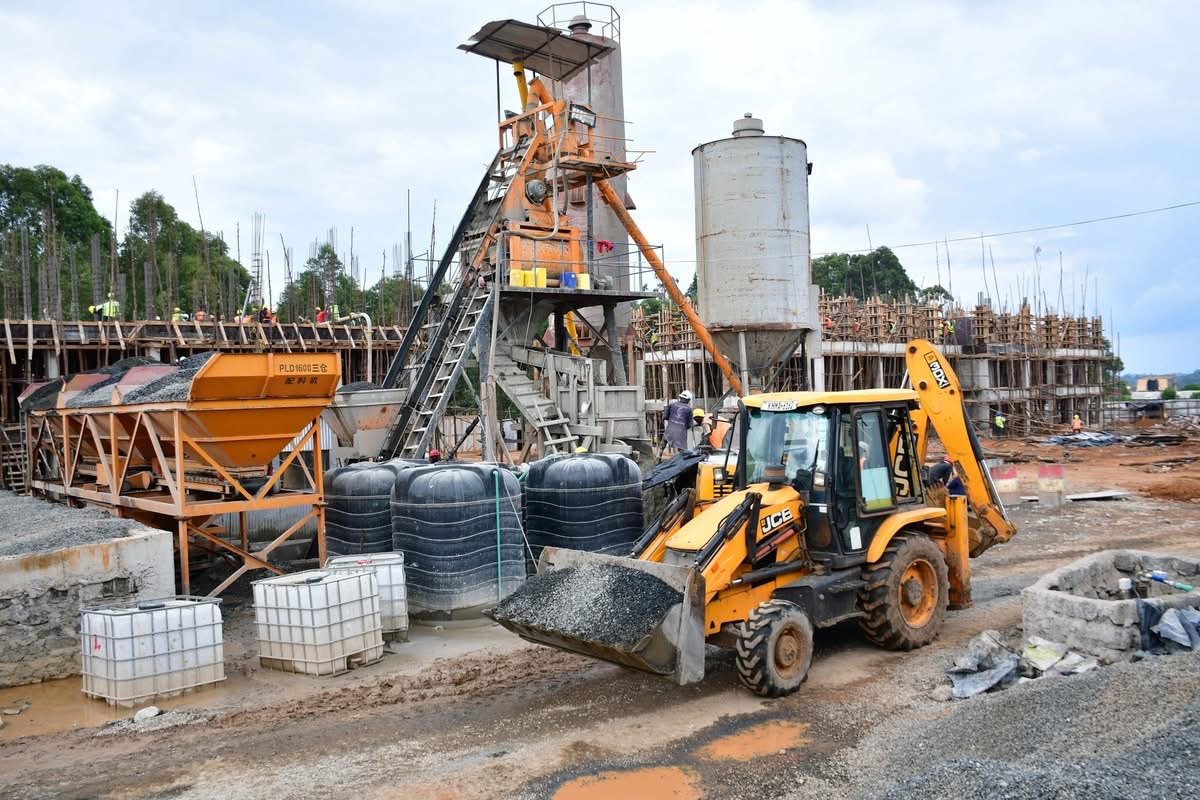
Bungoma affordable housing project taking shape…….Photo/IP.
By IP Reporter.
KANDUYI, Kenya.
The Kanduyi Affordable Housing Project in Bungoma County, part of President William Ruto’s flagship Affordable Housing Programme (AHP), is steadily rising — both in concrete and in hope — as the government accelerates its push to address the housing deficit and stimulate economic growth.
Speaking during an inspection visit, Interior Principal Secretary Dr. Raymond Omollo said the project, which was launched in August 2024, has reached 32% completion. Construction is currently at the ground floor slab casting stage, with engineers targeting a 12-day cycle to complete the slab work, in a bid to keep the momentum steady and deliver the units on time.
“This project is not only about housing — it’s about jobs, dignity, and economic transformation,” said Dr. Omollo, adding that the site currently employs 160 workers, including 80 on night shifts. He emphasized that the housing agenda is a cornerstone of President Ruto’s Bottom-Up Economic Transformation Agenda (BETA), designed to uplift grassroots communities and trigger sustainable development.
The Kanduyi development features four residential blocks totaling 372 housing units, carefully planned to serve a cross-section of income levels. These include:
178 Affordable Housing Units – among them, 20 studio apartments, 40 two-bedroom units, and 60 three-bedroom units.
74 Social Housing Units – including 20 one-bedroom, 30 two-bedroom, and 40 three-bedroom units.
120 Market-Rate Units – comprising 60 two-bedroom and 80 three-bedroom units.
The mixed-income approach, officials say, is meant to encourage social integration while offering pathways for low- and middle-income earners to own quality homes.
Dr. Omollo noted that the Bungoma project mirrors similar successes in other African nations such as Morocco and Ethiopia, where large-scale government-supported housing developments have spurred urban renewal, lifted thousands out of informal settlements, and energized local economies. Kenya’s model, however, is gaining attention for its deliberate inclusion of local labor and its public-private partnership framework.
For Bungoma, the implications extend beyond bricks and mortar. Local leaders see the project as a step toward elevating Bungoma Municipality to city status, a goal that hinges on infrastructure expansion, population growth, and economic diversification.
“This housing project is a foundational block in Bungoma’s urban transformation,” said a county official involved in urban planning. “It will not only provide dignified living but also attract investors, boost the construction sector, and increase demand for retail and other services.”
Traders and small business owners are already feeling the ripple effects. New kiosks, food stalls, and transport services have sprung up around the construction zone, feeding into the county’s wider economic ambitions.
As the national government scales up similar developments in counties like Nakuru, Machakos, and Kisumu, Kanduyi is emerging as a symbol of how housing policy can be harnessed to reimagine the future of a county — and perhaps, a nation.
Ends.