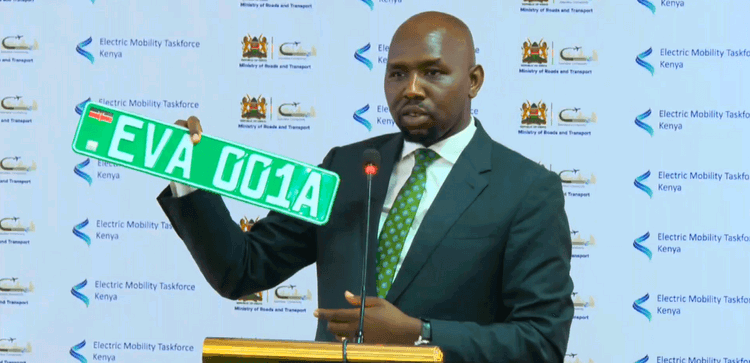
Former Transport CS displaying the green numberplates in March,2024…Photo/Courtesy.
By Micah Sali.
Nairobi,Kenya.
Kenya’s green mobility initiative, heralded by former Transport Cabinet Secretary Kipchumba Murkomen’s announcement of green-colored number plates for electric vehicles (EVs) in March 2024, promised a cleaner, greener future.
Yet, nearly a year later, the country’s transition to sustainable transport remains in limbo.
The expected infrastructure rollout has faltered, key targets have been missed, and questions loom over the government’s commitment.
The urgency of these issues is amplified when considering the untapped potential of Western Kenya, particularly the counties of Bungoma, Busia, and Trans Nzoia, which are strategically positioned as gateways to Uganda, Rwanda, and the Democratic Republic of Congo (DRC).
These counties already experience significant cross-border traffic, with thousands of commercial and passenger vehicles passing through daily.
This makes them ideal candidates for the establishment of electric vehicle (EV) charging stations, which could drive both economic growth and job creation in the region.
Missed Deadlines and the Delay of EV Infrastructure:
In July 2024, Kenya Power was expected to roll out EV charging stations in major cities like Nairobi, Mombasa, Kisumu, Nakuru, and Eldoret.
However, six months after the deadline, no meaningful progress has been made.
The reasons behind the delay are multifaceted: from financial challenges to the political disruption caused by the Finance Bill 2024 protests.
The result has been stagnation, and the vision for a green, sustainable transportation system is at risk of becoming yet another abandoned promise.
The green number plates and the infrastructure to support them are part of a broader strategy to position Kenya as a regional leader in clean energy, reduce carbon emissions, and generate green jobs.
However, without the rollout of EV charging stations and other necessary infrastructure, this vision will remain out of reach.
Western Kenya’s Opportunity to Lead:
Bungoma, Busia, and Trans Nzoia counties stand at the crossroads of a major opportunity.
Each of these counties handles significant traffic flows from neighboring countries like Uganda, Rwanda, and the DRC.
For example, Bungoma, with its population of 1.67 million, sees over 7,000 vehicles (both commercial and passenger) pass through daily, much of it cross-border traffic.
This heavy traffic flow makes these counties an ideal location for EV charging stations.
By tapping into this potential, the government could create a steady stream of revenue.
If just one EV station in Bungoma serves 50 vehicles a day at KES 1,000 per charge, it could generate KES 1.5 million per month.
Multiply this by the number of stations that could be established, and the economic benefits become clear.
But it’s not just about revenue generation—it’s about creating new jobs for the youth.
The rollout of EV charging stations could result in hundreds of new positions, from technicians and engineers to customer service personnel.
In Bungoma alone, it is feasible to expect over 200 jobs in the initial phase of infrastructure development.
The potential for job creation extends far beyond just a few counties—across Western Kenya, the transition to a green transport network could create thousands of positions and stimulate local economies.
Regional Development and the Role of Sports Infrastructure:
The ongoing upgrades to Masinde Muliro Stadium in Kanduyi and Bukhungu Stadium in Kakamega provide a perfect opportunity to integrate green infrastructure.
As these facilities are upgraded to international standards, incorporating EV charging stations into their design could position them as eco-friendly landmarks in the region.
Globally, stadiums like the Johan Cruijff Arena in Amsterdam, Cape Town Stadium in South Africa, and Mercedes-Benz Stadium in Atlanta, USA, have led the charge in integrating EV infrastructure into their operations.
These initiatives not only help to reduce emissions but also serve as visible symbols of the venues’ commitment to sustainability.
Bungoma and Kakamega could replicate this model, not only boosting their reputation but also drawing more international attention to Western Kenya as a regional leader in green energy.
The Role of Political Leadership in Western Kenya:
For this initiative to succeed, it will take more than just promises from the national government—it will require strong, sustained pressure from local political leaders.
MPs, MCAs, and Governors in Western Kenya, particularly those under the leadership of National Assembly Speaker Dr. Moses Wetang’ula, have the opportunity to be the driving force behind this transition.
Through their collective influence, these leaders can push for targeted funding, tax incentives, and government support for green mobility.
They can ensure that the green mobility agenda doesn’t stay on paper but becomes a reality that drives economic growth in the region.
More importantly, they can position themselves as champions of the green revolution in Kenya, enhancing their political hold on the voting block.
By advocating for green transport solutions, they can align their political campaigns with the aspirations of young voters who are eager for job opportunities and sustainable growth.
Urban Areas Must Not Be Left Behind:
While Western Kenya has a unique opportunity to lead the way, urban areas like Nairobi and Mombasa must not be left behind.
Although there have been some steps forward—such as the introduction of electric buses in Nairobi—the capital city and other major urban centers lack a comprehensive EV infrastructure.
This gap in infrastructure risks hindering the adoption of electric vehicles in these areas and could lead to Kenya falling behind other countries in the region.
The government must act swiftly to establish a robust EV charging network in urban centers.
If Kenya is to realize its potential as a leader in green mobility, the capital and other large cities must embrace electric mobility with the same enthusiasm as the smaller counties.
Time for Action:
As 2024 draws to a close, the government’s failure to meet its green mobility targets is becoming increasingly evident.
The national government must demonstrate its commitment to the e-mobility agenda by providing clear directives, concrete deadlines, and ensuring the effective rollout of EV infrastructure.
If President William Ruto is serious about transitioning Kenya to a green economy, he must prioritize the development of this infrastructure in his New Year speech.
He must hold both national and county governments accountable and provide the resources necessary to make green mobility a reality.
Bungoma, Busia, and Trans Nzoia counties have a chance to lead the way in Kenya’s green revolution.
By capitalizing on their strategic position as key trade routes to neighboring countries, they can create new economic opportunities and pave the way for a sustainable, job-creating transport network.
At the same time, they can elevate their global profile by integrating EV infrastructure into major developments like Masinde Muliro and Bukhungu stadiums.
But for this to happen, both the government and local leaders must act swiftly and decisively.
If Kenya is to become a leader in sustainable transport, the time for action is now.
Ends.