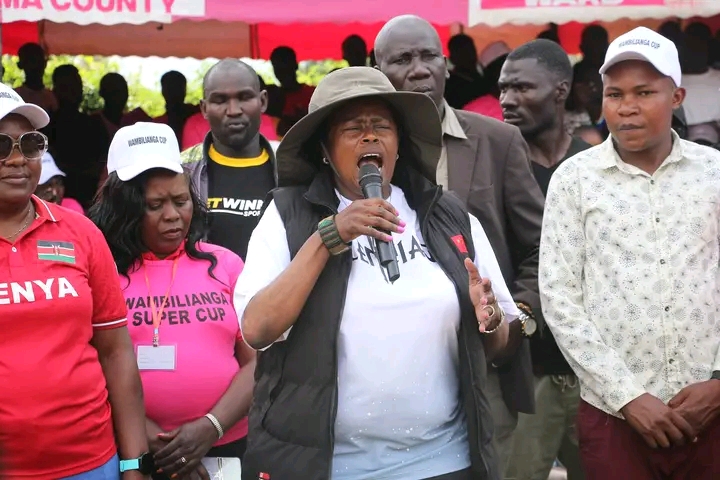
Bungoma Women MP Catherine Wambilianga addressing a mamoth crowd that attended the finals of Wambilianga Super cup at Pan Paper grounds,Webuye town on Sunday.
By I.P. reporter.
BUNGOMA, Kenya .
Bungoma Woman Representative Catherine Wambilianga has called on parents to prioritize the welfare of children with disabilities, emphasizing their heightened vulnerability to gender-based violence (GBV).
Speaking during the grand finale of the Wambilianga Super Cup at Webuye Pan Paper Stadium on Sunday, Wambilianga praised the participation of special needs teams in the tournament.
“I am more than impressed to see the resilience that our amputee teams have portrayed since we started this zero-tolerance GBV tournament in August this year,” said Wambilianga, reaffirming her commitment to fostering inclusivity in sports.
The tournament, which brought together teams from across the county, was not only a platform to nurture talent but also an avenue to address the pervasive issue of GBV.
Governor Kenneth Lusaka who was present emphasized the importance of investing in infrastructure to nurture talent.
“My administration is committed to ensuring that Bungoma has state-of-the-art stadiums and training fields. Sports not only shape youth behavior and lifestyle but also unlock their potential to compete nationally and internationally,” said Lusaka.
Senator David Wakoli urged the youth to seize opportunities provided by such initiatives.
“This tournament is a testament to the power of sports in uniting communities and providing opportunities for young people to grow their skills,” said Wakoli.
Turbo MP Janet Sitienei commended Wambilianga’s efforts, highlighting the role of sports in addressing social issues.
“I am glad to have seen my fellows with disabilities playing gracefully; a true articulation of disability is not inability,” said Sitienei. “The youth should also keep off drug and substance abuse as it plays a major role in gender-based violence.”
Siaya Woman Representative Christine Ombaka lauded the initiative, terming it a model for other counties.
“Hon. Wambilianga has challenged us a great deal,” Ombaka said. “When we go back to our home counties, we shall follow suit and bring more young boys, girls, women, and men on board.”
National Government Affirmative Action Fund (NGAAF) CEO Roy Telewa underscored the importance of addressing teenage pregnancies and GBV through community-driven approaches.
“Our patron, Wambilianga, has been at the forefront of utilizing NGAAF resources to curb teenage pregnancies and forced early marriages,” said Telewa.
Youth Development Through Sports.
The Wambilianga Super Cup has proven to be more than just a sporting event.
It has shaped youth behavior and lifestyle by promoting teamwork, discipline, and resilience.
The inclusion of special needs teams underscores the transformative power of sports in fostering inclusivity.
Globally, countries in Europe and West Africa have demonstrated how well-structured sports programs can develop talent and address social issues.
For instance, European nations like Germany and Spain have invested heavily in youth academies, while countries in West Africa, such as Nigeria and Ghana, have successfully nurtured world-class footballers through grassroots initiatives.
Bungoma’s Sports Resource Allocation.
Compared to other counties in Kenya, Bungoma faces challenges in resource allocation for sports.
Data from the Ministry of Sports and Youth Affairs reveals that counties like Nairobi and Mombasa allocate significantly more funds toward sports infrastructure and talent development.
To compete effectively, Bungoma must prioritize the construction of modern stadiums and training facilities, as Governor Lusaka has pledged.
Such investments would position the county as a hub for nurturing skilled athletes and creating opportunities for youth.
As the curtains fall on this year’s Wambilianga Super Cup, the focus shifts to how Bungoma can build on this momentum.
By addressing systemic issues such as GBV and expanding sports infrastructure, the county has the potential to become a model for youth empowerment in Kenya.
Ends.