


By IP reporter
NAIROBI, Kenya (IP)
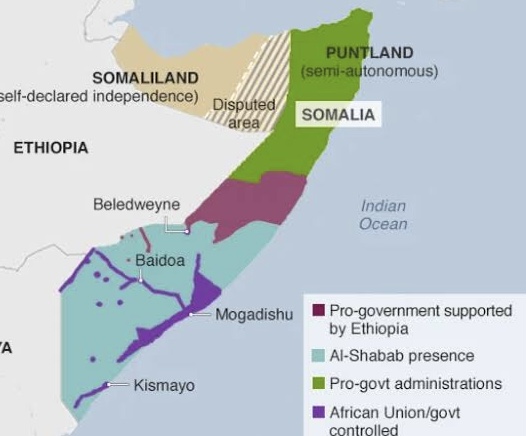
The political turmoil in Jubaland, a semi-autonomous region of southern Somalia, is drawing unusual attention from Ethiopia and Kenya.
Their involvement isn’t just meddling in Somalia’s fragile politics — it is about survival, security and regional power.
Buffer Against Al-Shabaab
For both countries, the main concern is Al-Shabaab.
The jihadist group has launched some of the deadliest attacks in the region, from Nairobi’s Westgate Mall and Garissa University to ambushes on Ethiopian peacekeepers inside Somalia.
Jubaland borders both Kenya and Ethiopia, making it a natural buffer zone.
Kenya backs Jubaland’s President, Ahmed Madobe, whose militia helps contain Al-Shabaab.
Ethiopia, however favors Mogadishu’s federal government, believing a stronger central state offers better coordination against militants.
The split exposes their competing approaches but underscores their shared fear of insecurity spilling across borders.
Trade Routes and the Kismayo Factor
Jubaland’s coastline adds another layer of importance.
The Port of Kismayo is a potential gateway for landlocked Ethiopia and a vital extension for Kenya’s own regional projects.
Kenya’s LAPSSET Corridor, linking Lamu Port to Ethiopia and South Sudan and Ethiopia’s road networks through Moyale to Mombasa depend on a secure southern Somalia.
For Addis Ababa, influence in Jubaland provides insurance for long-term access to the Indian Ocean ; a historic weakness for the landlocked nation.
Ethnic and Border Pressures
Both countries also share fragile, Somali-populated borderlands.
Kenya’s North Eastern region and Ethiopia’s Ogaden are culturally tied to Somalia.
Any instability in Jubaland risks fueling radicalization, cross-border militancy and refugee surges.
Kenya is still managing the vast Dadaab refugee camp.
Ethiopia dealing with multiple insurgencies at home, fears renewed unrest in Ogaden if Somalia fractures further.
The Bigger Picture: Ethiopia’s Regional Ambitions
Beyond immediate security, Ethiopia’s vision to become a regional power hinges on stability.
The Grand Ethiopian Renaissance Dam (GERD) is central to this ambition, with Addis Ababa aiming to export surplus electricity across East Africa.
But those plans rely on secure transmission routes and Somalia, including Jubaland, lies on that map.
Prolonged instability could choke off Ethiopia’s energy diplomacy and weaken its hand in the Horn of Africa.
High Stakes, Fragile Balance
For Nairobi and Addis Ababa, Jubaland is more than a contested Somali region.
It is a shield against terrorism and ethnic spillovers and a key to unlocking trade and energy integration in East Africa.
Yet the crisis also exposes a dangerous rift: Kenya’s alliance with Madobe versus Ethiopia’s alignment with Mogadishu.
Unless Somalia finds a lasting federal solution, the two regional powers will remain locked in a delicate balancing act intervening just enough to protect their interests but never enough to resolve the crisis outright.
The stakes go far beyond Somalia’s borders.
Jubaland’s fate could shape the stability of the entire Horn of Africa.



