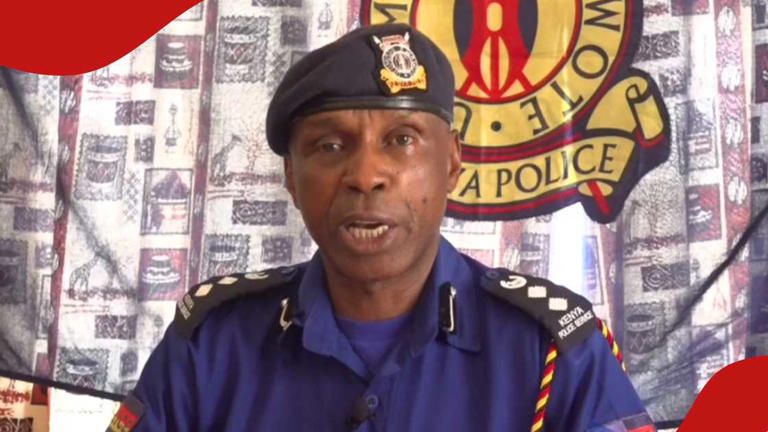
Luanda Sub-County Police Commander Richard Siele …Photo/IP.
“Murder in uniform”
By IP reporter.
Vihiga, Kenya (Aug. 24, 2025)
Police in Vihiga County have launched a manhunt after an officer allegedly shot and killed his colleague .
The deceased and the murder suspect were both on duty at a government fertilizer depot in Esirabe, Luanda.
The shocking incident has reigniting debate over rising violence within Kenya’s security forces.
Luanda Sub-County Police Commander Richard Siele said the deceased Officer Nicholas Samoei, died from a gunshot wound to the head.
The suspected shooter, identified as Kevin Omondi initially claimed Samoei had killed himself before switching off his phone and disappearing.
Residents reported hearing gunfire late Friday night before discovering Samoei lying motionless.
At the scene, investigators recovered two firearms;one belonging to Samoei and the other to Omondi.
Early findings point to deliberate foul play.
“As the investigation continued, it became clear that the officer did not kill himself but was killed and we suspect the colleague who was with him,” Siele said.
Local residents expressed shock.
“We are deeply saddened because police are supposed to be our protectors. It was not wise for an officer to kill his colleague,” said villager Thomas Okwako.
Samoei’s body was transferred to the Vihiga County Referral Hospital mortuary as police appealed to the public for information to help track the fugitive officer.
The killing is more than a tragic workplace dispute as it has reopened questions about a worrying trend of officers turning against each other.
The state of mental health in the police service is worrying and Kenya’s oversight systems are uncapable of restoring accountability.
A Force Under Fire
Kenya’s National Police Service has long been accused of brutality and heavy-handedness but increasingly the violence is inward.
Cases of officers killing colleagues, superiors or even themselves have become frequent, signaling an institution under enormous strain.
Analysts point to crushing workloads, low pay, internal rivalries and a lack of psychological support as factors fueling the crisis.
Murder in Uniform — A National Trend
Samoei’s killing is not an isolated case.
In Nakuru last year a constable gunned down his senior after a dispute.
In Garissa, an officer killed his colleague before turning the gun on himself.
Internal reports suggest at least a dozen officers have died in similar incidents over the past two years yet few cases result in convictions, leaving families without closure.
“This is a ticking time bomb,” said a security analyst. “When officers feel trapped, frustrated and unsupported, violence becomes the outlet.”
Police Against Police — A Pattern Emerges
Behind these killings lies a disturbing reality that Kenya’s officers often have no access to counseling despite working in high-stress conditions.
“Policing is one of the most stressful jobs in the country but there is no real support system,” said a former officer. “Instead, frustrations are bottled up until they explode sometimes tragically.”
Disciplinary systems are also weak, with disputes often ignored until they turn deadly. For communities the consequences are unsettling.
“If police cannot protect themselves, how can they protect us?” asked a Nakuru resident.
Kenya’s Oversight Challenge — IPOA Under Fire
The Independent Policing Oversight Authority (IPOA) was created in 2011 to investigate police misconduct.
Critics say it has been slow, underfunded and easily frustrated by lack of cooperation from police leadership.
The conviction of officers in the 2016 Willie Kimani murder case was hailed as a milestone but such wins are rare.
For many families, IPOA represents a drawn-out process with little guarantee of justice.
The Luanda case now tests IPOA again: Can it act decisively or will it be another file gathering dust?
Gen Z and the Police — A Broken Social Contract
For Kenya’s Gen Z who have led protests this year against corruption and state excesses, the Luanda killing reflects a deeper institutional collapse.
Young people already see the police as enforcers of repression rather than protectors.
Social media has amplified their grievances with videos of brutality going viral within minutes.
“If officers can’t trust each other, why should we trust them?” asked a university student in Kisumu.
Activists argue reform must tackle both citizen safety and officer welfare or else mistrust will only deepen.
Reforming the Force — What Can Be Done?
Experts say the solution lies in a combination of reforms:
Mental health care: Counseling and peer-support systems for officers.
Training: Better handling of disputes and stress management.
Oversight: Stronger IPOA authority and swifter prosecutions.
Pay and conditions: Improved welfare to reduce frustrations in the ranks.
“Policing is not just about guns and uniforms,” said a governance expert. “It is about trust both within the service and between the police and the people. If we fail to fix that we will keep repeating these tragedies.”
The Bigger Picture
The murder of Officer Samoei has left a community grieving and a country asking hard questions.
It highlights an institution at breaking point ; one where the line between protector and perpetrator grows increasingly blurred.
For Kenya, the challenge is urgent; reform the force, rebuild trust and ensure that the men and women in uniform do not become each other’s greatest threat.