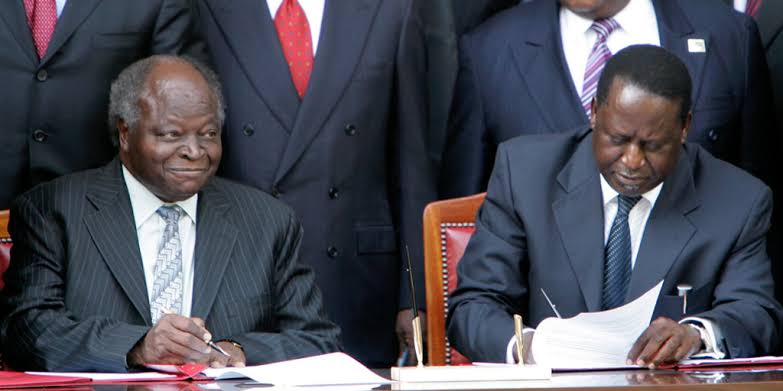
The late President Kibaki and ODM leader Raila Odinga…Photo/courtesy
By IP reporter.
Kenya’s politics has never lacked drama although few alliances shook the nation like the partnership between Mwai Kibaki and Raila Odinga in the early 2000s.
Their coalition, the National Rainbow Coalition (NARC) was hailed as a revolution at its birth and remembered as a cautionary tale at its collapse.
It was a marriage of convenience: not forged on trust but on a shared mission to bury KANU’s 40-year rule.
How It Started: A Common Enemy:
By the late 1990s, President Daniel arap Moi’s KANU was running out of goodwill.
Kibaki, once Moi’s trusted ally had quit the party in 1991 to form the Democratic Party.
Raila, after years of detention and political exile, had also broken ranks with Moi.
Though rivals, Kibaki and Raila found common ground: Moi’s rule had to end.
Kibaki had the networks and experience; Raila had the masses and political energy.
Their pact birthed NARC — a rainbow coalition with one mission: power change.
The Victory: “Kibaki Tosha”;the 2002 election was electrifying.
Raila’s rallying cry —“Kibaki Tosha!”galvanized the opposition vote making NARC broad based.
Kibaki swept into State House riding on a wave of hope and promises of reform.
Kenya cheered. The Moi era was over.
The Betrayal: Broken Promises but the honeymoon didn’t last.
Once in office, Kibaki filled key positions with his allies mostly from the Democratic Party.
Raila’s camp was left out in the cold despite a pre-election power-sharing deal.
To Raila, it was betrayal. To Kibaki, it was politics as usual.
“Agreements are not cast in stone,” one Kibaki insider quipped at the time reflecting the cold dismissal of Raila’s protests.
The rift widened. Raila rebranded himself as opposition leader clashing with Kibaki on everything from reforms to appointments.
The Breakup: 2005 Referendum
By 2005, the coalition was in ruins.
The constitutional referendum became the battleground. Raila led the “No” side; Kibaki backed the “Yes.”
When Raila’s side triumphed, the divorce was final.
“This was the people’s victory not Kibaki’s,” Raila declared after the referendum, signaling open war.
The rainbow had faded.
The Aftermath: Rivalry and Violence
NARC’s collapse reshaped Kenya’s politics.
The Kibaki-Raila rivalry exploded in the 2007 elections whose disputed results plunged the country into post-election violence.
More than 1,000 people were killed and hundreds of thousands displaced.
Ironically, the two men found themselves back together in 2008 — this time in a forced coalition government brokered to end the chaos.
The Lesson: Kenyan Politics Never Forgets as the rise and fall of NARC is more than history.
It is a reminder that in Kenya alliances are rarely about ideology — they are survival tactics meant to win elections, not govern.
Kibaki and Raila’s short-lived partnership delivered change but also exposed the fault lines of betrayal and ambition that continue to shape the country’s politics.
“In Kenyan politics, there are no permanent friends, only permanent interests.”
NARC promised unity. Instead it left scars and a political playbook still in use today.
NARC at a Glance
Full Name: National Rainbow Coalition
Formed: 2002
Key Figures: Mwai Kibaki, Raila Odinga, Charity Ngilu, Kijana Wamalwa
Objective: End KANU’s 40-year rule
Biggest Win: 2002 general election — Kibaki elected president
Biggest Split: 2005 constitutional referendum (“Yes” vs “No” camps)
Collapsed: 2005
Legacy: Proof that coalitions can topple giants — but also that in Kenyan politics, betrayal is never far away.
Ends.