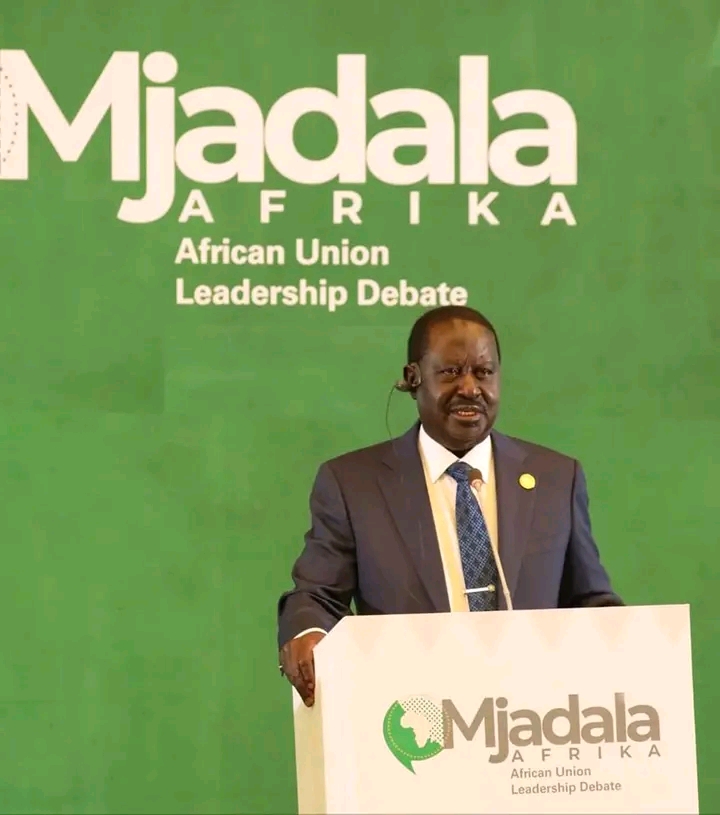
ODM leader Raila Odinga…Photo/Courtesy.
By Micah Sali.
Raila Odinga is not afraid of losing the African Union Commission (AUC) Chairmanship because every political loss in his storied career has laid the foundation for his next move.
Whether leading grassroots mobilization at home or negotiating power-sharing agreements, Raila’s ability to turn setbacks into opportunities has defined his legacy as one of Africa’s most resilient leaders.
His bid for the AUC reflects both his ambition for the continent and his readiness to pivot back to Kenyan politics if the race does not go his way.
Speaking candidly during a recent interview, Raila said he is not afraid of Losing,
“If we win, very good for us. If we lose, so what? There will be other things for us to do.”
For Raila, losing the AUC race would mean returning to Kenya, where his unparalleled grassroots network remains intact.
With ODM under his indirect control, Raila could leverage his influence to negotiate power-sharing arrangements in Kenya’s evolving political landscape ahead of the 2027 elections.
His political history is a testament to this strategy.
From his 2008 coalition with President Mwai Kibaki to his 2018 handshake with former President Uhuru Kenyatta, Raila has consistently used moments of perceived defeat to craft new opportunities for influence.
Speculation is rife that if he returns home, Raila might advocate for constitutional reforms to establish a powerful Prime Ministership, a role he could potentially occupy.
This would be reminiscent of his 2008 strategy, where he secured the Prime Minister position in the wake of post-election violence, showcasing his ability to blend pragmatism with leadership.
Born on January 7, 1945, Raila inherited a rich political legacy as the son of Jaramogi Oginga Odinga, Kenya’s first Vice President.
Educated as a mechanical engineer in East Germany, Raila returned to Kenya to become a key figure in the push for multi-party democracy.
His political journey saw him endure detention for eight years following the 1982 attempted coup against Daniel arap Moi, cementing his image as a freedom fighter.
Over the years, Raila’s political strategy has combined grassroots mobilization with power-sharing alliances.
From the formation of the Orange Democratic Movement (ODM) in 2005 to his tenure as Kenya’s Prime Minister after the disputed 2007 election, Raila has consistently shown his ability to turn electoral setbacks into opportunities for influence.
While Raila’s political instincts at home are sharp, his vision for Africa as AUC Chairperson is equally compelling.
He has prioritized boosting intra-African trade through the African Continental Free Trade Area (AfCFTA) to ensure economic self-reliance.
Raila has also called for securing two permanent seats for Africa in the United Nations Security Council (UNSC), arguing that the continent’s growing population—projected to hit 2.5 billion by 2060—justifies its inclusion in global decision-making.
This vision is underpinned by his experiences as a reformist leader, pushing for justice, equity, and inclusion throughout his career.
His continental agenda mirrors his domestic politics, blending grassroots advocacy with high-level diplomacy.
Raila’s ability to read political currents has kept him relevant for decades.
From leading protests in the streets to forming coalitions with rivals, he has repeatedly demonstrated his capacity to adapt.
His decision to hand over ODM leadership to Anyang’ Nyong’o instead of a younger leader reflects not just loyalty but also a calculated move to maintain influence without direct responsibility.
If he loses the AUC bid, many believe Raila could use his grassroots mobilization skills to influence the 2027 elections.
He could push for constitutional changes or even form new alliances to secure a share of power, a strategy he perfected in 2008 and 2018.
In his bid for the AUC Chairmanship, Raila has also emphasized the importance of intra-African trade, which has historically been minimal.
African countries have predominantly exported raw materials to international markets, importing finished goods in return.
This imbalance has limited the continent’s industrialization and economic resilience.
The AfCFTA aims to change this narrative by reducing tariffs and barriers, fostering economic integration, and creating jobs.
Raila’s plan to strengthen this framework reflects his vision for a self-reliant Africa.
Moreover, Raila’s call for Africa’s representation on the United Nations Security Council is rooted in his belief that the continent’s voice is critical to global peace and security.
He seeks to secure two permanent seats for Africa, arguing that its growing population and economic importance justify this inclusion.
For Raila Odinga a Leader Unafraid of the Future losing the AUC race is not the end—it’s a pivot.
Whether as an African statesman or a political force at home, Raila’s ability to blend ambition with pragmatism ensures he remains a central figure in shaping both Kenya’s and Africa’s futures.
His enduring legacy as a reformist and power broker reflects a leader unafraid to lose because every loss has always been the foundation for his next move.
Whether in Addis Ababa or Nairobi, Raila’s vision and influence are far from over.
Ends.