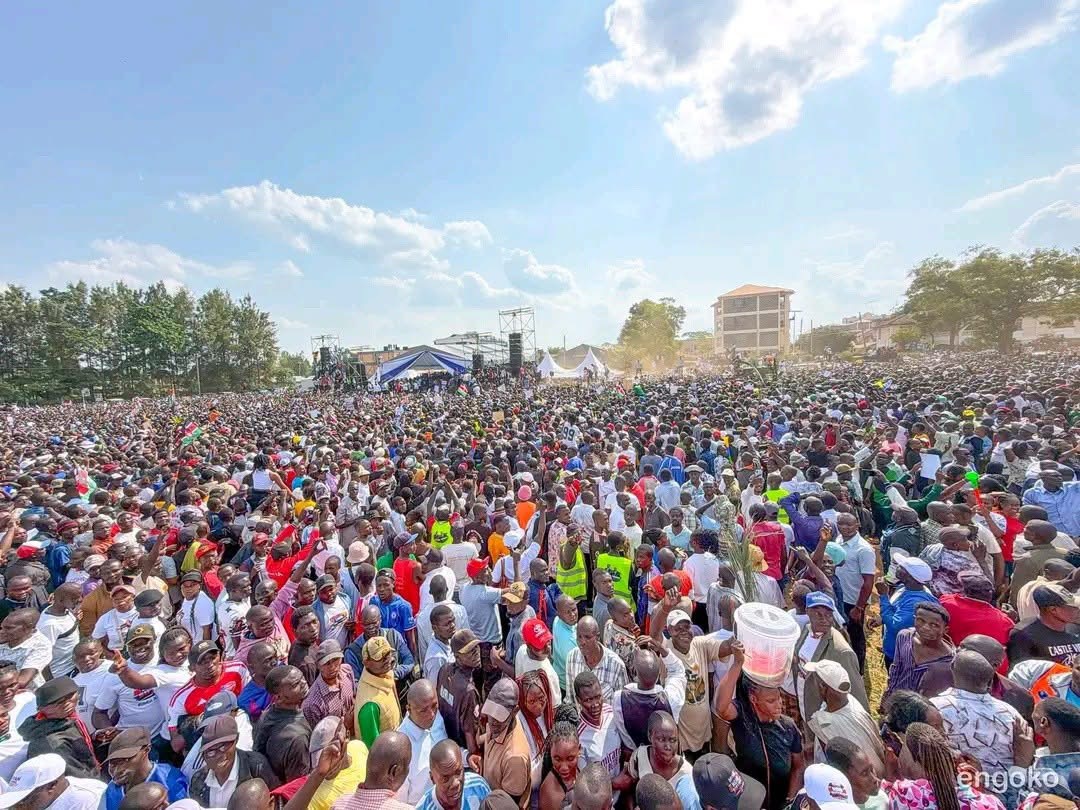
Edwin Sifuna and Linda mwananchi leaders at Kimilili on Sunday
By IP reporter
Nairobi,Kenya
The thunderous reception accorded to Nairobi Senator Edwin Sifuna during his Western Kenya tour may prove to be one of the defining political moments on Kenya’s road to the 2027 General Election.
Whether viewed as a protest movement, a generational awakening or the birth of a formidable opposition force, one conclusion is becoming increasingly difficult to dismiss: Kenya’s political landscape is shifting.
As thousands of supporters lined the streets of Trans Nzoia and Bungoma counties, chanting the slogans of the Linda Mwananchi movement, the symbolism extended far beyond campaign theatrics.
It represented a region long regarded as politically fragmented beginning to rally behind one of its own.
Reports from the tour described enthusiastic crowds and growing support for Sifuna’s movement, even as he has maintained that the opposition will ultimately settle on a single presidential candidate after broader national consultations.
For President William Ruto, these developments could complicate an already challenging political equation.
Kenyan presidential elections have historically been won through broad regional coalitions.
Every serious presidential contender must assemble support that cuts across ethnic, regional and generational divides.
If Western Kenya becomes increasingly competitive, it may force every major political camp to rethink its electoral strategy.
More importantly, Sifuna appears to be speaking to a constituency that extends beyond traditional party loyalists.
Generation Z and millennials have become increasingly vocal in demanding accountable leadership, constitutional governance, employment opportunities, transparency and an end to politics driven primarily by patronage.
Many younger voters increasingly judge leaders through performance rather than historical political affiliations.
That changing political culture may be the greatest significance of the “Sifuna storm.”
Unlike previous political waves largely built around personalities, this movement attempts to present itself as citizen-driven, relying on grassroots mobilisation and small public contributions rather than elite political financing.
Supporters have publicly highlighted grassroots fundraising as evidence of that approach.
Western Kenya itself stands at a historic crossroads.
For decades, the region has supplied influential cabinet ministers, party leaders, parliamentary leaders and coalition partners.
Yet critics have often argued that despite its numerical strength, it has rarely translated that influence into sustained national political leadership.
Sifuna’s emergence challenges that narrative.
As a lawyer, legislator and national political figure born in Western Kenya, he presents himself as a candidate capable of projecting regional strength onto the national stage while appealing to younger voters seeking generational renewal.
Still, political momentum should not be confused with electoral inevitability.
Large crowds generate headlines, but elections are won through organisation, coalition-building, financing, policy credibility and voter turnout.
Sifuna must still demonstrate that his popularity in Western Kenya can be replicated across Kenya’s 47 counties and converted into a genuinely national movement.
He must also navigate the complex politics of opposition unity. Kenya’s opposition has historically struggled to balance individual ambition with collective strategy.
Whether Sifuna eventually becomes the presidential candidate, a running mate or a key strategist may ultimately depend on negotiations among opposition leaders and the electoral mathematics they present.
Yet politics is often about momentum.Today’s crowds shape tomorrow’s headlines.Tomorrow’s headlines shape public perception.Public perception frequently influences political alliances and political alliances often determine electoral outcomes.
That is why the events unfolding across Western Kenya deserve close attention.
The excitement witnessed in Bungoma and Trans Nzoia is not merely about one politician.
It reflects a deeper national conversation about leadership, accountability and the future direction of Kenya.
Millions of young Kenyans are increasingly asking whether the country needs a new political generation capable of confronting unemployment, corruption, rising public debt, inequality and declining public trust in institutions.
Whether Edwin Sifuna ultimately becomes that standard-bearer remains uncertain.
But one reality is becoming unmistakable.A political wind is blowing through Western Kenya.If it gathers enough national force, it may become more than a regional movement.
It could become the catalyst for one of the most consequential political realignments since the return of multiparty .
Ends.