


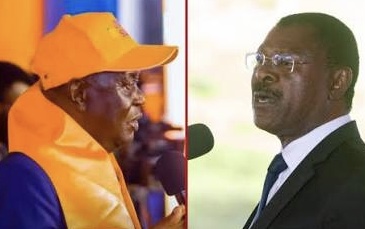
Dr Oburu Odinga and Dr Moses Wetang’ula…their political blocks are targetted swing vote
Political Analysis (lP)
NAIROBI, Kenya
A profound political recalibration is underway as Kenya approaches the 2027 general election, with the Mount Kenya and Nyanza regions — historically rival power centers — now standing at a shared crossroads, facing leadership vacuums, generational shifts and a volatile electorate.
For decades since the advent of multiparty politics in 1992, the two regions have largely anchored opposing political camps.
With one defining exception — the 2002 election — each bloc has consistently backed its own political establishment or aligned coalitions in successive presidential contests.
In 2002, however, the regions converged behind a united opposition candidate to dismantle KANU’s four-decade grip on power, delivering one of the most consequential electoral upsets in Kenya’s history.
That moment of unity remains an outlier — and now, a possible template under renewed consideration.
A rivalry under strain
The Mount Kenya–Nyanza divide has long been rooted in historical, ideological and leadership differences dating back to Jomo Kenyatta and Jaramogi Oginga Odinga.
Their political legacies hardened into a generational rivalry that has shaped electoral alignments for over half a century.
In 2022, that divide remained intact: President William Ruto secured overwhelming support in Mount Kenya, while opposition leader Raila Odinga retained Nyanza’s loyalty.
Yet, recent developments suggest that both regions are entering uncharted political territory.
Leadership vacuum and symbolic disruption
The reported “political death” — or more accurately, the diminishing centrality — of Raila Odinga as the unifying figure in Nyanza has triggered uncertainty within the region.
For decades, Odinga has been the singular gravitational force holding Nyanza’s political identity together.
Without a clear successor of equal stature, the region faces fragmentation risks, internal competition and strategic ambiguity ahead of 2027.
Mount Kenya is experiencing a parallel disruption. The exit of Uhuru Kenyatta from active frontline politics has left a leadership vacuum, with multiple factions competing to inherit regional kingpin status.
The result is a fractured political landscape where unity can no longer be assumed.
The rise of a restless political generation
Complicating this transition is the emergence of younger, assertive leaders unwilling to operate within traditional political hierarchies.
Figures such as Edwin Sifuna and Ndindi Nyoro are increasingly charting independent political paths, signaling a generational shift away from personality-driven politics toward issue-based and future-oriented positioning.
This shift is not confined to Nyanza and Mount Kenya alone — it is reshaping dynamics in Western Kenya and beyond, weakening long-standing regional voting blocs and complicating coalition-building efforts.
The numbers: A shifting electoral calculus
Demographic projections underscore the strategic importance of both regions in 2027:
2022 registered voters
Nyanza: 2,160,439
Mount Kenya: 5,770,976
Projected 2027 voters
Nyanza: 2,776,499
Mount Kenya: 7,416,587
Mount Kenya will remain the single largest voting bloc, but Nyanza’s steady growth enhances its bargaining power in coalition negotiations.
Combined, the two regions represent a decisive electoral mass capable of determining the presidency if aligned.
Economic discontent and political recalibration
Mount Kenya’s political mood has shifted markedly since 2022.
Economic strain — driven by taxation pressures, cost of living concerns and perceived policy disconnect — has eroded the region’s previously solid backing of the Kenya Kwanza administration.
In Nyanza, the shift is more strategic than emotional.
A segment of leaders is moving toward pragmatic engagement with the government, prioritizing development outcomes over traditional opposition posturing.
This dual recalibration forms the core of the “paradox reset”: Mount Kenya drifting from government consolidation, while Nyanza edges toward strategic accommodation.
Western Kenya factor: The silent disruptor
The evolving dynamics in Western Kenya add another layer of complexity.
Emerging regional movements and leaders are redefining political loyalty making Western Kenya less predictable and more competitive as a swing bloc.
This triangulation — Mount Kenya, Nyanza and Western — creates a fluid, multi-polar electoral battlefield rather than the traditional binary contest.
Implications for Ruto’s 2027 bid
For President William Ruto, the emerging landscape presents both risk and opportunity.
His 2022 victory was built on a near-solid Mount Kenya base and strategic inroads elsewhere. That foundation now appears less secure.
Retaining Mount Kenya while making gains in opposition strongholds — particularly Nyanza and Western — will be essential for a second-term path.
However, fragmentation in both regions could also work in his favor if opposition forces fail to coalesce around a single candidate or unified agenda.
Who carries the day?
The central question heading into 2027 is no longer which region dominates, but which coalition best navigates fragmentation.
Three scenarios are emerging:
1. Reunified opposition (2002 model):
If Mount Kenya dissent converges with a reorganized Nyanza leadership, a broad anti-incumbency coalition could replicate the 2002 formula and pose a serious challenge to the regime
2. Fragmented opposition, consolidated government:
If Nyanza fractures and Mount Kenya divisions fail to crystallize into a coherent альтернатив bloc, Ruto could capitalize on a divided opposition and retain power.
3. Generational realignment:
A youth-driven coalition led by emerging leaders could disrupt both traditional blocs, redefining Kenya’s political order beyond legacy figures.
Conclusion: A high-stakes reset
Kenya’s 2027 election is shaping into a contest defined not by entrenched loyalties but by volatility, demographics and generational change.
The Mount Kenya–Nyanza rivalry that has long structured Kenyan politics is no longer rigid. Instead, both regions are undergoing simultaneous transformation — politically, economically and socially.
The paradox is stark: two regions that once defined opposition and establishment politics are now equally uncertain, equally fragmented and equally pivotal.
In that uncertainty lies the decisive question for 2027: not who has the strongest base, but who can build the most credible coalition out of shifting ground.



