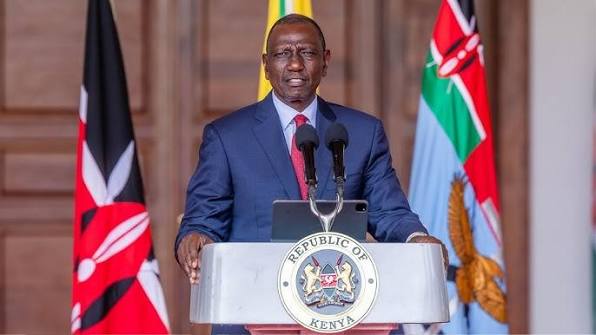
President William Ruto
By Peter Mwibanda — Nairobi
President William Ruto has made one promise louder than all others: Kenya will become a first-class nation, capable of competing with global economic powerhouses.
He envisions a digital economy driven by skilled youth, food security for every household, and an industrial sector powering national growth — all backed by transparent governance and technology.
Halfway through his first term, one question hangs over his administration: Can Kenya turn that vision into reality?
Big Promises, Bold Agenda
Ruto’s Bottom-Up Economic Transformation Agenda — known as BETA — targets agriculture, micro-enterprises, housing, healthcare and the digital sector.
It is marketed as the antidote to inequality and the path toward shared prosperity.
“Kenya cannot be trapped in dependency and mediocrity,” Ruto has said. “We must build an economy that works for everyone — from the mama mboga to the tech innovator.”
The messaging resonates in a country where millions crave dignity and opportunity. It mirrors earlier ambitions, including Vision 2030, to elevate Kenya to middle-income status.
Economic Pain Overshadows Policy
The reality on the ground tells a tougher story.
Inflation is squeezing households. The Kenyan shilling’s decline continues to drive up import costs.
Tax hikes — including the controversial Housing Levy — have triggered nationwide pushback.
“The government is asking citizens to tighten their belts while it keeps expanding its own,” said economist James Muriithi. “You cannot tax your way into prosperity. You build confidence.”
Public debt, estimated above 11 trillion shillings, now consumes nearly half of national revenue in repayments, limiting room for development spending.
Youth unemployment remains above 35%, fueling frustration across the country.
Progress, But Slow and Uneven
Kenya remains a global leader in mobile banking and renewable energy, with more than 80% of electricity sourced from clean power.
Government-led projects — from digital services to affordable housing — have rolled out in multiple counties.
The Hustler Fund has issued billions in small loans to traders. Major infrastructure projects remain underway.
Yet critics argue the impact is more visible in speeches than in people’s livelihoods.
“You cannot measure progress by groundbreakings,” said political analyst Mercy Atieno. “Measure it by how many Kenyans escape poverty.”
Corruption continues to drain public resources. Transparency International recently ranked Kenya among Africa’s most graft-burdened nations — a major obstacle to Ruto’s ambitions.
Kenya’s Youth: Power or Pressure?
With more than 75% of the population under 35, Kenya’s potential is vast. Innovation hubs in Nairobi, Kisumu and Eldoret attract global interest and start-ups like M-Pesa and Twiga Foods showcase world-class ingenuity.
Translating ideas into jobs remains a challenge. Underfunded research, limited capital and shrinking formal employment push many young people into informal work or migration.
“Ruto’s dream is valid,” said Naomi Githinji of the University of Nairobi. “But youth must be more than political slogans.”
Governance: The True Test
Political stability and strong institutions are the backbone of successful economies.
Kenya, however, is still battling tribal patronage, bureaucracy and corruption.
Legal experts warn that unless reforms deepen responsibility and accountability, Ruto’s dream may stall.
“Kenya’s issue is not lack of dreams,” said constitutional lawyer John Khaminwa. “It’s the absence of discipline and enforcement.”
Regional Competition Rising
Despite holding East Africa’s biggest economy, Kenya faces stiff competition from neighbors offering more attractive business environments.
Investors cite high energy costs and corruption as major barriers.
Strengthening logistics and reducing inefficiencies — especially at ports — will be critical to maintaining the country’s lead.
What It Will Take
Kenya’s transformation requires more than vision. Analysts point to several urgent shifts:
• Fiscal responsibility and transparency
• Institutional reforms and anti-corruption enforcement
• Education aligned to modern industry demands
• Youth integration into the economy
• Investment-friendly policies that spur productivity
As development scholar Bitange Ndemo has noted, “Kenya’s rise will depend on how we invest in people, not just projects.”
The Crossroads
Ruto’s dream of a first-class Kenya inspires hope across the nation and the continent.
The country has the talent, technology and strategic position to lead Africa’s next economic leap.
But the divide between aspiration and implementation is widening. Many Kenyans remain skeptical — bruised by decades of lofty promises.
Kenya’s future will not be shaped by how loudly the dream is declared, but by how boldly and consistently it is pursued.
For now, the journey toward a first-class nation hangs between ambition and action — waiting to see whether vision will finally meet reality.