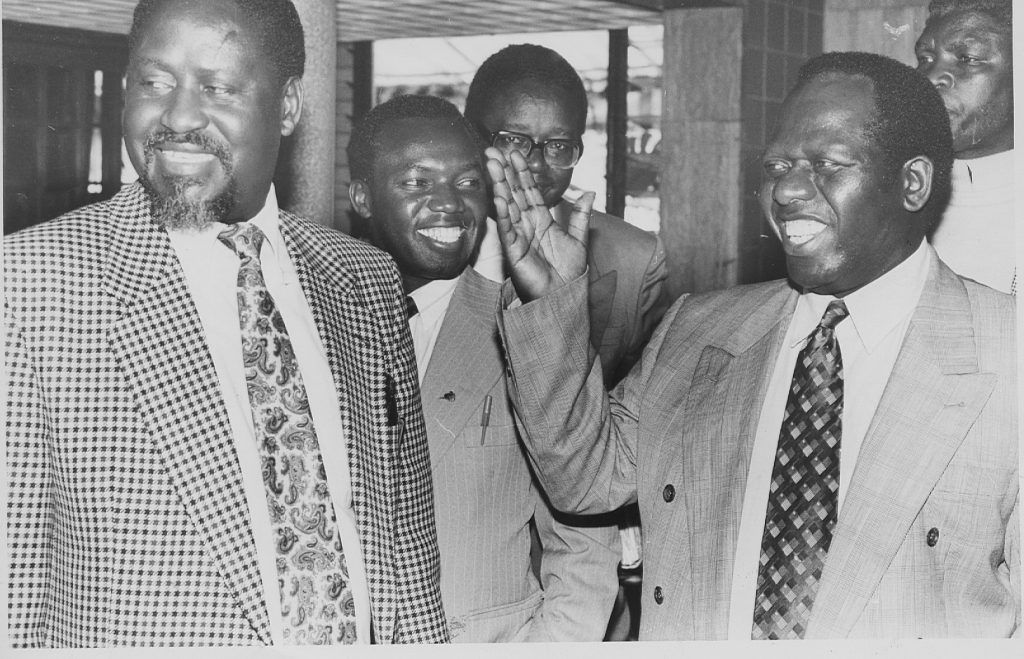
The late VP Wamalwa Kijana (Ford Kenya chairman then)and Raila Odinga (the Ford Kenya deputy director of elections in the early 90s )
By Peter Mwibanda
Nairobi, Kenya (IP)
Few figures in Kenya’s history have endured and defined political turbulence like Raila Amolo Odinga.
His long public life was forged in fire, marked by prison walls and protest marches, electoral heartbreak and national acclaim.
He was, at once, a symbol of Kenya’s democratic struggle and a survivor of its most punishing political seasons.
Odinga’s entry into politics was neither ceremonial nor calculated. It was seismic.
In the wake of the failed 1982 coup attempt against then-President Daniel arap Moi, the young engineer and university lecturer found himself pulled into the eye of Kenya’s authoritarian storm.
Accused of collaborating with the coup plotters — a charge he never publicly admitted nor denied — Raila was arrested and later charged with treason, a crime punishable by death.
He would spend the next nine years of his life behind bars, much of it in solitary confinement.
He was never tried. He was never convicted but the state made him a prisoner — and history made him a symbol.
The Birth of the Rebel
It was inside those prison walls that Odinga was reborn — not as the son of Jaramogi Oginga Odinga, Kenya’s first vice president but as the man who would come to be known simply as “Baba” — father of the struggle, patron of the people and a towering figure in opposition politics for the next four decades.
The detention hardened him, but it also clarified his purpose.
By the time he was released in 1991, Kenya was on the cusp of multi-party democracy. Odinga returned to a country hungry for change and he delivered his politics with fire.
In 1992, he joined the opposition under the Ford Kenya party led by his father but internal wrangles and political betrayals followed.
Ford Kenya splintered,Paul Muite and Gitobu Imanyara left .
Before the 1997 elections Raila again differed ideologically with Ford Kenya party chairman Michael Wamalwa Kijana and eventually formed the National Development Party (NDP).
After the 1997 general election Railas NDP then merged with the ruling KANU, only to walk out again when promises were broken.
These shifting alliances became part of Odinga’s long and winding political journey — always principled, often controversial.
The Climb to National Prominence
The early 2000s saw Odinga rise from regional leader to national contender. His role in the 2002 election — when he famously declared “Kibaki Tosha!” and backed Mwai Kibaki — proved decisive.
The victory marked the end of KANU’s 40-year rule, and Odinga’s status as a kingmaker was cemented.
But soon, he would seek the crown himself.
In the disputed 2007 election, Odinga ran against Kibaki and claimed victory.
The post-election violence that followed killed more than 1,100 people and displaced hundreds of thousands.
A power-sharing deal brokered by the international community installed him as Prime Minister — a role that gave him a platform but not full authority.
Still, he governed with pragmatism and vision, championing infrastructure development and constitutional reforms.
The 2010 Constitution, which radically restructured Kenya’s political system, bears his fingerprints.
Yet, the presidency eluded him again in 2013 and 2017. In both contests, he cried foul.
In 2017, the Supreme Court took the unprecedented step of annulling the election — a decision widely seen as a victory for the rule of law and for Odinga’s relentless pursuit of electoral justice.
He boycotted the rerun and in 2018, in a dramatic turn, he shook hands with President Uhuru Kenyatta on the steps of Harambee House — the now-famous “Handshake” that stunned allies and critics alike.
The Final Peak — and the Ultimate Loss
Odinga’s 2022 presidential bid, under the Azimio la Umoja coalition, seemed poised to finally deliver the presidency.
Backed by the incumbent and with a broad alliance, it was his most sophisticated campaign yet.
Yet again, he fell short — this time to William Ruto, who ran as the outsider.
The loss was not just political. It was personal.
Raila had devoted his life to a democratic dream that always seemed within reach — but never quite his to hold.
A Legacy Cast in Stone and Struggle
Raila Odinga’s political journey was defined as much by the valleys as the mountains.
The 1982 coup attempt placed him on the path of resistance. The detentions made him unbreakable.
The elections, even in defeat, built his legend.
To his supporters, he was the People’s President — robbed but revered, battered but unbeaten.
To his detractors, he was a destabilizer, unable to accept defeat. But even they could not deny his centrality to Kenya’s democratic evolution.
In his death, Kenya loses more than an opposition leader.
It loses a memory of resistance, a living archive of constitutional struggle, and the last of a generation that dared to confront state power head-on.
The valleys made Raila. The mountains revealed him and in both, Kenya found its most enduring voice of defiance.