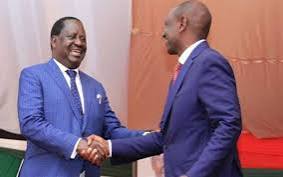
Raila Odinga and President William Ruto.
Commentary.
NAIROBI, Kenya — For decades, Raila Odinga stood as the face of Kenya’s opposition politics the unyielding voice against state excesses, human rights abuses and democratic erosion.
He marched with citizens in the streets, endured arrests, tear gas and political betrayals, and became, for many, the conscience of the republic.
His recent declaration that his alliance with President William Ruto will hold until and after 2027 has jolted his traditional base.
In dismissing critics as “notice makers”,political noisemakers irrelevant to his long-term plan, Raila signaled not only a political shift but in the eyes of some, a moral U-turn.
From Doyen of Opposition to Defender of Power.
The Kenya Kwanza administration under Ruto faces persistent accusations of authoritarianism, economic mismanagement and a deliberate clampdown on civil liberties.
Since mid-2024, young protesters — largely from the Gen Z demographic — have been met with water cannons, live bullets, abductions and terrorism charges that often collapse in court.
Raila built his political career opposing such tactics.
Even the late President Daniel arap Moi’s regime, authoritarian in its own right, stopped short of the open street killings alleged under Ruto’s watch.
The man once leading the charge against police brutality and electoral injustice is now politically aligned with the same system accused of those violations.
Pragmatism or Betrayal?
Supporters say the partnership is strategic — a bridge-building effort to stabilize Kenya ahead of a potentially volatile election season.
Critics call it a betrayal, trading decades of principle for proximity to power.
The alliance comes as the government grapples with a deep trust deficit.
The Ruto administration faces charges not only of economic failure but of criminalizing dissent.
The Unanswered Question of Victims.
Perhaps the greatest moral test for Raila is the unresolved issue of justice for victims of the Gen Z protests.
The government labeled its own protesting youth “terrorists” — a term used by Ruto himself — yet no official process exists to compensate victims, clear the names of the wrongfully accused or hold security officers accountable.
Without such reckoning, calls for national unity risk being dismissed as political theater.
A 2027 Gamble.
Some analysts see Raila’s alliance as part of a calculated bid to secure support for his African Union Commission chairmanship and, indirectly, shape succession politics in 2027.
Aligning with an unpopular regime could alienate the very base that sustained him for decades — and risk tarnishing the moral authority that once made “Baba” a rallying cry for justice.
Raila Odinga’s legacy was forged in resistance to oppressive power.
Standing beside it now could redefine not only his political twilight but the way history remembers him.
Raila Odinga’s Political Shifts
Key Turning Points:-
1997–2002: Opposition leader under NDP; later joins KANU before fallout with Moi.
2002: Co-founder of National Rainbow Coalition (NARC) to oust KANU.
2005: Leads “No” camp in constitutional referendum, forming ODM.
2007: Contests disputed election; post-election violence follows.
2013 & 2017: Loses presidential bids; alleges electoral fraud.
2018: Surprises supporters with “Handshake” with President Uhuru Kenyatta.
2024: Enters alliance with President William Ruto despite years of fierce rivalry.
Public Approval Ratings (Nationwide polls)
July 2023: 58% favorable
Aug 2024: 49% favorable (alliance talks begin)
Jan 2025: 42% favorable
July 2025: 39% favorable
Alliance Context.
Stated Goal: Promote political stability and national unity
Critics’ View: A bid for AU Commission post and control over 2027 succession politics
Unresolved Issues:
Justice for Gen Z protest victims
Police accountability
Economic reform and cost-of-living relief
Public Reaction Snapshots (Social Media Sentiment Analysis)
Positive Mentions: 28% (Unity, diplomacy, maturity)
Negative Mentions: 65% (Betrayal, hypocrisy, opportunism)
Neutral/Undecided: 7%
Quote of the Moment:
“Baba taught us to fight for justice. Now he tells us to embrace those we fought against. It feels like we’ve been left in the rain without an umbrella.” — Gen Z protester, Nairobi