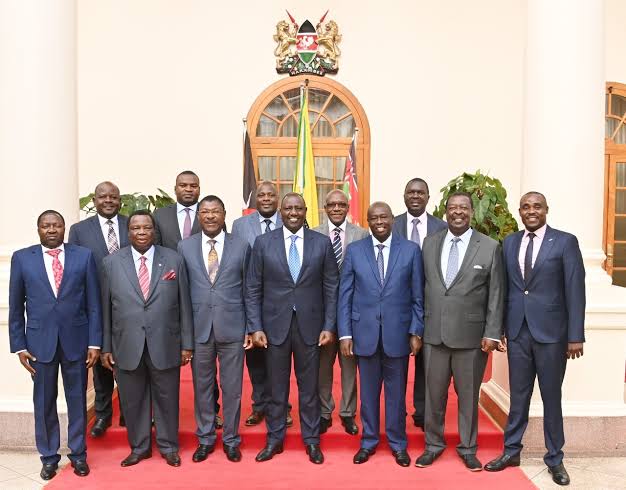
The current Luhyia leadership meeting President Ruto at state house when Rigathi Gachagua was still the deputy President.
By Peter Mwibanda
The Luhya community — often referred to as the Mulembe Nation — is one of Kenya’s most populous and culturally rich groups. But despite its numbers, it remains politically fragmented, economically sidelined, and socially disjointed.
While other ethnic blocs vote as a unit, bargain collectively, and reap national benefits, the Luhya have largely failed to convert their numerical strength into political or economic power.
Poverty as a Political Tool
In Western Kenya, poverty isn’t just an economic condition — it’s a means of control. The region has endured decades of underdevelopment, while politicians continue to dangle promises of “development” every election season.
Rather than investing in industries or infrastructure, many leaders offer sugar, maize, and t-shirts — short-term handouts that entrench dependence and political loyalty.
A hungry population, critics say, is easier to manipulate.
Self-Serving Leadership
The community’s leaders often put ego ahead of service. Once elected or appointed, many abandon the people who backed them. Empowering others is viewed as a threat, not a responsibility.
Instead of building institutions or mentoring the next generation, they build personal brands and crush potential successors.
These leaders quickly become tools of the ruling elite — deployed during campaigns to rally Luhya votes, only to retreat into silence after elections. The community is reduced to a political stepping stone.
Why Others Succeed Where Luhyas Stumble
Other communities — notably the Kikuyu, Luo, Kalenjin, and increasingly the Kamba — have embraced bloc politics. They rally behind a single figure or agenda and leverage that unity for cabinet seats, government projects, and influence.
The Luhya, by contrast, have no central political ideology or strategy. Every sub-tribe and MP wants to be king. The result is division, competition, and lost opportunity.
A Glimmer of Hope: Enter Gen Z
But change may be on the horizon. Kenya’s Gen Z is rising — fearless, digitally savvy, and unwilling to be silenced. They don’t worship names or tribal affiliations. They demand accountability, equality, and reform.
In recent protests and movements, Gen Zs have emerged as the voice of conscience. They organize across regions, challenge political elites, and expose corruption with courage and clarity.
They could be the force that awakens the sleeping giant.
The Way Forward
Unity will not come from political endorsements, staged rallies, or recycled slogans. It must come from the people — especially the youth — who are tired of poverty, betrayal, and empty politics.
For the Mulembe Nation, the path to relevance lies in rejecting egotism, investing in new leadership, and rallying around purpose, not personalities.
Until that happens, the Luhya will remain a powerful community shackled by its own contradictions.
But there’s hope — and its name is Gen Z.
Ends.