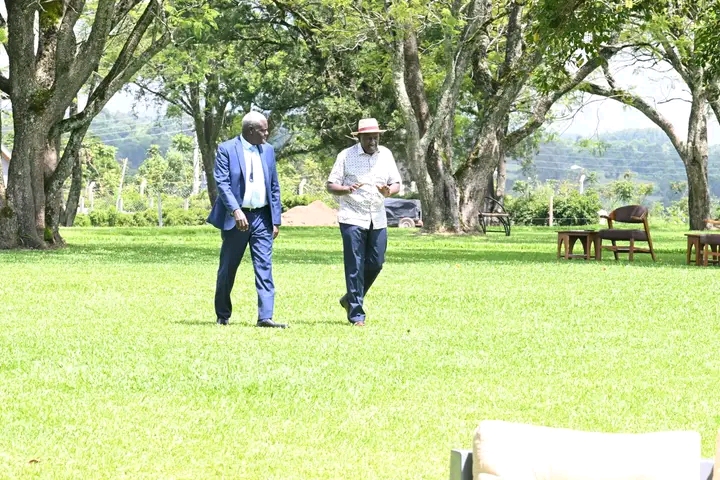
President William Ruto meeting with outgoing AUC chairman at Narok today.
By I.P. reporter.
Nairobi,Kenya.
The African Union Commission (AUC) Chairpersonship race is shaping up to be a critical juncture for Africa’s political future, with Raila Odinga emerging as a strong contender.
Backed by Kenyan President William Ruto, Odinga’s campaign is built on a robust platform that seeks to redefine Africa’s role in global governance, particularly with his proposal to secure two permanent African seats on the United Nations Security Council.
This vision underscores the broader narrative of Africa’s push for greater representation in international decision-making.
Odinga’s experience as a former Prime Minister and AU envoy, coupled with his diplomatic networks, positions him as a frontrunner.
However, his competitors, Djibouti’s Mahmoud Ali Youssouf and Madagascar’s Richard Randriamandrato, are also leveraging their regional strengths and diplomatic experience to gain support.
Kenya’s Calculated Moves.
President Ruto’s meeting with outgoing AUC Chair Moussa Faki in Narok County is widely seen as a strategic move to ensure Odinga’s campaign gains traction.
By aligning with Faki, Ruto likely aims to secure continuity in ongoing AU reforms, which could be beneficial for Odinga if he assumes office.
This synergy suggests a coordinated Kenyan strategy to dominate AU politics and influence the continent’s future trajectory.
Furthermore, Ruto’s vocal endorsement of Odinga signals a rare show of unity in Kenya’s otherwise polarized political landscape.
This alignment could also serve as a blueprint for African nations to rally behind shared interests and candidates who represent broader continental aspirations.
Competitors’ Positioning.
While Odinga’s candidacy has gained significant attention, his competitors bring unique strengths to the table.
Djibouti’s Mahmoud Ali Youssouf, as a seasoned diplomat, may appeal to nations prioritizing stability and incremental progress within the AU framework.
On the other hand, Madagascar’s Richard Randriamandrato’s economic expertise could resonate with member states seeking transformative economic reforms.
However, both Youssouf and Randriamandrato face challenges in matching Odinga’s pan-African appeal and policy agenda.
Djibouti’s smaller geopolitical footprint and Madagascar’s relative isolation from continental politics may limit their ability to build coalitions.
Impact on AU Reforms.
The AUC election will likely shape the pace and direction of AU reforms.
Odinga’s vision for structural changes, including Africa’s representation at the UN, aligns with broader calls for the AU to become more assertive on the global stage.
If elected, Odinga’s leadership could mark a shift toward a more united and ambitious African Union.
Conclusion.
As the race intensifies, Odinga’s campaign reflects Kenya’s proactive role in continental politics.
His potential election as AUC Chairperson could cement Kenya’s influence within the AU and accelerate efforts to amplify Africa’s voice in global governance.
However, success hinges on his ability to navigate the intricate web of AU politics and secure the trust and votes of member states.
This contest is more than a race for a leadership position; it is a battle for Africa’s political future and its place in the global order.
Ends.