


By IP Editorial desk
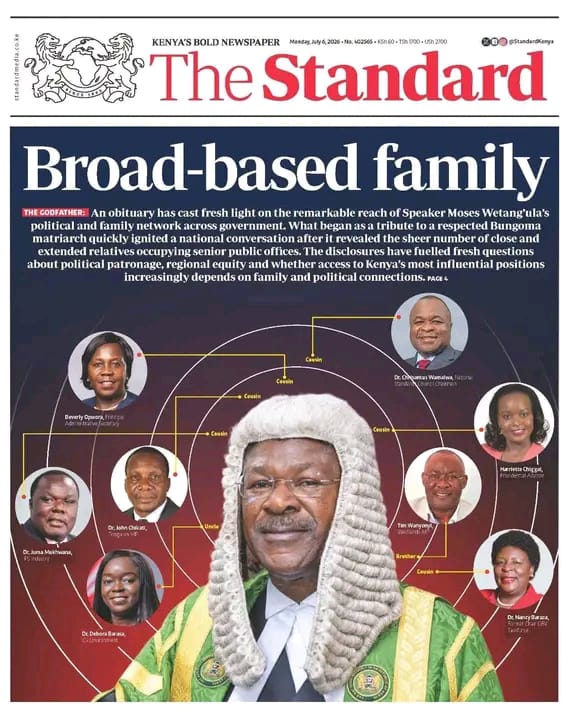
The recent, targeted media fixation on mapping the familial relationships of Kenyan officials—such as National Assembly Speaker Moses Wetang’ula—has weaponised personal genealogies.
This focus replaces necessary, evidence-based legal scrutiny with sensational, selective outrage.
True meritocracy dictates that public service appointments be judged on competence and legal compliance rather than the number of relatives in office.
This historical reality in Kenya has long seen leadership anchored by influential political families, from the Kenyatta and Moi eras to the Kibaki and Uhuru administrations.
Crucially, oversight institutions like the Public Service Commission (PSC), the Ethics and Anti-Corruption Commission (EACC) and other bodies advocating for ethics and equity have never condemned the named individuals as incompetent or unqualified for their respective roles.
Under Section 57 of the Public Service Commission Act and Article 232 of the Constitution, recruitment processes are strictly anchored on competitive merit, fair competition and equal opportunities.
Because these independent regulatory agencies have fully vetted, cleared and maintained the legitimacy of these professionals, it confirms that their career placements successfully met the stringent statutory requirements and the integrity thresholds of Chapter Six.
However, the Linda Mwananchi movement strongly rejects this institutional defense, viewing the concentration of positions within a single family as a systemic failure of equity.
Movement leaders argue that while individual appointees may technically hold papers, the sheer volume of relatives landing lucrative state jobs systematically locks out equally qualified, ordinary young Kenyans who lack political connections.
To the youth-centric movement, relying on technical clearances by the PSC ignores the foundational spirit of inclusivity, turning public service recruitment into a closed-loop system where political patronage dictates upward mobility.
The Myth of the Virgin Appointment:
A Historical Reality
To pretend that family networks in government are a novel invention unique to the current administration is to ignore the foundational blueprint of the Kenyan state.
Since independence, successive administrations have consistently integrated qualified family members into public service:
The Kenyatta Era: Independent Kenya’s first president, Jomo Kenyatta, established a clear precedent of balancing statecraft with trusted kin.
His daughter, Margaret Kenyatta, was appointed as Kenya’s Ambassador to the United Nations and later became the Mayor of Nairobi.
His son, Peter Muigai Kenyatta, served as an Assistant Minister for Foreign Affairs.
Decades later, retired President Uhuru Kenyatta continued the tradition by appointing his nephew, Jomo Gecaga, as his powerful Private Secretary, and his niece, Nana Gecaga, as the Chief Executive Officer of the Kenyatta International Convention Centre (KICC).
The Moi Administration: President Daniel arap Moi systematically elevated trusted familial and close communal networks into the echelons of state corporations and elective politics.
His long-term ally and ‘brother inlaw’ Moses Mudavadi, held influential Cabinet slots, paving a natural career trajectory for his son, Musalia Mudavadi, to enter the Cabinet at a young age and eventually rise to Vice-President.
Similarly, the offspring of major Moi-era stalwarts, such as Jeremiah Nyagah’s sons (Joe and Norman Nyagah) and Dr. Zachary Onyonka’s son (Richard Onyonka), seamlessly transitioned into high-profile legislative and executive roles through their inherited political capital.
The Kibaki Governance: While Mwai Kibaki maintained a reputation for bureaucratic distance, his administration heavily relied on trusted family networks to execute key state policies.
Close relatives and immediate family allies quietly but firmly occupied influential behind-the-scenes positions within strategic advisory boards, financial regulators and private-sector partnerships driving the government’s economic agenda.
The Three Questions for the Critics
If the independent regulatory bodies tasked with upholding equity and competitiveness see no legal fault in these appointments, the current public uproar reveals itself as selective political warfare.
Critics seeking to weaponise public sentiment must provide objective answers to three critical questions:
Which specific appointment breached the law?
If every recruitment process followed the laid-down statutory requirements of the PSC Act, then a shared surname is entirely irrelevant.
Which individual lacks the required qualifications?
If the individuals possess the necessary degrees, experience, and professional clearance, denying them employment based on their lineage is a violation of their constitutional right to fair labor practices.
Will every Kenyan leader be subjected to the same standard?
If the media and the opposition intend to audit family trees, they must uniformly catalog the relatives of every governor, senator,MP and opposition leader currently serving in national and county governments or admit this principle is reserved for selective outrage.
Ends.



