


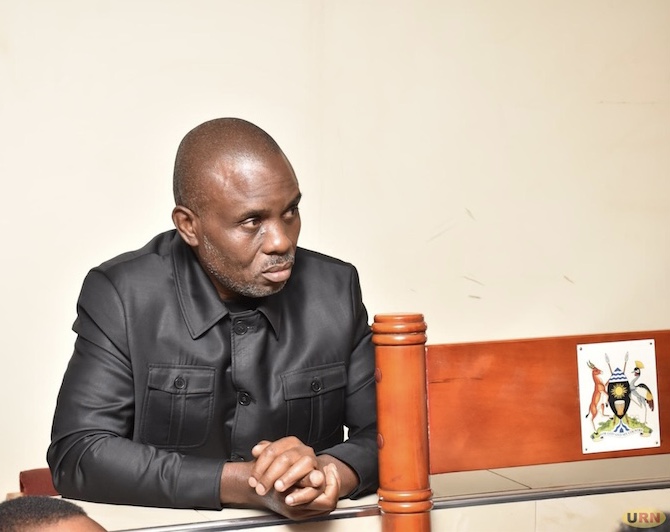
Ugandan Lawyer and politician Erias Lukwago in the dock….Photo/IP
By Peter Marango Mwibanda, Political and Legal Analyst
The prosecution of Ugandan opposition lawyer Erias Lukwago on charges of misprision of treason has reignited a longstanding debate within criminal jurisprudence.
Can a lawyer be criminally liable for failing to disclose information allegedly obtained from a client, particularly in politically charged circumstances?
The case has attracted attention beyond Uganda’s borders because it sits at the intersection of criminal law, constitutional rights, legal ethics, and political accountability.
It raises fundamental questions about the limits of state power and the independence of the legal profession in democratic societies.
Misprision of treason is a legal doctrine rooted in English common law.
Traditionally, it refers to the deliberate concealment of knowledge that another person intends to commit or has committed treason.
Unlike treason itself, the offence does not require active participation in the alleged plot.
Rather, the prosecution must establish that the accused had actual knowledge of treasonous conduct and intentionally failed to report it to the authorities.
At first glance, the doctrine appears straightforward. A state has a legitimate interest in protecting itself from threats against its constitutional order.
Citizens who become aware of attempts to overthrow the government are generally expected to assist law enforcement agencies.
However, criminal jurisprudence demands more than mere suspicion. The burden rests upon the prosecution to prove knowledge, intent and deliberate concealment beyond a reasonable doubt.
In politically sensitive prosecutions, courts are often required to exercise heightened vigilance to ensure that criminal law is not transformed into a weapon against dissent.
The Lukwago case presents an even more complex challenge because he is not merely a private citizen.
He is a practicing advocate and a prominent opposition figure representing veteran opposition leader Kizza Besigye.
Across democratic jurisdictions, the relationship between lawyer and client is protected by the doctrine of legal professional privilege.
This principle exists not to shield wrongdoing but to ensure that every accused person can communicate freely with counsel without fear that confidential communications will later become evidence against them.
Legal scholars argue that weakening this protection could have far-reaching consequences.
If defence lawyers risk prosecution for information obtained during representation, the right to legal counsel may become meaningless.
Clients would be reluctant to speak openly, and advocates could find themselves serving two masters: their clients and the state.
History offers numerous examples where offences related to national security have been invoked during periods of political tension.
Governments often justify such measures as necessary for public safety, while critics view them as instruments for silencing opposition voices.
This tension is not unique to Uganda. Similar debates have emerged in jurisdictions ranging from the United Kingdom and South Africa to the United States and Kenya, where courts have consistently emphasized that national security concerns must be balanced against constitutional liberties and due process guarantees.
The central legal question in the Lukwago matter is therefore not whether treason is a serious offence.
It unquestionably is. The more difficult question is whether the prosecution can establish, through credible and admissible evidence, that Lukwago possessed actual knowledge of a treasonous scheme and intentionally concealed that knowledge outside the protected boundaries of legal representation.
Equally important is the broader constitutional question.
If lawyers can be prosecuted for their proximity to politically controversial clients, what effect might that have on the administration of justice?
Could it discourage advocates from representing opposition leaders, activists, journalists or government critics?
Criminal jurisprudence has long recognized that justice must not only be done but must also be seen to be done.
Where prosecutions involve opposition politicians and their legal teams, public confidence depends upon transparency, fairness and strict adherence to the rule of law.
Ultimately, the Lukwago case will be judged not merely on the facts presented in court but also on what it reveals about the relationship between state security and individual liberty.
For legal scholars, it offers a critical test of the boundaries of criminal liability.
For citizens, it is a reminder that the strength of a democracy is measured not by how it treats the popular and powerful, but by how it protects the rights of those who challenge authority.
As the proceedings unfold, the case is likely to become a landmark reference in African constitutional law, legal ethics and criminal jurisprudence.
The outcome may shape future debates on the independence of lawyers, the protection of political freedoms and the enduring struggle to balance security with justice.
This version frames the issue as a broader jurisprudential and constitutional debate, making it appealing to legal scholars, policymakers, lawyers, human rights advocates and general readers alike.
Ends.



