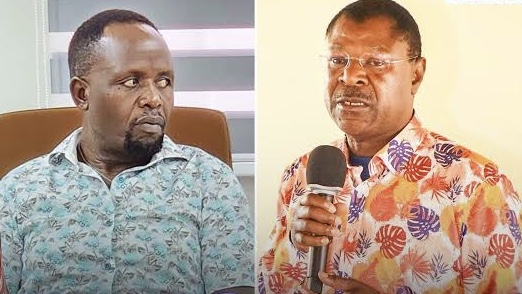
Trans Nzoia Governor George Natembeya and Speaker of the National Assembly Dr Moses Wetang’ula….Photo/IP
By Peter Marango Mwibanda | Political and Legal Analyst
BUNGOMA, Kenya (AP)
As Kenya edges closer to the 2027 General Election, the political landscape of Western Kenya is undergoing a dramatic transformation that could redefine the region’s influence for decades to come.
At the center of the unfolding political chessboard is National Assembly Speaker Moses Wetang’ula, whose recent political activities in Trans Nzoia County have raised eyebrows across the region.
Wetang’ula’s apparent endorsement of former Health Cabinet Secretary Susan Nakhumicha for the Trans Nzoia governorship has generated intense debate.
While the Speaker appears keen on shaping the county’s political future, many observers are asking why he has remained silent about Bungoma, his political birthplace and the traditional bedrock of Ford Kenya.
The silence is particularly striking because his younger brother, Timothy Wanyonyi, has publicly expressed interest in contesting the Bungoma governorship.
Yet beneath the surface lies a much bigger story.
Western Kenya is witnessing the erosion of old political loyalties and the emergence of new centers of power.
The once-dominant Ford Kenya and ODM structures are facing unprecedented pressure from a new generation of politicians who argue that the region has historically settled for symbolic representation rather than meaningful economic and political bargaining at the national level.
The weakening of ODM following the political realignments involving opposition leader Raila Odinga has created a vacuum that ambitious political actors are rushing to fill.
Among the biggest beneficiaries is Eugene Wamalwa and his DAP-Kenya party, which has steadily positioned itself as an alternative political vehicle for a region increasingly dissatisfied with traditional political establishments.
DAP-Kenya’s rise has coincided with the growing popularity of Trans Nzoia Governor George Natembeya and his now-famous Tawe Movement.
Natembeya’s blunt criticism of corruption, elite politics, poverty and underdevelopment has resonated strongly with young voters across Western Kenya.
His message that leaders should focus on empowering ordinary citizens rather than enriching political cartels has transformed him into one of the region’s most influential political voices.
The Tawe Movement has unsettled established political figures because it challenges a system that many voters believe has failed to deliver tangible benefits despite decades of political loyalty.
For Wetang’ula and Ford Kenya, this presents a significant challenge.
While the Speaker occupies one of the most powerful constitutional offices in Kenya, many residents of Bungoma continue to question whether the county has benefited proportionately from his national stature.
Despite producing Cabinet ministers, senators, governors, party leaders and now the Speaker of the National Assembly, Bungoma remains among Kenya’s economically challenged counties, grappling with youth unemployment, poor infrastructure and limited industrial investment.
The growing frustration has created fertile ground for alternative political movements.
Meanwhile, Trans Nzoia presents its own unique political equation.
Although the county is cosmopolitan and home to diverse ethnic communities, electoral history since the advent of devolution reveals a consistent pattern.
Every governor elected in Trans Nzoia has come from the Luhya community, reflecting the demographic realities of the county’s voting population.
This reality makes the governorship race more than a county contest. It is increasingly becoming a battleground for determining which political force will dominate the broader Western Kenya region heading into 2027.
The contest is shaping up as a clash between established political structures represented by Ford Kenya and UDA, and emerging formations such as DAP-Kenya and the Tawe Movement.
The political mood on the ground suggests that voters, particularly young people, are no longer impressed by titles, seniority or historical political achievements.
Instead, they are demanding measurable development outcomes, economic opportunities and stronger representation in national power-sharing arrangements.
For Wetang’ula, the challenge is no longer simply retaining Ford Kenya’s traditional strongholds.
It is convincing a restless electorate that the party still represents the future rather than the past.
As DAP-Kenya expands its footprint, Natembeya’s influence grows and younger politicians rally behind new political formations, Western Kenya may be approaching its most consequential political realignment since the return of multiparty democracy.
The question facing the region is no longer who controls the old political order.
It is who will define the next one.
And as 2027 draws closer, the ground beneath Western Kenya’s political establishment appears increasingly unstable.
When the ballots are finally cast, the outcome may not only determine who governs Bungoma and Trans Nzoia, but also who speaks for Western Kenya at the national table for years to come.
This version presents a sharper geopolitical analysis, examining the Ford Kenya–DAP Kenya–Tawe Movement triangle and the broader struggle for political supremacy in Western Kenya ahead of 2027.
Ends.