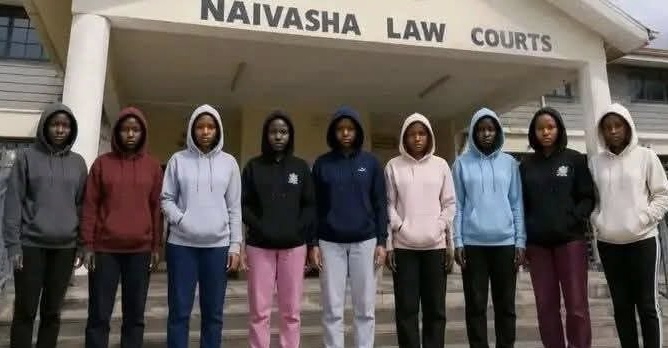
The nine female students accused of arson at Utumishi Girls School paraded at Naivasha Law courts …..Photo/IP
By Peter Mwibanda
NAIROBI, Kenya
The decision to place nine female students of Utumishi Girls School Academy in custody following the tragic dormitory fire that claimed 16 lives has sparked intense public debate.
While investigations are ongoing, any attempt by prosecutors to pursue murder charges is likely to encounter significant legal and constitutional challenges.
First, the girls are minors. Under the provisions of the Kenyan Children Act and the Constitution, children in conflict with the law enjoy special protection and treatment.
The justice system is required to prioritize the best interests of the child, rehabilitation and reintegration rather than punitive measures.
Courts are generally reluctant to subject minors to harsh criminal processes without compelling evidence.
Secondly, should the Director of Public Prosecutions Mr Ingonga charge the students with murder, the law would require mental assessment examinations before plea-taking can proceed.
Such assessments are critical in determining whether the accused persons are fit to stand trial and understand the proceedings. This process may prolong investigations and delay prosecution.
The evidentiary burden facing investigators may also be substantial. Murder cases require proof beyond reasonable doubt, including evidence of intent or malice aforethought.
Establishing criminal responsibility in a school fire involving minors may prove legally complex, particularly where multiple factors could have contributed to the tragedy.
Another potential legal hurdle concerns the reported existence of CCTV cameras installed in dormitory sleeping areas.
If confirmed, this raises serious constitutional questions regarding the right to privacy under Article 31 of the Constitution.
Dormitories are spaces where children have a reasonable expectation of privacy. The placement of surveillance cameras in sleeping quarters could be challenged as an unlawful intrusion into the private lives of minors.
Further, the collection, storage, and use of such footage may invite scrutiny under the Data Protection Act.
Defence lawyers could argue that evidence obtained through unlawful or unconstitutional surveillance should be excluded or accorded limited evidentiary value.
Ultimately, while the public demands accountability, prosecutors must navigate a delicate legal landscape involving children’s rights, constitutional safeguards, evidentiary standards and data protection concerns.
The outcome of the Utumishi Academy tragedy may ultimately test the balance between justice for victims and the protection of fundamental rights.
Ends.