


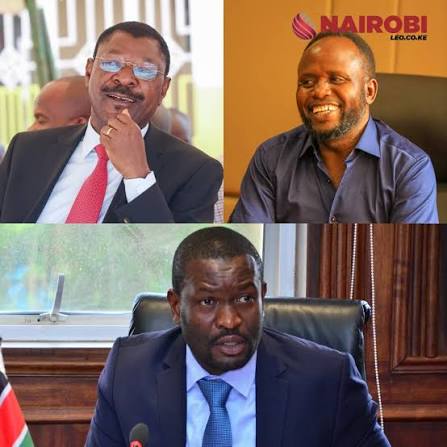
Nairobi Senator Edwin Sifuna and Trans Nzoia Governor George Natembeya are holding a political collabo to edge out Speaker Dr Moses Wetang’ula from the 2032 succession plan……Photo/IP
WESTERN KENYA SUCCESSION
By Micah Sali
NAIROBI, Kenya
Internal friction in the ‘Mulembe nation’ is shaking Ford Kenya, one of the country’s oldest active political organizations, even as supporters position National Assembly Speaker Dr. Moses Wetangula as a premier successor to President William Ruto for the 2032 elections.
Political analyst Philip Wanyonyi Wekesa praised Wetangula for resisting pressure to dissolve Ford Kenya into the ruling United Democratic Alliance (UDA).
He contrasted the move with the Musalia Mudavadi-led Amani National Congress (ANC), which folded into the ruling party.
“All political jostling will end next year after the general election. The 2032 political journey will commence from there. How will Wetang’ula run for the Presidency without a party?” Wekesa said.
Known by its slogan “Haki, Ukweli na Usawa” (Justice, Truth, and Equality), Ford Kenya maintains a powerful regional stronghold in Western Kenya while operating on a national scale.
However, Wetangula’s efforts to consolidate the Western Kenya voting bloc behind the current administration face aggressive local pushback.
The resistance is anchored by a progressive generational takeover campaign led by Nairobi Senator Edwin Sifuna and Trans Nzoia Governor George Natembeya.
Representing a unified opposition front, Sifuna and Natembeya have engaged in fierce supremacy battles with Wetangula.
They reject his strategy of waiting until 2032 to field a leader from the region, complicating Ford Kenya’s strategy to serve as the exclusive pathway to the State House.
The escalating rivalry includes sharp public blowouts.
Sifuna recently blasted Wetangula over the unconstitutional suspension of opposition lawmakers, declaring that “Wetangula’s power begins and ends within the walls of Parliament.”
Additionally, Natembeya has deployed his grassroots “Tawe” (No) movement to directly challenge Ford Kenya’s long-standing hegemony over the Western region’s electorate.
Wekesa noted that the true source of the friction is not the immediate future, but the long-term succession matrix.”
Wetang’ula is facing trouble not because of 2027 Ruto re-election but because of the 2032 succession wars,” Wekesa added. “He has the affluence and connections to bring down the opposition candidates. That’s why they have to break his wings using his own community members who are pretenders to the throne.”
Kenya Kwanza allies have frequently labeled Sifuna and Natembeya as political proxies sponsored by external political factions—specifically disgruntled Mt. Kenya leaders—seeking to fracture the Western voting bloc.
Wekesa stated that those opposed to Wetang’ula must first remove what he called “the veil” of working for outsiders.
”They should not be puppets and allow Gachagua and Uhuru to direct their campaigns,” Wekesa said. “The Mulembe community will treat them as traitors pulling down their own to hand over the seat to ‘outsiders’.”
The narrative took a definitive turn on Wednesday, May 20, 2026, when Sifuna, leading the Linda Mwananchi opposition faction and Natembeya held a high-profile political strategy meeting at a Nairobi hotel.
Accompanied by Western region MPs like Godfrey Osotsi and Jack Wamboka, the leaders officially unified their efforts to bypass Wetangula entirely and build an independent Western front ahead of the upcoming general election.
“We are tired of our community being negotiated for like commodities in the marketplace for individual survival,” Sifuna declared after the strategy session. “If our senior leaders cannot demand the top seat now in 2027, they must step aside and let a new generation take the lead.”
Natembeya echoed these sentiments, asserting that the political awakening in Western Kenya is unstoppable.
“Our journey is about liberation from old-guard patronage. We are not anyone’s project; we are the voice of a community that refuses to wait for empty promises in 2032.”
Regional Reactions & The Battle of Blueprints
The Nairobi meeting has triggered sharp, polarized reactions across the Western region’s political landscape.
Inside President William Ruto’s inner circle, there is strong conviction that Wetangula remains the safest pair of hands for the Bottom-Up economic agenda.
Insiders within Kenya Kwanza state that Wetangula has the unique capacity to seamlessly transition and safeguard Ruto’s multi-billion development projects after 2032.
This stands in stark contrast to Sifuna, whom the ruling camp views as an obstructionist determined to oppose and dismantle all policy gains embedded in the Kenya Kwanza blueprint.
Furthermore, Wetangula’s supporters firmly believe that Sifuna is being used as a pawn by shrewd Mt. Kenya political brokers.
According to this faction, these external brokers are terrified of Wetangula’s rising national profile and are actively funding local “pretenders to the throne” to clip the Speaker’s wings from within his own backyard.
However, grassroots voices in Bungoma,TransNzoia,Vihiga,Busia and Kakamega are deeply divided.
Local youth groups have expressed exhaustion with the “wait for 2032” rhetoric, applauding the Sifuna-Natembeya axis for introducing a long-overdue conversation on immediate economic accountability.
Conversely, Luhya Council of Elders representatives have cautioned the younger politicians against destroying Wetangula’s hard-earned national machinery, warning that fracturing the region’s top leadership will only benefit “outsiders”.
Wetangula’s Greatest Weapons:
Geopolitics & Affluence
Despite the aggressive local pushback, political strategists point out that Wetangula holds a formidable advantage that his younger rivals cannot easily match.
His twin pillars of power remain mastery of regional geopolitics and deep financial affluence.
With decades of experience traversing Kenya’s diplomatic and state architecture—having served as the late President Moi’s lawyer,Foreign Affairs Minister, Senate Minority Leader and now head of the legislature—Wetangula possesses an intricate understanding of how power is brokered at the highest level.
His vast network of national connections, for more than 30 years at the national platform combined with deep campaign resources, allows him to command immense institutional loyalty and influence local networks in ways that independent opposition campaigns struggle to match.
The Quiet Architect:
Musalia Mudavadi’s Strategic Balance
While Wetangula absorbs the direct political heat from the Sifuna-Natembeya alliance, Prime Cabinet Secretary Musalia Mudavadi continues to play a quiet, calculated game that heavily complicates the Western matrix.
The Shielding Mechanism:
Unlike Wetangula, who has preserved Ford Kenya as an independent vehicle, Mudavadi chose to fold his ANC party directly into UDA.
This move effectively anchored Mudavadi as an irreplaceable centerpiece of the Kenya Kwanza core, insulating him from party-level rebellions while forcing him to operate strictly within the administration’s civil service architecture.
The Dynamic Duo Strategy:
Behind closed doors, Mudavadi and Wetangula maintain a highly synchronized political handshake.
Mudavadi serves as the polished, diplomatic face of the region’s interests nationally, while Wetangula acts as the aggressive local “muscle” to maintain grassroots discipline.
The 2027 Referendum Variable:
Mudavadi has subtly begun floating proposals for structural reforms, including floating the idea of a 2027 constitutional referendum.
Analysts believe this is Mudavadi’s long-term play to expand executive offices, creating a fallback mechanism to absorb both himself and Wetangula at the highest levels of governance, even if the Sifuna-Natembeya axis breaks their traditional regional strongholds.
The Shadow over the Mountain: Mt. Kenya’s Electoral Arithmetic
The desperation of the ruling alliance to guard Wetangula’s Western turf is directly fueled by a looming crisis in the Mt. Kenya voting bloc, which remains the ultimate numerical prize in Kenyan politics.
The Baseline:
Mt. Kenya accounts for a massive 5.7 million to 6 million registered voters. In 2022, it delivered a commanding 3 million votes straight to William Ruto’s basket, making up roughly 43% of his entire national victory.
The Fracture:
With shifting dynamics, internal divisions and rising economic discontent across Central Kenya, the region’s previous monolithic alignment behind the President has severely fractured.
Projections indicate that the opposition could siphon up to 55% of the Mountain’s vote away from the administration.
The Western Substitute:
This exact vulnerability elevates the 2.85 million Western Kenya voters into the ultimate fallback shelter for the administration.
To survive a Mt. Kenya deficit, Ruto fundamentally depends on Wetangula and Mudavadi to deliver an absolute minimum of 55% to 60% of the Western bloc (roughly 1.5 million votes).
The Mathematical Weight of Western Kenya
The Western Kenya voting bloc (comprising the core counties of Kakamega, Bungoma, Busia and Vihiga, alongside the politically tied Trans Nzoia county) commands a massive collective baseline of over 2.85 million registered voters.
Estimated Voter Breakdown by County
Kakamega: ~1.08 million voters (The heavyweight anchors the region and has officially crossed the 1M mark).
Bungoma: ~640,000 voters (The absolute political fortress of Speaker Moses Wetangula).
Trans Nzoia: ~440,000 voters (The battlefield of both Wetang’ula and Governor George Natembeya).
Busia: ~390,000 voters.
Vihiga: ~290,000 voters.
Scenario Analysis:
How a Split Affects 2027
To win the presidency in Kenya, a candidate must secure 50% + 1 vote of the national total and at least 25% of the votes in 24 counties.
A mathematical split in Western Kenya alters the entire national equation.The Death of the 50% + 1 First-Round Victory:
In 2022, President William Ruto scraped a first-round victory by a razor-thin margin of just over 200,000 votes nationally.
If Wetangula and Musalia Mudavadi fail to deliver Western Kenya as a uniform, cohesive block, Ruto cannot easily absorb losses from a volatile Mt. Kenya region.
If the Sifuna-Natembeya axis successfully peels away 40% to 45% of the 2.85 million Western votes (roughly 1.1 to 1.2 million votes) into the opposition, it mathematically triggers a presidential run-off.
The Isolation of Bungoma County:
Wetangula’s structural hold is strongest in Bungoma (~640,000 voters).
If Sifuna and Natembeya run away with Trans Nzoia, Busia, Vihiga and the youth vote of Kakamega, Wetangula becomes a “Bungoma kingpin” rather than a “Western kingpin.”
His bargaining leverage within Kenya Kwanza shrinks if his arithmetic contribution is isolated to just one out of five counties.
The Gen-Z and Youth Voter Disruption:
A massive portion of the new voters registered ahead of 2027 are young, less loyal to traditional ethnic kingpins and highly sensitive to economic hardships.
Sifuna’s Linda Mwananchi and Natembeya’s Tawe movement are trying to appeal directly to this demographic.
By capturing the youth vote, they suppress the voter turnout or conversion rate that Wetangula needs to fulfill his commitments to the ruling alliance.



