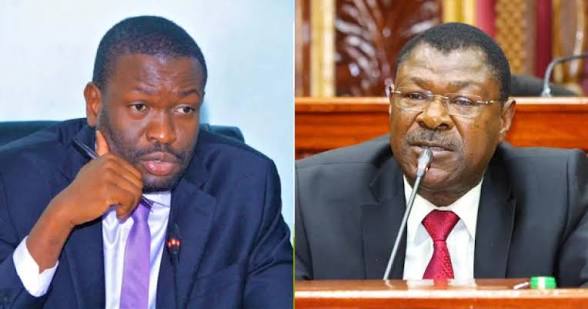
Luhyia leaders Nairobi Senator Edwin Sifuna and Speaker of the National Assembly Dr Moses Wetang’ula…Photo/IP
By Peter Marango Mwibanda | Political and Legal Analyst | IntellectualsPost
NAIROBI, Kenya (IP)
Every five years, Kenya’s political class makes a pilgrimage west.
They travel to the fertile counties of Bungoma, Kakamega, Busia, Vihiga and Trans Nzoia carrying promises, handshakes and carefully rehearsed speeches.
They speak of inclusion, equity and national unity. They invoke the power of the “Mulembe Nation” — the collective political identity of the Luhya community, Kenya’s second-largest ethnic bloc and arguably its most politically courted constituency.
Then elections end and so does the romance.
For decades, the Luhya nation has remained one of Kenya’s most politically significant yet strategically underutilized voting blocs — large enough to influence presidential outcomes, but fragmented enough to deny itself the leverage that comes with numbers.
That paradox has defined Kenyan politics for generations.
The question now is whether a younger, more assertive crop of leaders — among them Edwin Sifuna and George Natembeya — can disrupt that cycle and transform demographic strength into lasting political power.
A giant that rarely acts like one
Numerically, the Luhya vote is formidable.
Spread across western Kenya and the diaspora, estimates consistently place the community among the country’s largest voting blocs — enough to decisively swing national elections.
Yet unlike the Mount Kenya voting bloc or the Kalenjin political bloc, the Luhya vote has historically lacked cohesion.
Its internal diversity — made up of multiple sub-communities including Bukusu, Maragoli, Idakho, Isukha, Wanga, Samia and others — has often been weaponized by national politicians.
Divide. Court selectively. Promise inclusion. Move on.
That formula has worked for decades.
It has kept the community relevant enough to matter — but divided enough not to demand more.
Who benefits from a divided Luhya nation?The answer is simple: everyone outside it.
Kenyan presidential politics thrives on coalition arithmetic.
A united Luhya voting bloc would command extraordinary bargaining power: deputy presidency, cabinet dominance, development guarantees and stronger national agenda-setting authority.
A fragmented bloc becomes politically cheaper.
Candidates can buy influence with symbolic appointments, temporary alliances and regional kingmakers rather than structural investment.
That has produced a painful contradiction: a politically loud region that remains economically underdeveloped.
Roads lag,Youth unemployment remains high agricultural modernization is uneven and ndustrial growth has underperformed.
Despite producing some of Kenya’s most educated citizens, the region continues exporting talent while importing political disappointment.That is what many younger voters now call political exploitation.
Enter the disruptors
That frustration is creating space for new leadership.
George Natembeya has emerged as one of the most outspoken regional voices.
His “Tawe” movement — loosely translated as “enough is enough” — is not merely political branding. It is a rebellion against inherited loyalty politics.
His appeal is blunt: stop donating votes without extracting value.His message resonates especially among youth.
Then there is Nairobi Senator and ODM secretary general Edwin Sifuna — articulate, combative, nationally visible and increasingly viewed as part of a younger political class less willing to accept old ethnic scripts.
Sifuna represents something different: a Luhya politician who is not confined by regional politics but influential within national political discourse.
Together, the two politucians symbolize two emerging tendencies:
Internal regional awakening and external national repositioning.
That combination matters but can momentum survive Kenya’s political machine?That is the harder question.
Kenyan politics has a long history of absorbing reformers.Today’s disruptor often becomes tomorrow’s insider.
Movements lose energy when personalities replace ideology.
The Luhya community’s biggest weakness has never been lack of leaders — it has been too many leaders pulling in different directions.
Without a unifying political philosophy, new faces alone cannot change the status quo.
For real transformation, the region would need a common economic agenda,a negotiated power strategy,disciplined voter education and leaders willing to subordinate ego to collective bargaining.
That is difficult in a political culture built on personal ambition.
The Gen Z factor
This may be the wildcard.Kenya’s younger voters are increasingly impatient with tribal mobilization.
They want service delivery,jobs,sound infrastructure, digital inclusion ,transparency and accountability.Their politics is less emotional and more transactional.
In western Kenya, that generational shift is becoming visible.Young Luhyas are asking a question older generations rarely asked loudly enough:
“What exactly have we gained from our loyalty?”That question is dangerous — for old political elites such as Speaker Wetang’ula,Prime CS Musalia Mudavadi,CS Wycliffe Oparanya,COTU leader Francis Atwoli and elected western Kenya governors.Its potentially revolutionary.
If Natembeya sustains grassroots momentum and Sifuna expands national credibility, the Luhya political story could change dramatically by 2027.
Why?its not because they become kings but because they help the community think differently.
The greatest transformation may not be electoral nor psychological but transformation from victimhood to leverage,fragmentation to strategy and being courted to becoming indispensable.
For too long, Kenya’s Luhya nation has been treated like political rainfall — seasonal, useful and taken for granted.
Demographics are power only when organized,votes are influence only when negotiated and identity is meaningful only when translated into outcomes.
The old political formula ( praise the Luhyas before elections, forget them after ), may finally be nearing its expiry date.
If this new generation gets it right, the next chapter of Kenyan politics may not be written in Nairobi.
It may be written in western Kenya and this political season the Luhya nation may finally read from its own script.