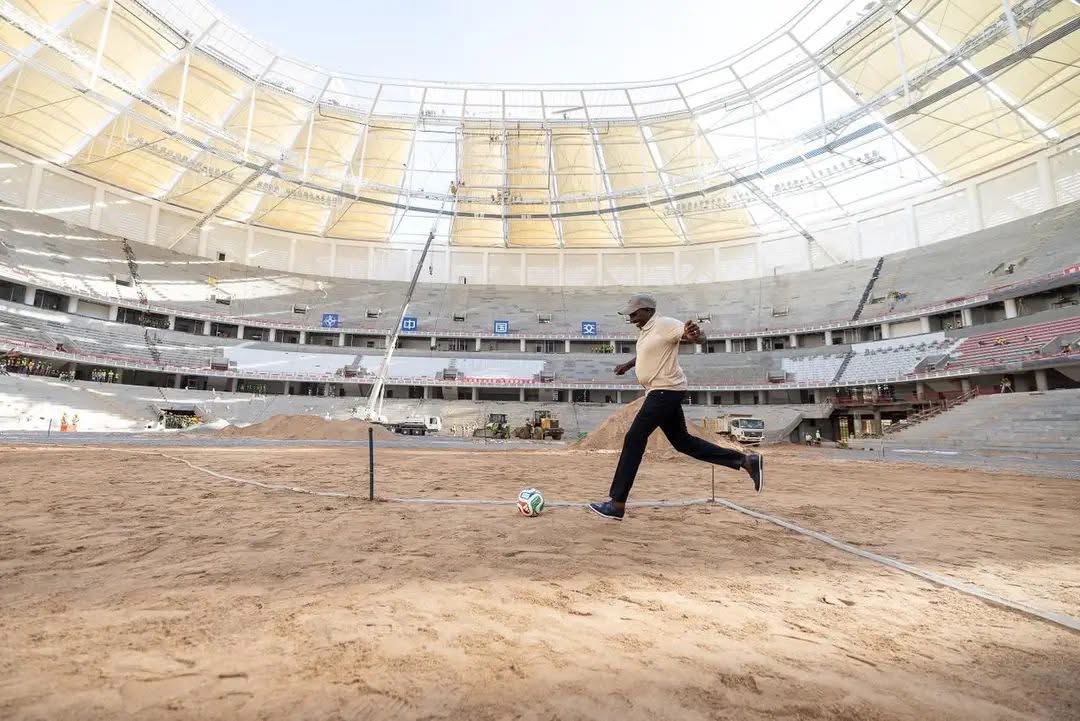
President William Ruto at Talanta stadium on Saturday….Photo /courtesy
NAIROBI (IP)
President William Ruto on Saturday inspected construction progress at the 60,000-seat Talanta Sports City Stadium in Nairobi, expressing satisfaction with work on the facility expected to host matches during the 2027 Africa Cup of Nations (AFCON).
The stadium, under construction at Jamhuri Grounds along Ngong Road, is one of Kenya’s flagship infrastructure projects tied to the continental tournament co-hosted with Uganda and Tanzania.
Officials say the project is targeting completion by early 2026 to allow testing ahead of major tournaments.
Costs: The Price Tag (Depending on Which Calculator You Use)
Government briefings place the Talanta Stadium construction cost at roughly KSh44–45 billion, funded largely through a bond-style infrastructure financing model backed by future stadium revenues.
The project is being built by China Road and Bridge Corporation and is designed as a FIFA-standard football facility forming the centerpiece of Kenya’s AFCON hosting plan.
The financing structure relies on borrowing against future earnings from events, naming rights and hospitality — a move intended to reduce immediate pressure on the national budget but potentially shifting risk to future revenues.
Some lawmakers and analysts have warned that interest and long-term repayment structures could significantly increase the overall cost over time.
Meanwhile, the broader stadium modernization program tied to AFCON preparations — including upgrades to Kasarani, Nyayo and other facilities — is projected to exceed KSh57 billion.
Railway and Transport Links: The “Arrival Experience” Plan
Beyond the stadium itself, the government is planning expanded transport connectivity, including road upgrades and rail access.
Plans include expansion of Ngong Road, new link roads connecting the complex to the Southern Bypass, and a commuter rail station expected to serve the stadium area.
The rail link is expected to connect commuter services from surrounding areas into the Nairobi central business district, easing match-day congestion.
Designs also include multiple entry gates and evacuation routes aimed at handling large match-day crowds.
Why It Matters (And Why Kenyans Are Watching Closely)
Talanta Stadium is expected to anchor Kenya’s AFCON hosting credentials while positioning Nairobi as a regional sports and entertainment hub.
The project is also being framed as a test case for market-based infrastructure financing and future mega public-private partnership projects.
If timelines hold, fans could soon arrive by commuter rail, glide through expanded highways and walk into a world-class stadium.
If timelines don’t hold, Kenyans will still arrive — just via traffic, faith, and Google Maps recalculating every three minutes.
And if the financing works perfectly, Kenya gets a modern sports hub.
If it doesn’t… future taxpayers might end up sponsoring AFCON 2027, AFCON 2037 and maybe AFCON 2057 (terms and conditions apply, interest compounded emotionally).