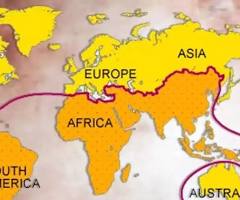
The global South….Photo/IP
By Peter Mwibanda /Intellectuals Post
NAIROBI
A quiet but consequential shift is underway in global politics, economics and diplomacy.
Power is no longer flowing in a single direction, nor is it concentrated exclusively in the traditional capitals of the Global North.
Across Africa, Asia and Latin America, the Global South is reshaping the world — and 2026 is poised to become the inflection point when that transformation moves from trend to reality.
For decades, the international system was defined by Western dominance in finance, security and agenda-setting.
Institutions created after World War II reflected that hierarchy, often marginalizing emerging economies and developing states.
Today, those structures are under unprecedented strain as countries of the Global South assert agency, diversify partnerships and challenge the old rules of engagement.
Economically, the shift is already visible and accelerating. Emerging markets are driving global growth, commanding larger shares of trade, manufacturing and consumption.
South–South cooperation has expanded rapidly, reducing dependence on traditional donors and lenders.
New development banks, regional financial mechanisms and local-currency trade arrangements are weakening the monopoly once held by Western-led systems.
Geopolitically, the Global South is no longer content with alignment by default.
Strategic non-alignment — pragmatic, interest-based and fluid — has replaced Cold War binaries.
States are hedging, bargaining and recalibrating, engaging multiple power centers rather than committing to a single bloc.
This has complicated Western diplomacy while amplifying the negotiating leverage of developing nations.
Africa’s role in this rebalancing is especially significant.
With the world’s youngest population, vast natural resources and growing political assertiveness, the continent is transitioning from a peripheral actor to a central arena of global competition and cooperation.
African states are shaping multilateral debates on climate finance, debt restructuring, global health and peace operations — often alongside partners from Asia and Latin America.
Yet the real challenge does not lie in recognizing the shift of power, but in rebuilding global systems to reflect it.
The Global South is increasingly demanding meaningful reform of the United Nations system, arguing that existing governance structures no longer correspond to contemporary realities.
Calls to reform the U.N. Security Council, rebalance voting power and strengthen the voice of developing states are no longer rhetorical; they are becoming central to diplomatic engagement.
Equally pressing is the construction of a more balanced global financial order.
Institutions that govern lending, debt resolution and development finance remain skewed toward creditor nations, often imposing constraints that limit growth and policy autonomy in the developing world.
The Global South is pushing for fairer debt frameworks, greater access to concessional finance and financial rules that prioritize development over austerity.
Trade is the third pillar of this transformation.
The demand is not merely for access to markets, but for a genuinely multipolar trading system capable of delivering global public goods — from climate resilience and food security to technology transfer and pandemic preparedness.
Regional trade blocs, industrial policy coordination and diversified supply chains are emerging as tools to reduce vulnerability and enhance collective resilience.
The turning point in 2026 will therefore be structural rather than symbolic. Demographic momentum, technological diffusion and geopolitical fatigue in the Global North are converging.
Western economies face aging populations, domestic polarization and strategic overstretch.
Meanwhile, countries in the Global South are investing in digital infrastructure, regional integration and industrial capacity, narrowing gaps once considered permanent.
Technology is accelerating this realignment.
Digital platforms, artificial intelligence and decentralized innovation have reduced entry barriers that historically favored advanced economies.
Startups in Nairobi, Bangalore and São Paulo are no longer peripheral; they are competitive, export-oriented and globally networked.
Still, the rise of the Global South is not without risk. Internal inequalities, governance deficits and climate vulnerability remain serious constraints.
The danger is that global influence expands faster than domestic institutional capacity, producing instability rather than transformation.
For the Global North, 2026 will be a moment of reckoning.
Engagement rooted in paternalism and conditionality is losing relevance.
Partnership, respect and reciprocity are becoming the new currencies of influence.
Those who resist reform risk strategic marginalization in a world they no longer singularly shape.
The Global South is not asking for permission to rise. It is demanding systems that match its weight, voice and responsibility.