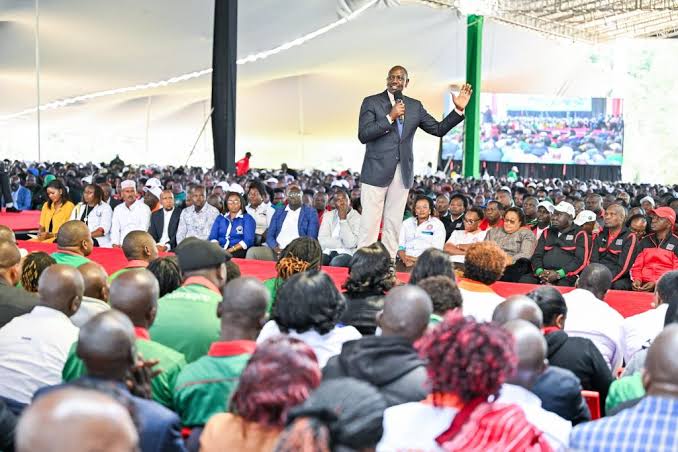
President Ruto meets teachers at statehouse last week
By peter mwibanda
NAIROBI, Kenya (IP)
President William Ruto has made sweeping promises to Kenya’s teachers, pledging sweeping reforms on housing, medical insurance, promotions and workload reduction.
For many educators and observers, the proposals are beginning to look less like policy and more like politics.
The timelines for implementation stretch far beyond the remaining years of his first term and with the 2027 election looming, doubts are growing about whether these pledges will survive a potential change in government.
During meetings with various teachers’ unions and delegations hosted at State House in recent weeks, Ruto has promised to streamline teacher promotions, improve medical coverage and expedite access to affordable housing.
However some of these “offers” are being viewed with skepticism by teachers who argue the government is merely repackaging benefits that should already be theirs under current labor agreements.
“This isn’t a gift—it’s an obligation,” said a senior official in the Kenya National Union of Teachers (KNUT), who requested anonymity to speak candidly.
“Teachers are being promised basic entitlements as though they are campaign favors. It’s insulting.”
Indeed, the push to include teachers in the government’s affordable housing scheme is seen by many as a smokescreen.
Teachers already contribute to the housing fund under the controversial Housing Levy, and unions say they were never consulted before being listed among the supposed “beneficiaries.”
Likewise, on medical insurance, teachers are covered under the Teachers Service Commission (TSC)’s existing scheme with Minet Kenya.
While there are valid complaints about service delivery, Ruto’s promise to overhaul the system is light on specifics and heavy on political theater.
“We’re being told of reforms coming in ‘five years’—but who says this administration will still be in power then?” said a high school principal in Nakuru County. “This feels more like a campaign strategy than a governance plan.”
Critics argue that these promises are being made to every delegation that visits State House in what increasingly resembles a charm offensive designed to secure electoral support rather than deliver meaningful reform.
Each announcement, often accompanied by well-publicized photo-ops and press briefings, fuels speculation that the administration is more focused on optics than outcomes.
Kenya’s economic constraints add another layer of complexity. The national budget is under pressure from mounting debt and revenue shortfalls casting further doubt on the government’s ability to fund these long-term teacher initiatives.
Moreover, the absence of legislative or regulatory frameworks to lock in these promises makes them highly vulnerable to reversal.
Should a new administration take over in 2027, there is no guarantee that Ruto’s pledges—however well-intentioned—will be honored.
For now, many educators are adopting a wait-and-see approach, wary of being used as political pawns.
“We’ve been here before,” said a veteran teacher in Kisii. “Grand pledges during campaigns, silence afterward. We’re not holding our breath this time.”
As Kenya’s teachers weigh these promises against the reality on the ground, one thing is becoming increasingly clear: without legal safeguards and immediate action, Ruto’s commitments may remain just that—commitments not change.