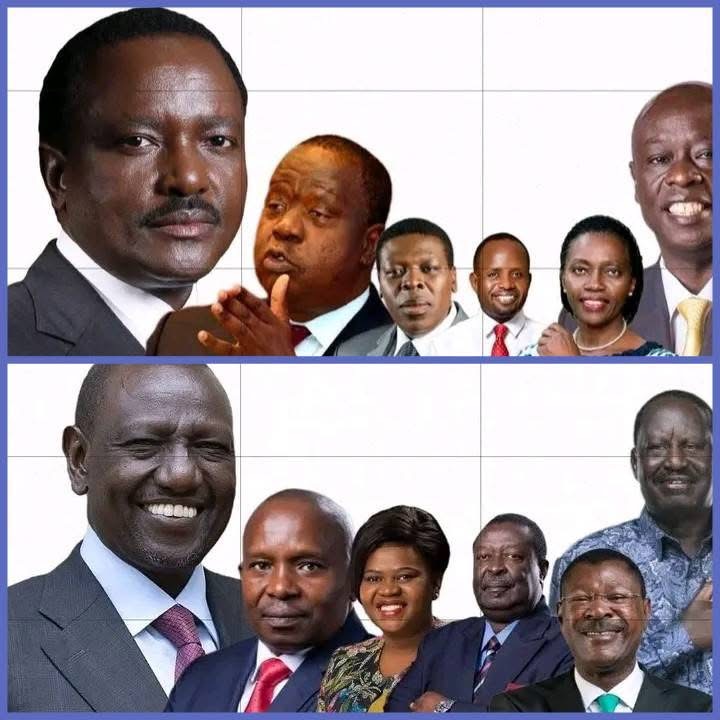
Wiper leader Kalonzo Musyoka and President Wiliam Ruto ‘s political bandwagons…….Photo/IP
By Peter Mwibanda
NAIROBI, Kenya (IP)
As the clock ticks toward Kenya’s 2027 general election, the country’s opposition forces are coalescing behind a fresh political blueprint aimed at unifying their ranks.
This wil be done by identifying joint candidates and building a formidable front to challenge President William Ruto’s Kenya Kwanza administration.
The new road map still under negotiation, is centered on five key pillars: joint nominations, integration of fringe parties, streamlined campaign financing, unified messaging and neutralizing divide-and-rule tactics allegedly employed by government-aligned actors.
Opposition leaders primarily drawn from the Azimio la Umoja coalition have begun closed-door consultations aimed at avoiding the fragmentation that contributed to their 2022 electoral loss.
However, deep-seated rivalries and emergent supremacy battles threaten to undermine the very unity they seek to foster.
Joint Candidates, Divided Loyalties
A major point of contention is the selection of joint candidates at both the presidential and grassroots levels.
While ODM leader Raila Odinga still commands significant influence, younger and ambitious leaders such as Wiper’s Kalonzo Musyoka, DAP-K’s Eugene Wamalwa, former Interior CS Fred Matiang’i and Trans Nzoia Governor George Natembeya are reportedly angling for broader roles — and possibly the top ticket.
“The coalition must find a balance between legacy and future,” said political analyst Mercy Njoroge.
“Raila’s stature is unquestionable, but 2027 is shaping up to be a transition election, whether the opposition admits it or not.”
Talks of a structured nomination process — possibly through consensus, opinion polls, or even party primaries are underway.
Yet history suggests this may be easier said than done.
In 2022, opposition factions failed to settle on joint gubernatorial and parliamentary candidates in several battleground regions allowing Ruto’s allies to secure victories with narrow margins.
Fringe Parties: Inclusion or Co-option?
Smaller parties, particularly those from marginalized regions and minority communities are demanding a seat at the table early in the planning process.
Many argue that their support is not only symbolic but also strategically essential in tipping tight regional races.
“There is a tendency to sideline smaller parties until the last minute,” said one party leader who requested anonymity.
“That model failed in 2022. We won’t play second fiddle again.”
The opposition’s leadership is reportedly considering a “zonal alliance model” that guarantees regional parties control over specific electoral zones in exchange for broader support for the presidential candidate.
The success of this approach will depend on mutual trust — a scarce commodity in Kenya’s volatile political terrain.
Campaign Cash and Message Discipline
Another critical factor is campaign financing.
With the government’s reported crackdown on opposition-aligned financiers and growing pressure from the Ethics and Anti-Corruption Commission (EACC), the coalition is seeking alternative funding models including diaspora contributions and transparent crowdfunding.
Simultaneously, the need for coherent, disciplined messaging is gaining urgency.
In 2022, conflicting narratives on economic policy, constitutional reform, and youth empowerment gave Kenya Kwanza an edge in messaging simplicity and consistency.
“There will be no room for solo projects or contradictory statements,” said a senior coalition strategist. “We must present one front, one vision and one message.”
Divide-and-Rule Tactics and Internal Sabotage
Several opposition leaders have accused the Ruto administration of deploying divide-and-rule tactics — including state appointments, covert financing and legal pressure to destabilize the opposition ahead of 2027.
“The regime is working overtime to splinter us,” Kalonzo Musyoka said during a recent rally in Machakos. “But we have learned our lesson. Unity is our only weapon.”
Still, internal distrust remains. Accusations of betrayal, backdoor deals, and political opportunism continue to simmer beneath the surface.
Without a structured conflict resolution mechanism, the coalition risks imploding before the campaign season officially begins.
Supremacy Battles and the Search for a Flagbearer
Perhaps the most delicate issue is the supremacy battle over who will carry the opposition’s presidential flag. While some leaders are pushing for a Raila “farewell candidacy,” others argue it is time for generational change — pointing to Kalonzo, Wamalwa, Matiang’i, Natembeya or even a dark horse outsider.
The coalition is expected to unveil its election strategy by mid-2026, giving candidates and parties ample time to prepare.
However, without early clarity on leadership and direction, factionalism may once again be the opposition’s Achilles’ heel.
Outlook: Lessons Learned or History Repeating?
As Kenya’s opposition redraws its strategy for 2027, the stakes could not be higher.
The path to victory demands unprecedented unity, maturity in leadership, and tactical discipline — all in short supply during past election cycles.
Whether this renewed effort represents a turning point or simply another rehearsal for disarray will depend not on rhetoric, but on the decisions made in the months ahead.
For continued coverage of Kenyan politics, elections, and democracy in East Africa, follow intellectualspost.co.ke