


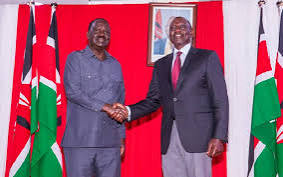
President Ruto and ODM leader Raila Odinga.
NAIROBI — The inaugural joint plenary session between lawmakers from the ruling Kenya Kwanza coalition and the opposition Orange Democratic Movement (ODM) erupted into controversy on Monday exposing cracks in the country’s fragile bipartisan cooperation.
What was intended as a closed-door meeting to rally support around the government’s 10-point development agenda quickly degenerated into a combative exchange.
President William Ruto and ODM leader Raila Odinga took turns chastising lawmakers over corruption and fiscal mismanagement.
President Ruto, addressing the meeting for the third time in as many months issued his strongest warning yet over what he called “brazen bribery” in Parliament.
“I am putting you on notice,” the president said. “This impunity will end. We will arrest and prosecute any MP caught trading their vote for money.”
The president’s remarks were echoed by senior UDA officials some of whom accused their colleagues of derailing government programs for personal gain.
The atmosphere turned tense when Odinga rose to speak criticizing the control MPs exert over the Constituency Development Fund (CDF).
“You cannot be lawmakers and contractors at the same time,” Raila said, arguing that letting MPs manage CDF funds creates a toxic environment for service delivery and accountability.
“We must remove these poisoned chalices if we want true development.”
The standoff triggered heated murmurs across party lines with some lawmakers reportedly walking out.
By mid-afternoon, the session was abruptly adjourned signaling an alarming setback for the so-called “broad-based governance” initiative launched earlier this year.
A Grand Coalition on the Brink?
Political analysts warn the incident could mark the beginning of the end for the much-touted bipartisan unity seen as crucial for national stability and the 2027 elections.
“This was more than just a disagreement,” said Dr. Linda Murage, a political scientist at the University of Nairobi. “What we witnessed was the unmasking of unresolved tensions between the executive and legislature, and between parties trying to coexist in an uneasy marriage.”
Ruto and Raila, once bitter political rivals, shocked the nation when they announced a working arrangement earlier this year.
It aimed at quelling opposition protests and building a united development front. That pact, however is now facing a legitimacy crisis.
“MPs are being told they are corrupt and unfit to manage resources while simultaneously being asked to champion a government agenda,” Murage added. “That contradiction is politically untenable.”
Implications for 2027
The fallout from the plenary could carry significant implications for Kenya’s political landscape heading into the 2027 general elections.
If the current cracks widen, Ruto risks losing the centrist appeal his administration has cultivated by bringing ODM into the fold.
On the other hand Odinga, whose base is already skeptical of his handshake-style politics could face mutiny within his ranks.
“This forum was supposed to unify,” said a senior MP who attended the session but asked not to be named. “Instead, it exposed fault lines—corruption, control of funds, and trust issues—that no amount of messaging can gloss over.”
As both camps regroup following the session’s collapse there are growing calls for a reset.
Without it the dream of a cohesive, issue-based government may slip away—replaced once more by the bitter partisan wrangles of the past.
And as Kenya inches toward 2027 the stakes could not be higher.
Ends.



